
Do you say “I enjoy to read” or “I enjoy reading”? “She decided going” or “she decided to go”? Choosing between gerunds and infinitives is one of the most common problems for English learners, because both forms look like verbs but work like nouns. The good news is that most of the choice depends on the verb that comes first, and a few simple rules cover nearly every sentence you will write or say.
Quick answer: gerunds and infinitives in 30 seconds
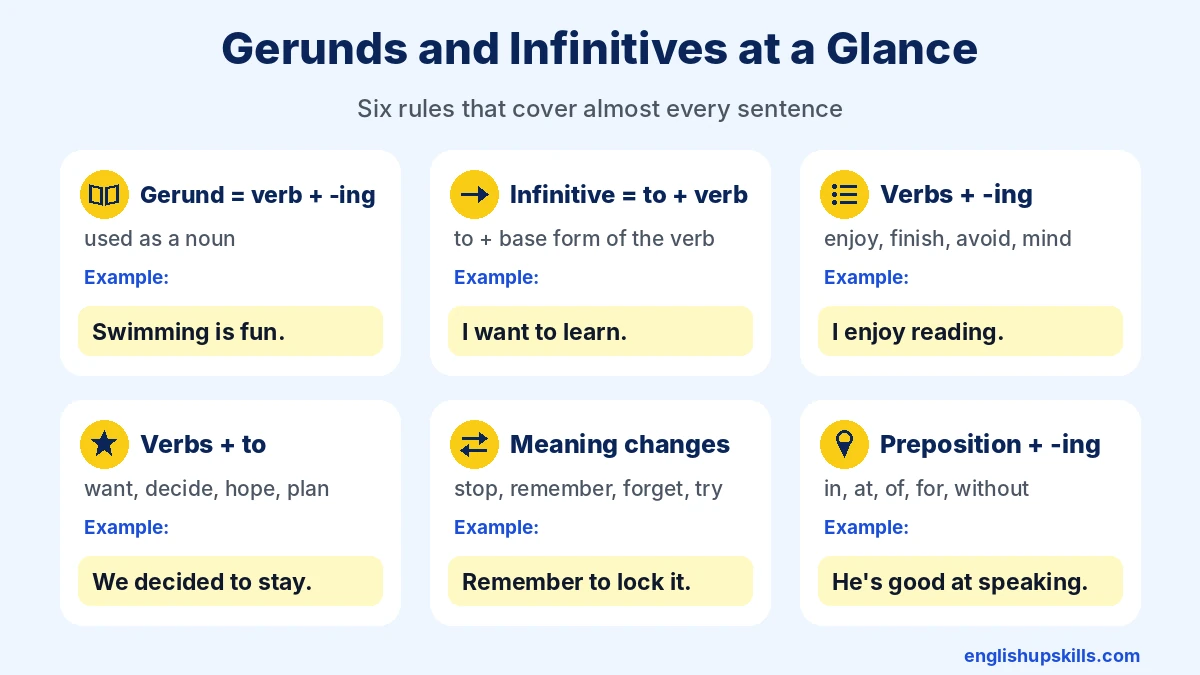
- A gerund is the -ing form of a verb used as a noun: Swimming is good exercise.
- An infinitive is to + the base verb: I want to learn English.
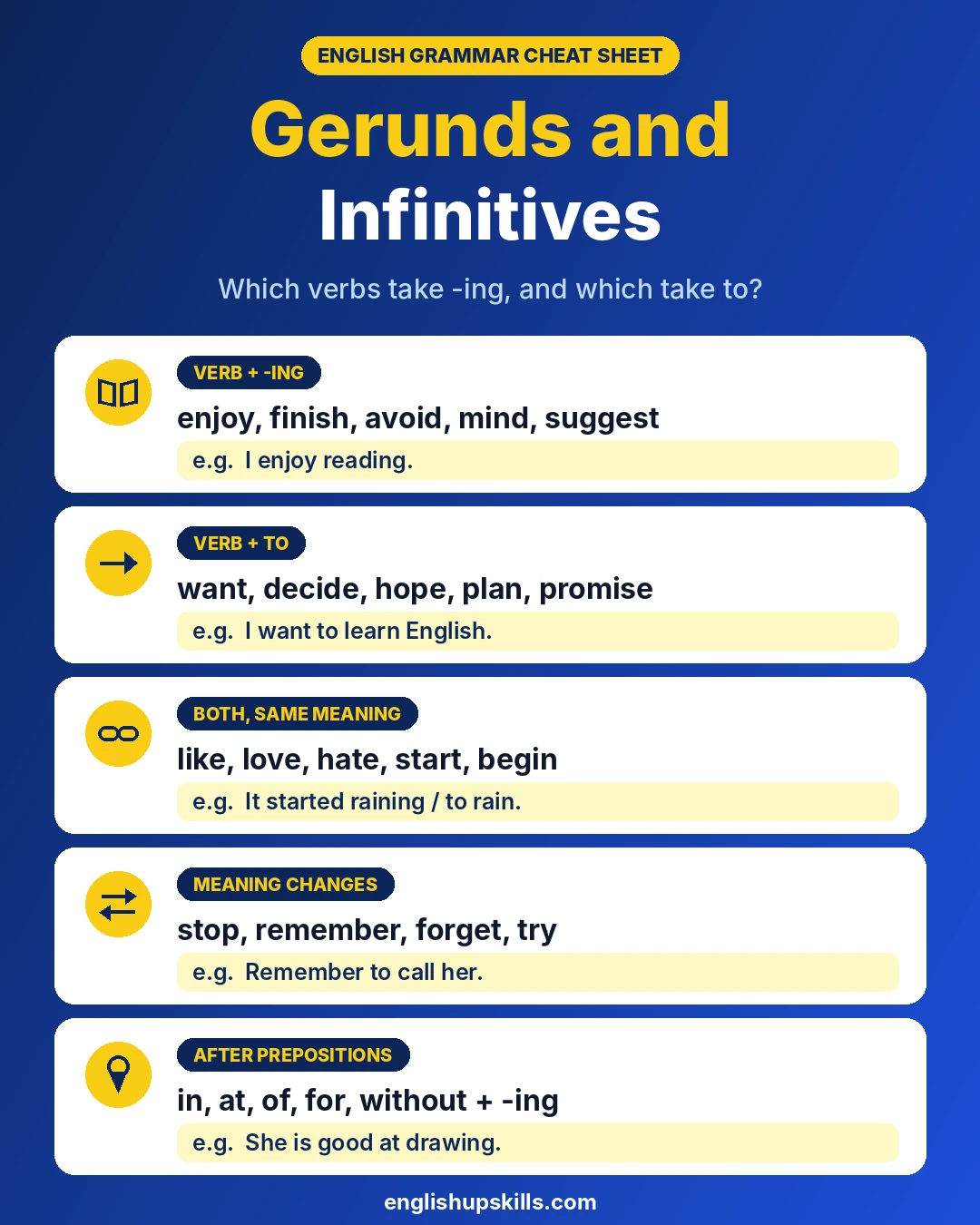
- Some verbs are followed by a gerund: enjoy, finish, avoid, mind, suggest.
- Some verbs are followed by an infinitive: want, decide, hope, plan, promise.
- Some verbs take both with little or no change in meaning: like, love, start, begin (see Rule 3 for the small difference with like).
- A few verbs take both but the meaning changes: stop, remember, forget, try.
- After a preposition, always use a gerund: interested in learning.
What is a gerund?
A gerund is a verb with -ing that does the job of a noun. It can be the subject of a sentence, the object of a verb, or come after a preposition. It looks exactly like a present participle (I am reading), but it does a different job.
| Job in the sentence | Example |
|---|---|
| Subject | Reading improves your vocabulary. |
| Object of a verb | I enjoy reading before bed. |
| After a preposition | She is good at reading maps. |
| After “be” (complement) | My favourite hobby is reading. |
To make a gerund negative, put not before it: I regret not studying harder.
What is an infinitive?
An infinitive is the base form of a verb, usually with to in front of it. We call this the to-infinitive. The form without “to” is the bare infinitive, and it follows modal verbs such as can, must and should.
| Type | Form | Example |
|---|---|---|
| To-infinitive | to + base verb | I hope to pass the exam. |
| Bare infinitive | base verb only | You should call her. |
| Negative infinitive | not to + base verb | He promised not to be late. |
| Infinitive of purpose | to + base verb (= in order to) | I went out to buy some milk. |
If you want a refresher on can, could, should and must, see our guide to modal verbs in English, which always take the bare infinitive.
Rule 1: Verbs followed by a gerund
Some verbs are always followed by the -ing form. There is no logical reason for this — you simply need to learn them. The British Council lesson on verbs followed by -ing or infinitive lists enjoy, admit and mind as typical examples.
| Verb | Example |
|---|---|
| enjoy | I enjoy cooking for my family. |
| finish | Have you finished writing the report? |
| avoid | Try to avoid eating late at night. |
| mind | Do you mind waiting a few minutes? |
| suggest | She suggested going to the cinema. |
| admit | He admitted taking the money. |
| consider | We are considering moving to Lahore. |
| keep | Please keep practising every day. |
| give up | My father gave up smoking last year. |
| can’t help | I can’t help laughing at his jokes. |
| miss | I miss playing cricket with my brothers. |
| practise | You should practise speaking with a partner. |
“Suggest” is a common trap: we say suggested going, not “suggested to go”. You can find more natural ways to do this in our list of phrases for making suggestions in English.
Rule 2: Verbs followed by an infinitive
Other verbs are followed by to + base verb. Many of them talk about plans, wishes, decisions and the future.
| Verb | Example |
|---|---|
| want | I want to improve my spoken English. |
| decide | They decided to stay at home. |
| hope | We hope to see you soon. |
| plan | She is planning to study abroad. |
| promise | He promised to call me back. |
| agree | They agreed to help us. |
| refuse | The shop refused to give me a refund. |
| learn | My son is learning to swim. |
| offer | Ali offered to carry my bag. |
| afford | We can’t afford to buy a new car. |
| need | You need to sign this form. |
| would like | I would like to book a table for two. |
Some of these verbs can also take an object before the infinitive: I want you to listen. She asked me to wait. The teacher told us to sit down.
Rule 3: Verbs that take both (same meaning)
A small group of verbs can be followed by either form, and the meaning stays almost the same.
| Verb | With gerund | With infinitive |
|---|---|---|
| like | I like swimming. | I like to swim. |
| love | She loves reading. | She loves to read. |
| hate | He hates waiting. | He hates to wait. |
| start | It started raining. | It started to rain. |
| begin | They began talking. | They began to talk. |
| prefer | I prefer walking. | I prefer to walk. |
| continue | He continued working. | He continued to work. |
There is a small difference with like in British English. “I like swimming” talks about enjoying the activity. “I like to visit the dentist every six months” talks about a habit you think is a good idea, even if you don’t enjoy it.
Remember that would like, would love and would prefer always take the infinitive: I would love to come, not “I would love coming”.
Rule 4: Verbs that change meaning
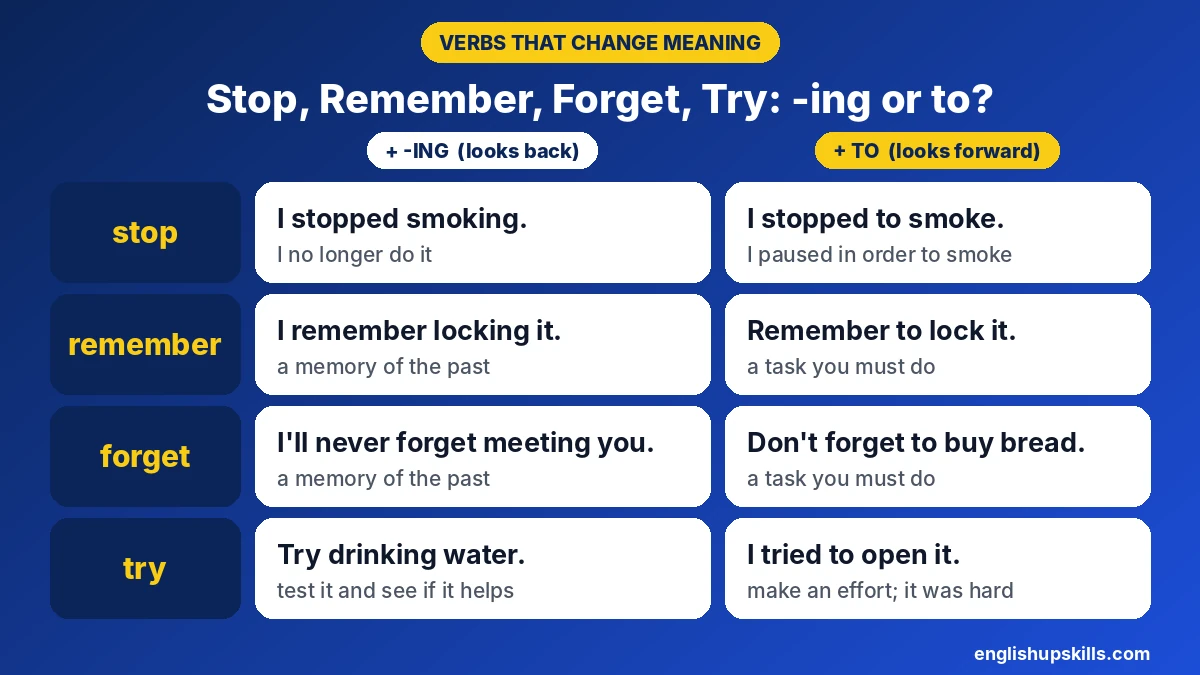
This is the part that confuses learners most. With these verbs, both forms are correct, but they mean different things.
| Verb | + gerund (-ing) | + infinitive (to) |
|---|---|---|
| stop | I stopped smoking. (I don’t smoke any more.) | I stopped to smoke. (I stopped walking so that I could smoke.) |
| remember | I remember locking the door. (I locked it and I have that memory.) | Remember to lock the door. (Don’t forget to do it.) |
| forget | I’ll never forget meeting you. (a past memory) | Don’t forget to buy bread. (a future task) |
| try | Try drinking warm water. (experiment and see if it helps) | I tried to open the window. (I made an effort, but it was difficult) |
| regret | I regret saying that. (I said it and I’m sorry) | We regret to inform you… (formal: we are sorry to tell you) |
| go on | He went on talking. (He continued the same thing.) | He went on to become a doctor. (He did something new next.) |
A helpful memory trick: the gerund looks back at something that has already happened, while the infinitive looks forward to something that still needs to happen. This works well for remember, forget and regret.
Rule 5: Always use a gerund after a preposition
When a verb comes straight after a preposition (in, on, at, of, about, for, without, before, after), it must be a gerund.
| Pattern | Example |
|---|---|
| interested in | She is interested in learning French. |
| good at | He is good at solving problems. |
| tired of | I’m tired of waiting. |
| thank you for | Thank you for helping me. |
| without | He left without saying goodbye. |
| before / after | Wash your hands before eating. |
| look forward to | I look forward to hearing from you. |
| be used to | I’m used to getting up early. |
Watch out for look forward to and be used to. Here “to” is a preposition, not part of an infinitive, so we use -ing. “I look forward to meet you” is wrong; “I look forward to meeting you” is correct.
Rule 6: Infinitives after adjectives and for purpose
We usually use the to-infinitive after adjectives, and to explain why someone does something.
- It is easy to learn these rules.
- I was happy to help.
- She was surprised to see him there.
- He saved money to buy a laptop. (purpose)
- I called the bank to ask about my account. (purpose)
Do not say “for to buy” or “for buy”. To show purpose with a verb, simply use to + base verb.
Common mistakes with gerunds and infinitives
| Wrong | Correct | Why |
|---|---|---|
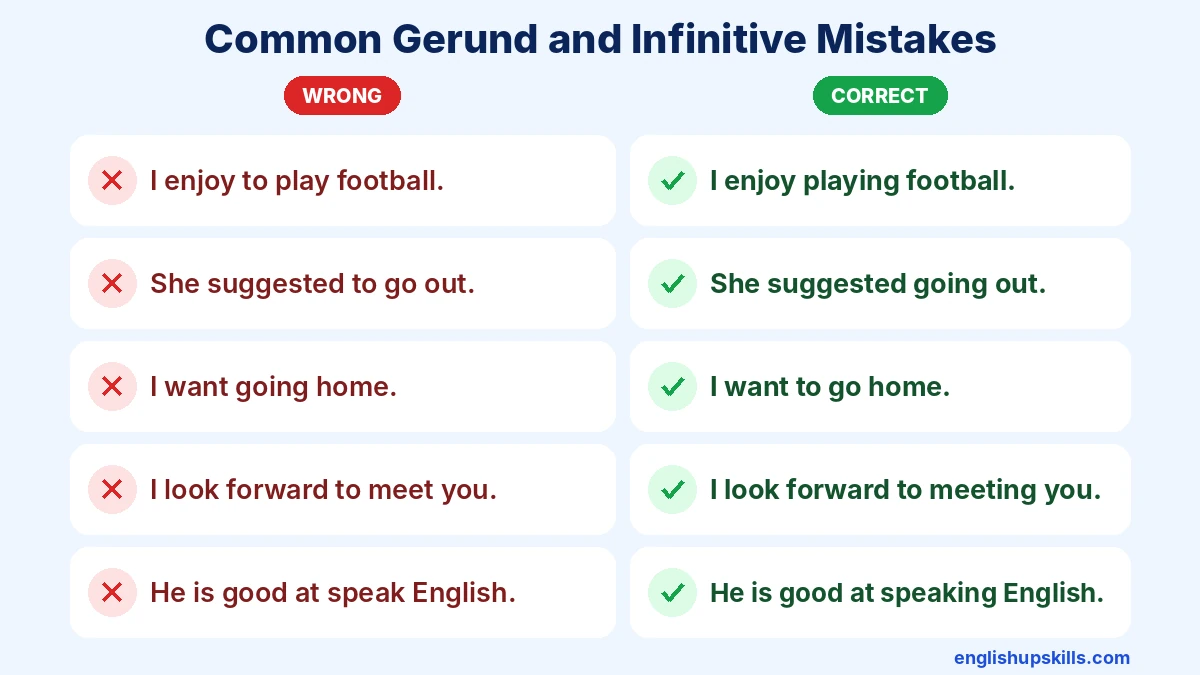
| I enjoy to play football. | I enjoy playing football. | Enjoy is always followed by -ing. |
| She suggested to go out. | She suggested going out. | Suggest takes a gerund (or a that-clause). |
| I want going home. | I want to go home. | Want is followed by to + base verb. |
| I look forward to meet you. | I look forward to meeting you. | “To” here is a preposition, so use -ing. |
| He is good at speak English. | He is good at speaking English. | After a preposition, use a gerund. |
| I came here for learn English. | I came here to learn English. | Use to + base verb for purpose. |
| You must to finish this today. | You must finish this today. | Modal verbs take the bare infinitive. |
| Remember locking the door when you leave. | Remember to lock the door when you leave. | A future task needs the infinitive. |
For more errors like these, see our full list of sentence correction rules.
Practice exercise: gerund or infinitive?
Choose the correct form of the verb in brackets.
- I can’t afford ______ (buy) a new phone this month.
- Would you mind ______ (close) the window?
- She is very good at ______ (draw) people.
- We decided ______ (take) the train.
- I’ll never forget ______ (see) the sea for the first time.
- Please remember ______ (send) me the file tomorrow.
- He finished ______ (paint) the room at midnight.
- They’re looking forward to ______ (visit) London.
- I went to the market ______ (get) some vegetables.
- My uncle stopped ______ (eat) sugar last year, and he feels much better.
Answers
- to buy — afford + infinitive
- closing — mind + gerund
- drawing — after the preposition “at”
- to take — decide + infinitive
- seeing — forget + -ing for a past memory
- to send — remember + to for a future task
- painting — finish + gerund
- visiting — “to” is a preposition in “look forward to”
- to get — infinitive of purpose
- eating — stop + -ing means he no longer does it
Frequently asked questions
What is the difference between a gerund and an infinitive?
A gerund is the -ing form of a verb used as a noun (swimming, reading). An infinitive is to + the base verb (to swim, to read). Both can act as nouns, but different verbs, adjectives and prepositions need one form or the other.
How do I know whether to use a gerund or an infinitive?
Look at the word that comes before. Verbs such as enjoy, finish, avoid and suggest take a gerund. Verbs such as want, decide, hope and promise take an infinitive. After a preposition, always use a gerund. When you are unsure, check a good learner’s dictionary, which shows the pattern for each verb.
Can a sentence start with a gerund or an infinitive?
Yes. Both can be the subject. “Learning a language takes time” sounds natural and is the most common choice. “To learn a language takes time” is correct but sounds formal. In everyday English we often say “It takes time to learn a language” instead.
Is “I like swimming” or “I like to swim” correct?
Both are correct, and in most situations they mean the same. In British English, “I like swimming” focuses on enjoying the activity, while “I like to swim in the morning” can suggest a habit or a choice you think is sensible.
Why do we say “look forward to meeting” and not “look forward to meet”?
Because in “look forward to”, the word “to” is a preposition, not part of an infinitive. After a preposition we always use the -ing form. The same is true of “be used to”, “get used to” and “object to”.
What verbs change meaning with a gerund or an infinitive?
The most common are stop, remember, forget, try, regret and go on. As a rule of thumb, the gerund often refers to something that has already happened, and the infinitive refers to something that still needs to be done.
Conclusion
Gerunds and infinitives become much easier once you stop trying to translate and start learning verbs in pairs: enjoy doing, want to do, interested in doing, decide to do. Learn the short lists in this guide, pay special attention to stop, remember, forget and try, and remember that a preposition is always followed by -ing. Write five sentences about yourself using verbs from each list, and say them out loud.
To keep building your grammar, read our guide to English grammar rules next, or review all 12 tenses in English.