
Prepositions of time are small words that tell us when something happens. The three you will use most are at, on and in, but English also uses for, since, during, by, until, before and after to talk about time. These words are short, yet they cause many mistakes — even for learners who speak English well. “I was born on 1998” and “See you in Monday” are sentences teachers hear every day.
The good news: the rules are simple once you see the pattern. In this guide you will learn exactly when to use each preposition, with tables, real examples, a list of common mistakes and a short quiz. If you are new to grammar terms, read our English grammar rules guide first.
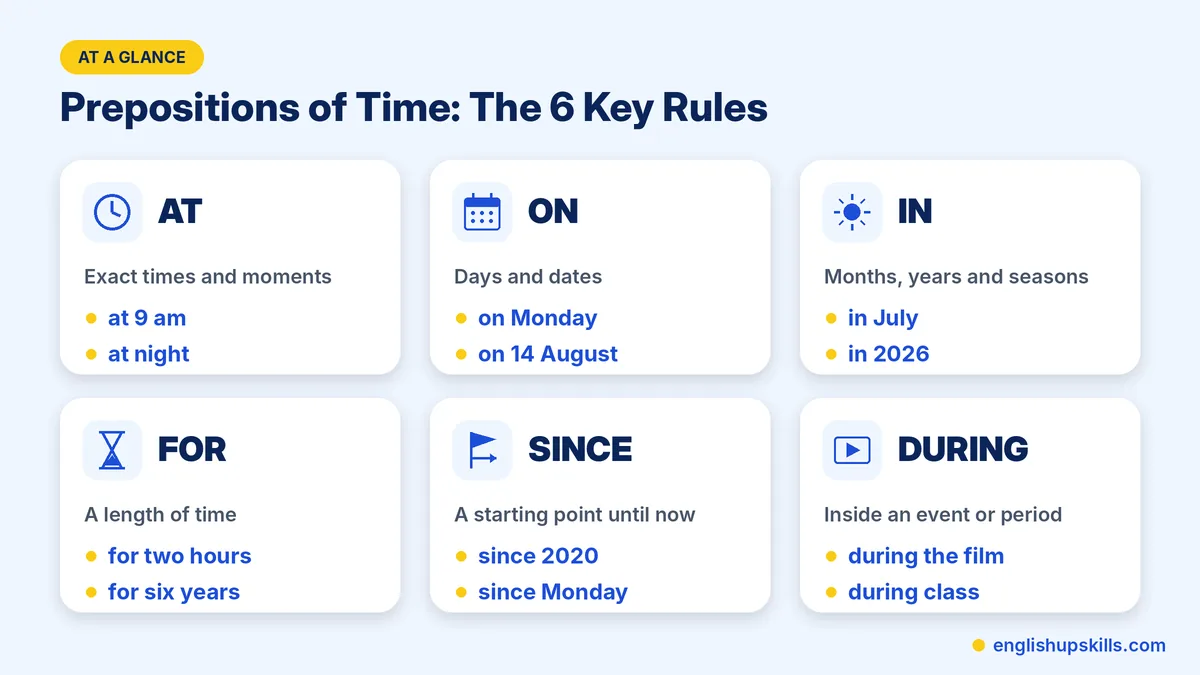
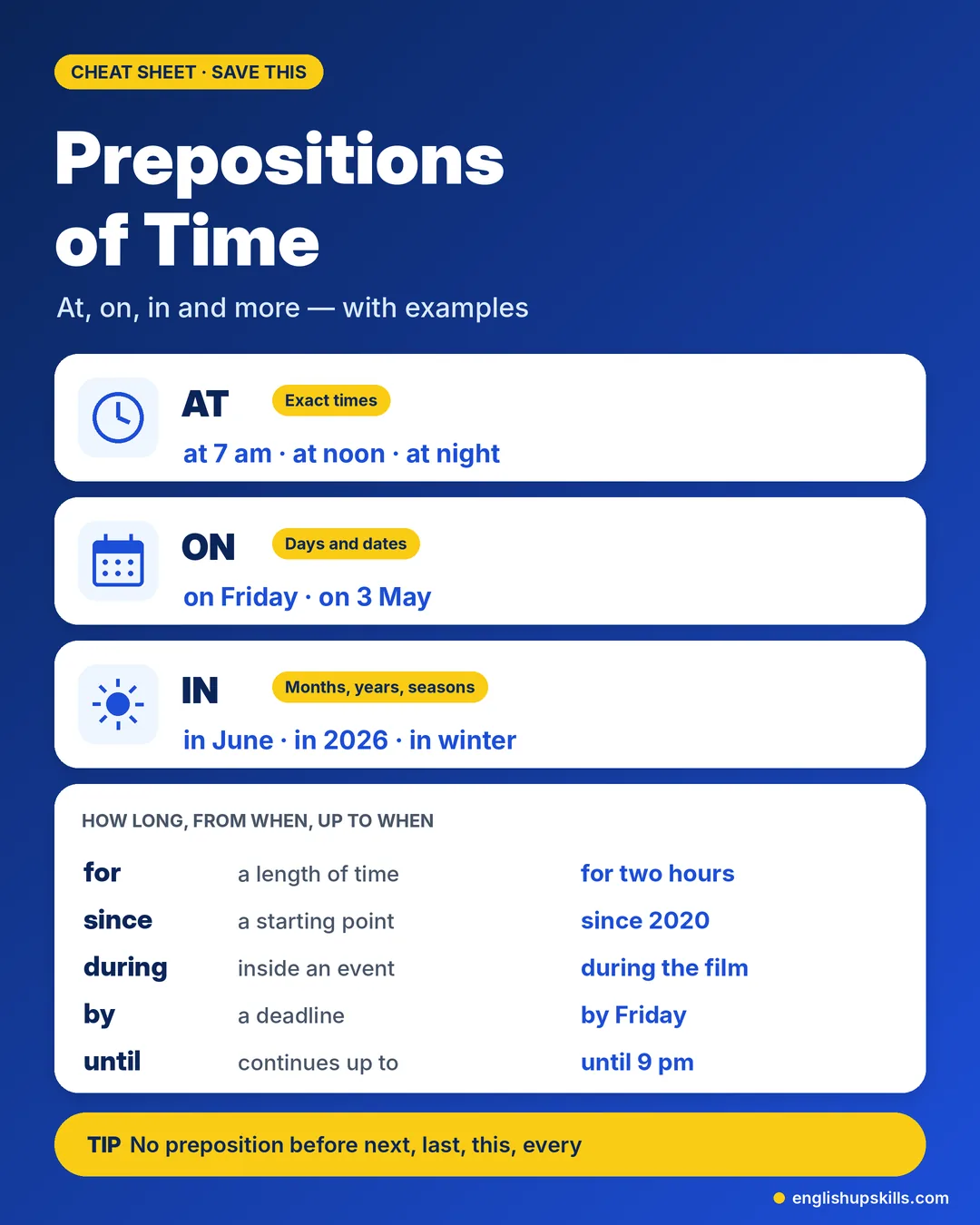
Quick answer — prepositions of time at a glance:
- At → exact times and short moments: at 7 o’clock, at noon, at night, at the weekend (UK)
- On → days and dates: on Monday, on 14 February, on my birthday
- In → longer periods: in the morning, in June, in 2025, in summer, in the 1990s
- For → a length of time: for two hours
- Since → a starting point until now: since 2020
- During → inside an event or period: during the film
- By / until → a deadline / a continuing action up to a time: by Friday, until Friday
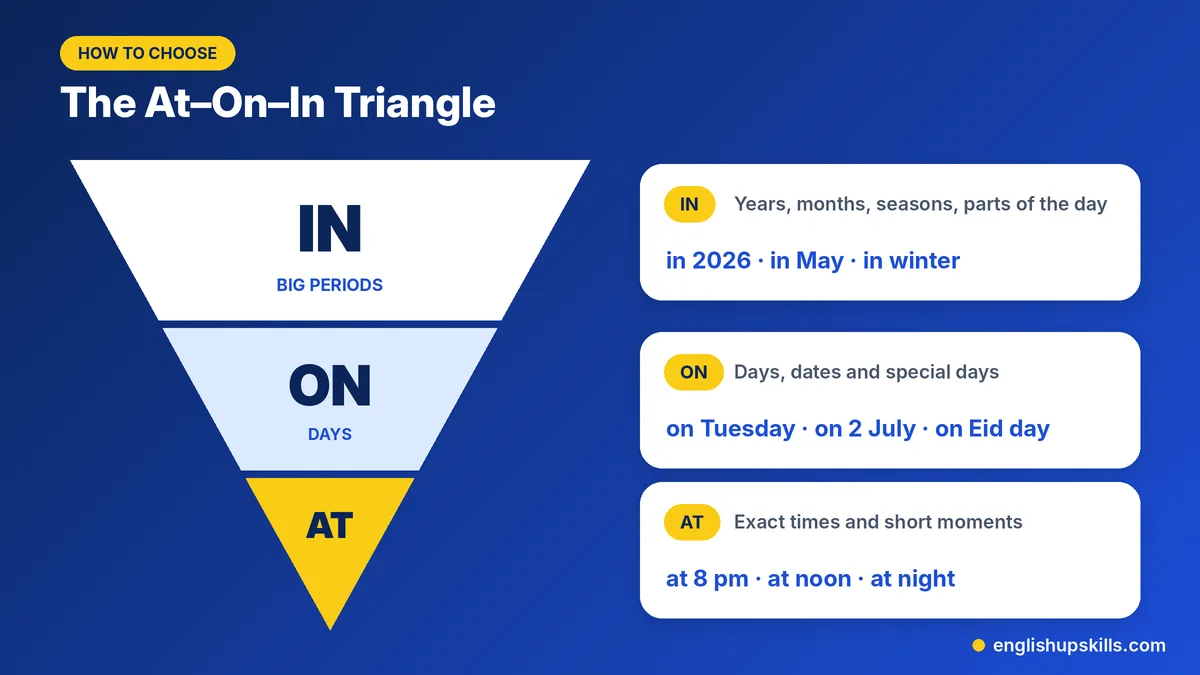
A simple way to remember at, on and in is the triangle rule: think of an upside-down triangle. In sits at the wide top (big periods like years and months), on sits in the middle (days and dates), and at sits at the narrow point (exact times).
What Are Prepositions of Time?
A preposition of time is a word placed before a noun or noun phrase to show when an action happens, how long it lasts, or when it starts or stops. The noun after it is a time expression: a clock time, a day, a month, a season, an event or a period.
- I wake up at six.
- The shop is closed on Sundays.
- We moved to Lahore in 2019.
- She has worked here since March.
The preposition never changes form. What changes is the size or type of time you are talking about. That is why the at–on–in rules are so useful.
When to Use “At” — Exact Times and Moments
Use at for a precise point in time. Think of it as a single dot on a clock.
| Use “at” with | Examples |
|---|---|
| Clock times | at 9 am, at half past four, at 10:15 |
| Specific moments of the day | at noon, at midnight, at sunrise, at sunset |
| Meals and breaks | at lunchtime, at breakfast, at the break |
| Night (in general) | at night — I can’t sleep at night. |
| Holiday periods (no “day”) | at Christmas, at Eid, at Easter |
| The weekend (British English) | at the weekend |
| Fixed phrases | at the moment, at present, at the same time, at the end of the month |
Examples in sentences:
- The meeting starts at 10 o’clock.
- We usually visit my grandparents at Eid.
- I’m busy at the moment — can I call you back?
Note: say at Eid for the holiday period, but on Eid day for the actual day. The word day turns it into a day, so it takes on.
When to Use “On” — Days and Dates
Use on for a specific day or date. If you can find it on a calendar page, it usually takes on.
| Use “on” with | Examples |
|---|---|
| Days of the week | on Monday, on Fridays (every Friday) |
| Dates | on 23 March, on the 5th of June |
| Special days | on my birthday, on Independence Day, on Christmas Day |
| A part of a named day | on Monday morning, on Saturday night |
| The weekend (American English) | on the weekend |
Examples in sentences:
- My exam is on Thursday.
- Pakistan celebrates Independence Day on 14 August.
- Let’s meet on Sunday afternoon.
Watch the last one. On its own, “the afternoon” takes in (in the afternoon). But when you name the day, the whole phrase becomes a day, so it takes on (on Sunday afternoon).
When to Use “In” — Months, Years and Longer Periods
Use in for longer periods of time, where the action happens somewhere inside the period.
| Use “in” with | Examples |
|---|---|
| Parts of the day | in the morning, in the afternoon, in the evening |
| Months | in January, in October |
| Years | in 2026, in 1947 |
| Seasons | in summer, in the winter, in the rainy season |
| Decades and centuries | in the 1990s, in the 21st century |
| Longer periods | in the past, in the future, in the holidays |
| Time from now (future) | in two weeks, in ten minutes |
Examples in sentences:
- I study best in the morning.
- She was born in 2001.
- The train leaves in five minutes. (= five minutes from now)
One exception to remember: we say in the morning, in the afternoon and in the evening, but at night.
At vs On vs In: Side-by-Side Comparison
This table puts all three together so you can compare them at a glance.
| Preposition | Size of time | Examples |
|---|---|---|
| in | Long periods | in 2026, in May, in winter, in the morning |
| on | Days and dates | on Tuesday, on 2 July, on New Year’s Day |
| at | Exact points | at 8 pm, at noon, at night, at lunchtime |
When NOT to Use a Preposition of Time
Do not use at, on or in before these words: last, next, this, every, today, tomorrow, yesterday, tonight.
- I saw him last Monday. (not on last Monday)
- We are travelling next month. (not in next month)
- I go to the gym every day. (not on every day)
- Call me tomorrow morning. (not in tomorrow morning)
Other Prepositions of Time: For, Since, During, By, Until
At, on and in tell us when. These prepositions tell us how long, from when and up to when.
| Preposition | Meaning | Example |
|---|---|---|
| for | a length of time | I have lived here for six years. |
| since | from a starting point until now | I have lived here since 2020. |
| during | inside an event or period | He fell asleep during the lecture. |
| by | not later than (a deadline) | Please send the report by Friday. |
| until / till | up to a time, then stop | The shop is open until 9 pm. |
| before / after | earlier / later than | Wash your hands before dinner. |
| from … to | start and end | I work from 9 to 5. |
| within | inside a time limit | Reply within 24 hours. |
For vs Since
For is followed by a period (two hours, three days, ten years). Since is followed by a point in time (Monday, 9 am, 2015, I was a child). Both are common with the present perfect tense — see our guide to the 12 tenses in English.
- She has been waiting for 40 minutes.
- She has been waiting since 3 o’clock.
By vs Until
By means at or before a time — the action is finished once. Until means the action continues up to that time. Both often appear with the future tense.
- I will finish the essay by Monday. (finished on or before Monday)
- I will be in Karachi until Monday. (staying there the whole time, then leaving)
During vs For
During answers when? and goes before a noun (during the meeting). For answers how long? and goes before a length of time (for an hour).
- I checked my phone during the meeting.
- The meeting lasted for an hour.
In Time vs On Time
On time means at the planned time, not late. In time means early enough to do something.
- The flight left on time.
- We arrived in time to see the start of the match.
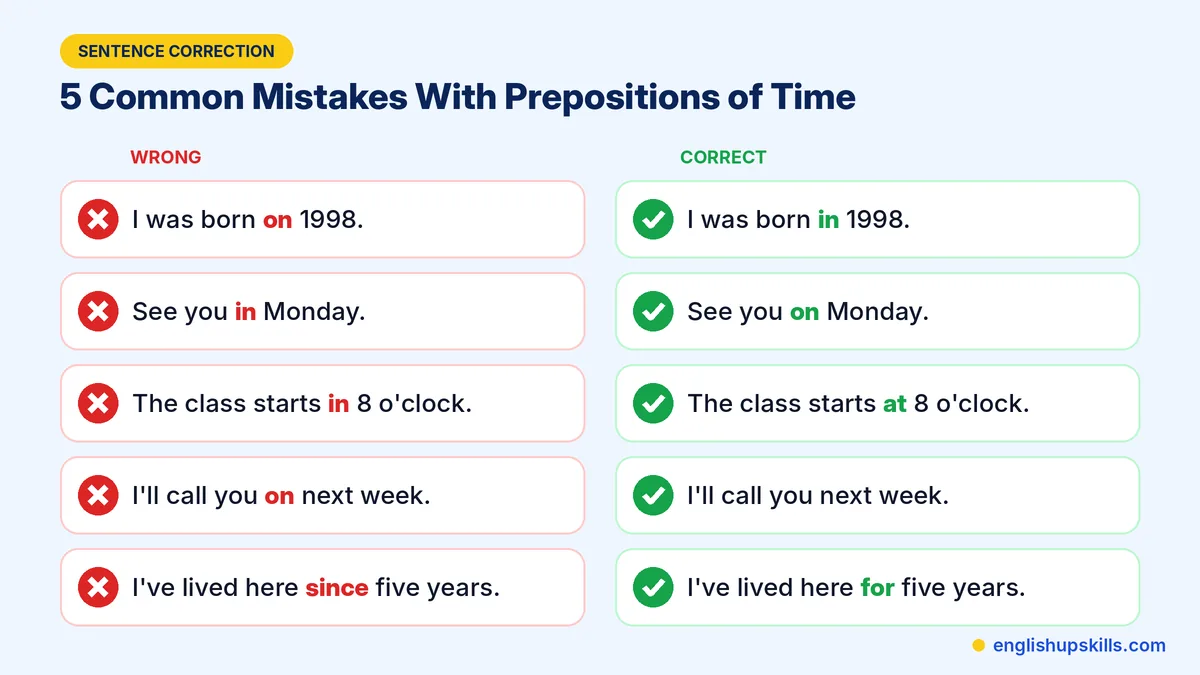
Common Mistakes With Prepositions of Time
These are the errors learners make most often. Read the “why” column — it is the rule you need to remember.
| Wrong | Correct | Why |
|---|---|---|
| I was born on 1998. | I was born in 1998. | Years take in. |
| See you in Monday. | See you on Monday. | Days take on. |
| The class starts in 8 o’clock. | The class starts at 8 o’clock. | Clock times take at. |
| I’ll call you on next week. | I’ll call you next week. | No preposition before next, last, this, every. |
| I have lived here since five years. | I have lived here for five years. | A length of time takes for. |
| She has worked here for 2021. | She has worked here since 2021. | A starting point takes since. |
| I’ll be at the office by 6 pm, then go home. | I’ll be at the office until 6 pm, then go home. | A continuing action takes until. |
| I woke up at the morning. | I woke up in the morning. | Parts of the day take in (except at night). |
| We met in Saturday evening. | We met on Saturday evening. | A named day + part of day takes on. |
| He slept during two hours. | He slept for two hours. | During goes before an event, not a length of time. |
Notice that “the” also matters: we say in the morning but at night, and in summer or in the summer (both are fine). For more on when to add the, see our guide to articles in English (a, an, the).
Practice Exercise: Fill in the Blank
Choose the correct preposition: at, on, in, for, since, during, by or until. Some sentences need no preposition — write — for those.
- My brother was born ___ July.
- The film starts ___ 7:30.
- We don’t have school ___ Sundays.
- I have known Ali ___ we were children.
- Please submit your homework ___ Thursday.
- It is very cold here ___ winter.
- She has been learning English ___ three years.
- I’ll see you ___ next Friday.
- Nobody spoke ___ the exam.
- The library stays open ___ 10 pm.
- I often feel tired ___ night.
- What are you doing ___ your birthday?
Answers:
- in July (month)
- at 7:30 (clock time)
- on Sundays (day)
- since we were children (starting point)
- by Thursday (deadline)
- in winter (season)
- for three years (length of time)
- — next Friday (no preposition before next)
- during the exam (inside an event)
- until 10 pm (continues up to a time)
- at night (fixed phrase)
- on your birthday (special day)
Want more practice? Try the gap-fill tests in the British Council’s guide to prepositions of time.
Frequently Asked Questions
What are the 3 main prepositions of time?
The three main prepositions of time are at, on and in. Use at for exact times (at 5 pm), on for days and dates (on Friday, on 3 May) and in for longer periods such as months, years and seasons (in March, in 2026, in summer).
Is it “at the weekend” or “on the weekend”?
Both are correct. At the weekend is standard in British English, and on the weekend is standard in American English. Pick one style and use it consistently in your writing.
Why do we say “at night” but “in the morning”?
It is a fixed expression. At night means during the night in general. We use in with the other parts of the day: in the morning, in the afternoon, in the evening. You can say in the night when you mean one particular night (I woke up in the night).
What is the difference between “for” and “since”?
For is used with a length of time (for two weeks). Since is used with the point when something started (since Monday). A quick test: if you can count it, use for; if you can point to it on a calendar or clock, use since.
Do we use a preposition before “next”, “last” or “every”?
No. Say next week, last year and every day without at, on or in. The same is true for today, tomorrow, yesterday and tonight.
What is the difference between “in time” and “on time”?
On time means at the planned or scheduled time — not late (The bus came on time). In time means early enough for something (We got home in time for dinner).
Conclusion
Prepositions of time follow a clear pattern. Use in for big periods, on for days and dates, and at for exact times. Then add for (how long), since (from when), during (inside an event), by (deadline) and until (continuing up to a time). Remember to drop the preposition before next, last, this and every.
Practise with the exercise above, then write five sentences about your own week using at, on and in. To keep improving your accuracy, read our sentence correction rules next.