
Articles in English are three small words — a, an and the — that come before a noun and tell the listener whether you mean any one thing or one particular thing. They are among the most common words in the language, yet they cause more mistakes than almost anything else, especially for learners whose first language (such as Urdu, Hindi, Chinese or Russian) has no articles at all.
The good news is that a handful of rules cover nearly every sentence you will ever write. In this guide you will learn when to use a, an, the or no article, see the patterns in clear tables, fix the most common errors, and test yourself with a short exercise. If you are new to grammar, you may also like our overview of basic English grammar rules.
Quick answer: how to use articles
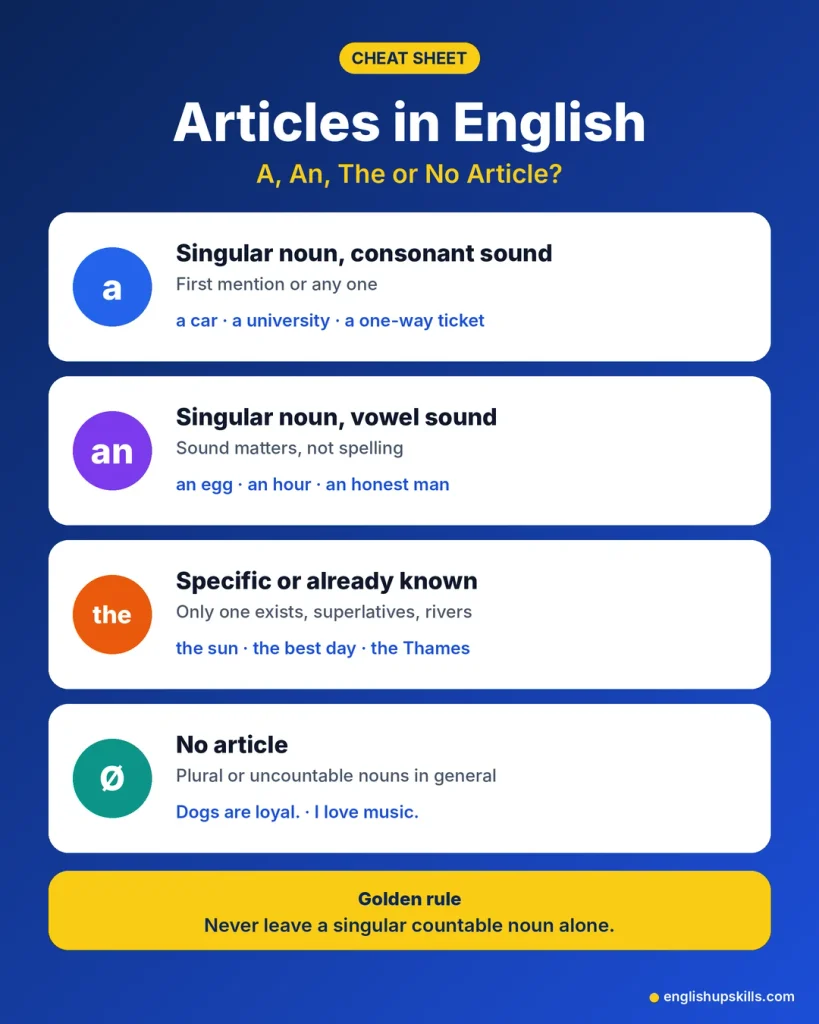
- Use a before a consonant sound: a book, a university, a one-way ticket.
- Use an before a vowel sound: an apple, an hour, an MBA.
- Use the when the listener knows exactly which thing you mean: the book on your desk, the sun.
- Use no article for things in general with plural or uncountable nouns: Dogs are loyal. Water is essential.
- A singular countable noun almost never stands alone — it needs a/an, the or another word such as my or this.
What are articles?
Articles are a type of determiner — a word that introduces a noun and limits its meaning. English has two kinds:
| Type | Article | Meaning | Example |
|---|---|---|---|
| Indefinite article | a / an | any one; not a specific one | I need a pen. |
| Definite article | the | a specific one both people know | Can I borrow the pen on your desk? |
| Zero article | (no article) | things in general | Pens are cheap. |
Think of it this way: a/an opens a door to something new, and the points back to something already known.
A vs an: it is the sound that matters
The choice between a and an depends on the first sound of the next word, not the first letter. Say the word aloud and listen.
| Next word begins with | Use | Examples |
|---|---|---|
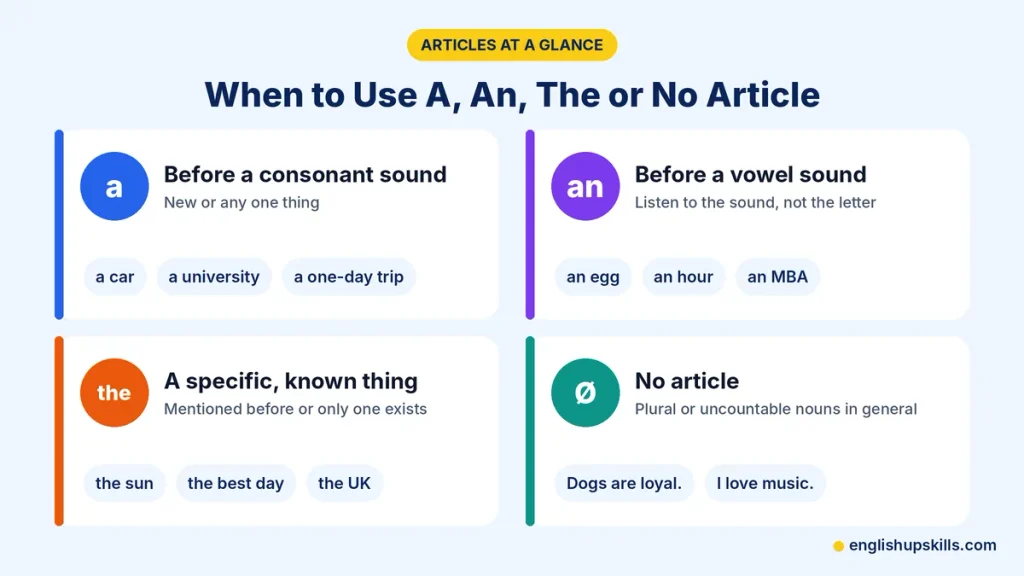
| A consonant sound | a | a car, a big dog, a European city (“yoo”), a uniform, a one-day course (“wun”) |
| A vowel sound | an | an egg, an old house, an hour (silent h), an honest man, an X-ray (“ex”) |
The article matches the word directly after it, even when that word is an adjective. We say an apple but a red apple, and a house but an old house.
Abbreviations follow the same rule. We say an MP (“em-pee”) and an FBI agent (“ef”), but a UN report (“yoo-en”) and a NATO meeting (“nay-toe”).
When to use a or an
Use a/an only with singular countable nouns — things you can count one by one.
- To mention something for the first time. I saw a fox in the garden this morning.
- To mean “any one” or “one of many”. Could you pass me a spoon? (any spoon will do)
- To say what someone’s job is. My sister is an engineer. He wants to be a teacher.
- To describe or classify something. It was an amazing film. London is a busy city.
- To mean “one” in measurements and frequency. twice a week, 60 miles an hour, £3 a kilo.
- In exclamations with what. What a beautiful day! What an idea!
Never use a/an with plural nouns (✗ a books) or uncountable nouns (✗ an advice). For uncountable nouns, use some or a counting phrase: some advice, a piece of advice.
When to use the
Use the when both you and your listener know exactly which thing you mean. It works with singular, plural and uncountable nouns.
| Rule | Example |
|---|---|
| Something mentioned before | I bought a shirt and a jacket. The jacket was on sale. |
| Only one exists | the sun, the moon, the internet, the Prime Minister |
| The context makes it clear | Please close the door. (the door of this room) |
| Defined by a phrase after it | The woman in the red coat is my aunt. |
| Superlatives and ordinals | the best day, the tallest building, the first time, the last chapter |
| Groups of people and nationalities | the rich, the elderly, the French |
| Musical instruments (in general) | She plays the piano. |
| Rivers, seas, oceans, mountain ranges | the Thames, the Atlantic, the Himalayas |
| Plural or “union” country names | the UK, the USA, the Netherlands, the Philippines |
| Decades and some time phrases | in the 1990s, in the morning, at the weekend |
As the British Council guide to articles puts it, we use the when the listener already knows which thing we are talking about.
When to use no article (the zero article)
Sometimes the right choice is no article at all. This is called the zero article.
| Use no article with | Examples |
|---|---|
| Plural nouns in general | Cats sleep a lot. Books are expensive. |
| Uncountable nouns in general | Music relaxes me. Information is power. |
| Most names of people, cities and countries | Ali lives in Lahore. Pakistan is beautiful. |
| Languages and school subjects | She speaks Urdu. I love history. |
| Meals | We had lunch at one. What’s for dinner? |
| Sports and games | They play cricket every Sunday. |
| Single lakes and mountains | Lake Victoria, Mount Everest |
| Days, months, holidays | on Monday, in June, at Eid |
Compare these two sentences: Coffee keeps me awake (coffee in general) and The coffee in this café is excellent (a particular coffee).
Places and institutions: go to school or go to the school?
With places such as school, university, hospital, prison, church and bed, the article changes the meaning.
| No article: the main purpose | With the: the building or a specific place |
|---|---|
| My son goes to school by bus. (as a pupil) | I went to the school to meet his teacher. |
| She is in hospital with a broken leg. (as a patient) | He works at the hospital near the station. |
| It’s late — I’m going to bed. | Your keys are under the bed. |
Note a small UK/US difference: British speakers say in hospital and at university, while Americans usually say in the hospital.
Common mistakes with articles
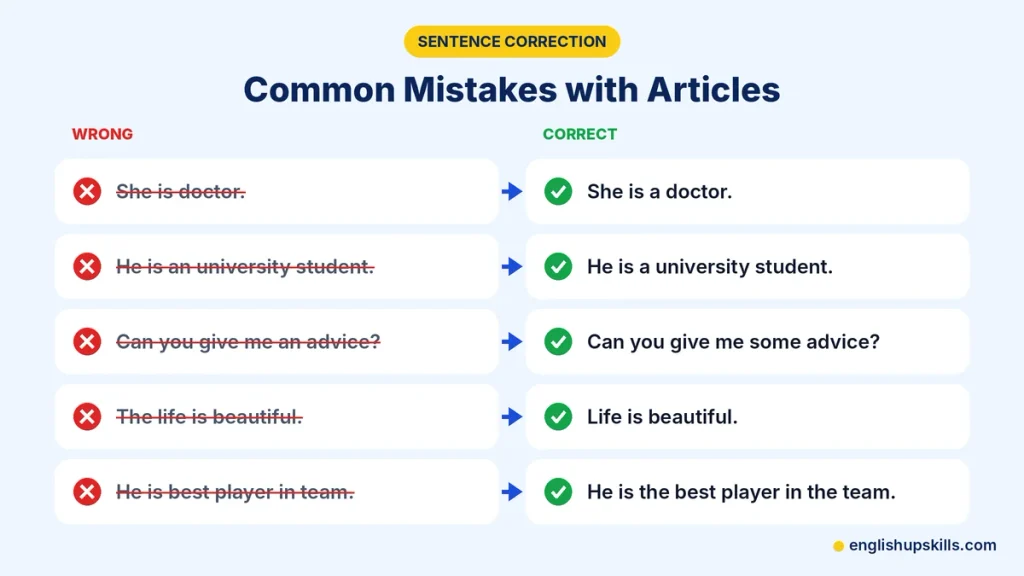
These are the errors examiners and teachers see most often. Read the “why” column carefully — it is the rule you need to remember. For more practice spotting errors like these, see our sentence correction rules.
| ✗ Wrong | ✓ Correct | Why |
|---|---|---|
| She is doctor. | She is a doctor. | Jobs take a/an. |
| I have a important meeting. | I have an important meeting. | “Important” starts with a vowel sound. |
| He is an university student. | He is a university student. | “University” starts with a “yoo” (consonant) sound. |
| Can you give me an advice? | Can you give me some advice? | “Advice” is uncountable — no a/an. |
| The life is beautiful. | Life is beautiful. | Abstract nouns in general take no article. |
| I love the dogs. | I love dogs. | General statements use plural nouns with no article. |
| Sun rises in east. | The sun rises in the east. | Only one sun; compass points take the. |
| He is best player in team. | He is the best player in the team. | Superlatives take the. |
| I went to the bed early. | I went to bed early. | “Go to bed” means to sleep — no article. |
| She speaks the English well. | She speaks English well. | Languages take no article. |
Tips to master articles faster
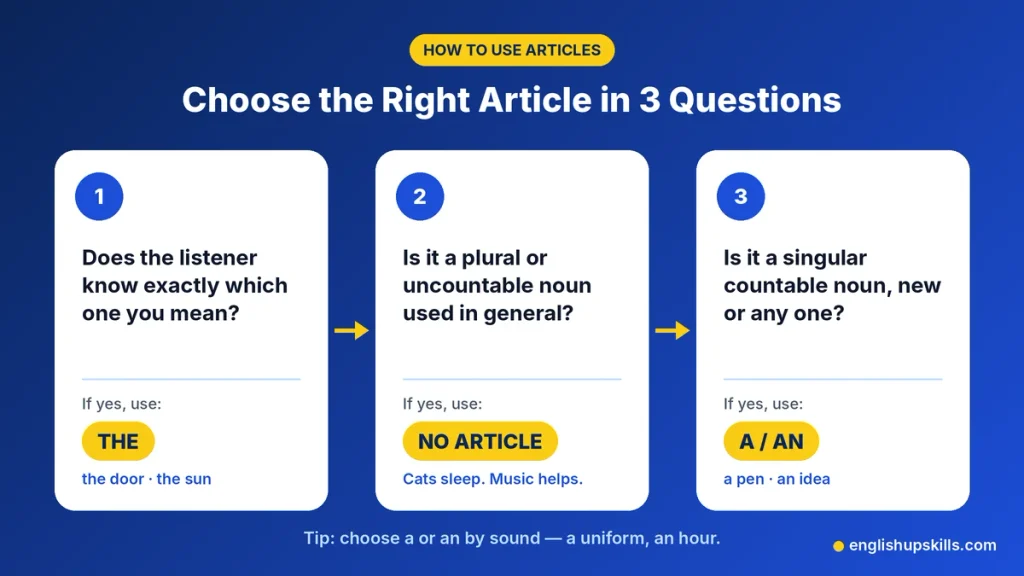
- Ask two questions every time you write a noun: Is it countable or uncountable? Does my listener know which one I mean?
- Learn nouns with their article. Note down an umbrella, an hour, a university rather than single words.
- Read and notice. During your daily reading practice, underline every article in one paragraph and ask why the writer chose it.
- Listen for sound, not spelling. If you are unsure between a and an, say the phrase aloud.
Practice exercise: fill in a, an, the or – (no article)
Try these ten sentences before checking the answers. They mix all the rules above, so you will also see how articles work across different tenses — if any verb forms look unfamiliar, revise the 12 tenses in English.
- My father is ___ honest man.
- I read ___ interesting article yesterday. ___ article was about climate change.
- ___ Mount Everest is ___ highest mountain in ___ world.
- She usually has ___ breakfast at seven.
- We stayed in ___ hotel near ___ River Thames.
- ___ honesty is ___ best policy.
- He has been waiting for ___ hour.
- Could you open ___ window, please? It’s hot in here.
- My brother is studying at ___ university in Manchester.
- ___ children need ___ love and attention.
Answers
- an honest man (silent h)
- an interesting article … The article (first mention, then known)
- – Mount Everest … the highest … the world (single mountain; superlative; only one world)
- – breakfast (meals take no article)
- a hotel … the River Thames (first mention; rivers take the)
- – Honesty … the best policy (abstract noun in general; superlative)
- an hour (silent h)
- the window (both people know which window)
- a university (“yoo” sound)
- – Children … – love (plural and uncountable nouns in general)
Frequently asked questions
What are the three articles in English? The three articles are a, an and the. A and an are indefinite articles used for any one thing; the is the definite article used for a specific thing the listener knows.
Is it “a hour” or “an hour”? It is an hour, because the h is silent and the word begins with a vowel sound. The same applies to an honour and an heir.
Why do we say “a university” and not “an university”? Because “university” begins with a “yoo” sound, which is a consonant sound. The rule depends on pronunciation, not spelling.
When should I use no article? Use no article when you talk about plural or uncountable nouns in general (Dogs are loyal, Water is precious), and with most names, languages, meals and sports.
Do we use “the” with country names? Most countries take no article (Pakistan, France), but use the with plural names or names containing words like kingdom, states or republic: the UK, the USA, the Maldives.
Can I use “a” with uncountable nouns like information or furniture? No. Uncountable nouns never take a/an. Say some information, a piece of furniture or an item of news instead.
Conclusion
Articles look tiny, but using them correctly makes your English sound natural straight away. Remember the core rules: a/an for one thing mentioned for the first time, the for something specific both people know, and no article for things in general. Choose a or an by sound, not spelling, and never leave a singular countable noun on its own.
Practise a few sentences every day and you will soon choose the right article without thinking. Ready for the next step? Read our guide on how to improve your spoken English and put these rules to work in real conversations.