
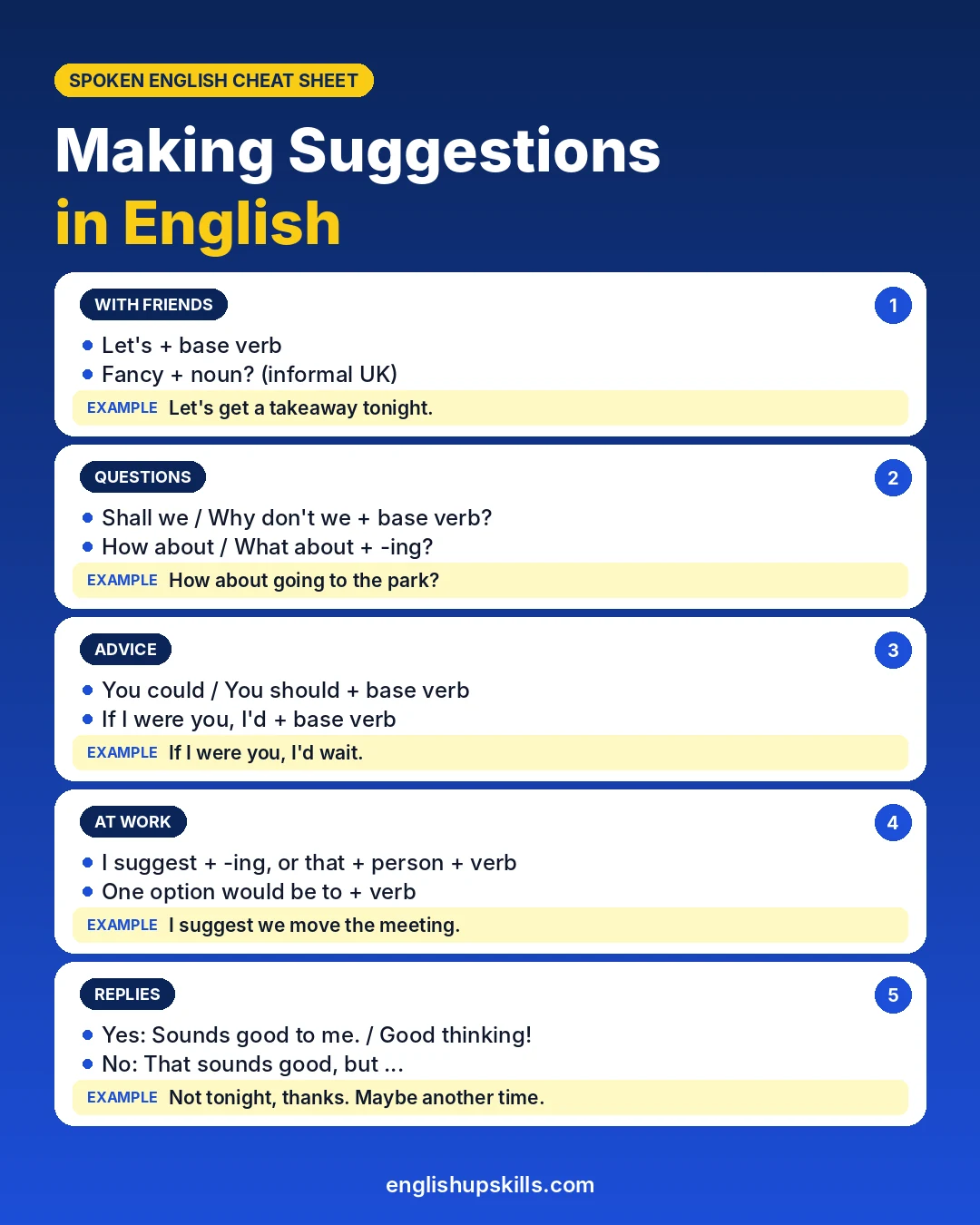
Making suggestions in English is one of the most useful speaking skills you can learn. Every day we suggest things to friends, family and colleagues: where to eat, when to meet, how to solve a problem. The good news is that you only need a small set of phrases, and each one follows a simple grammar pattern. Learn the pattern once and you can make hundreds of natural suggestions.
In this guide you will learn 50 useful phrases for making suggestions, the grammar that follows each one, how to answer when someone suggests something to you, and the mistakes learners make most often. There is a practice exercise with answers at the end. If you are working on your speaking in general, our guide on how to improve your spoken English is a good companion to this lesson.
Quick answer: the most common ways to make a suggestion
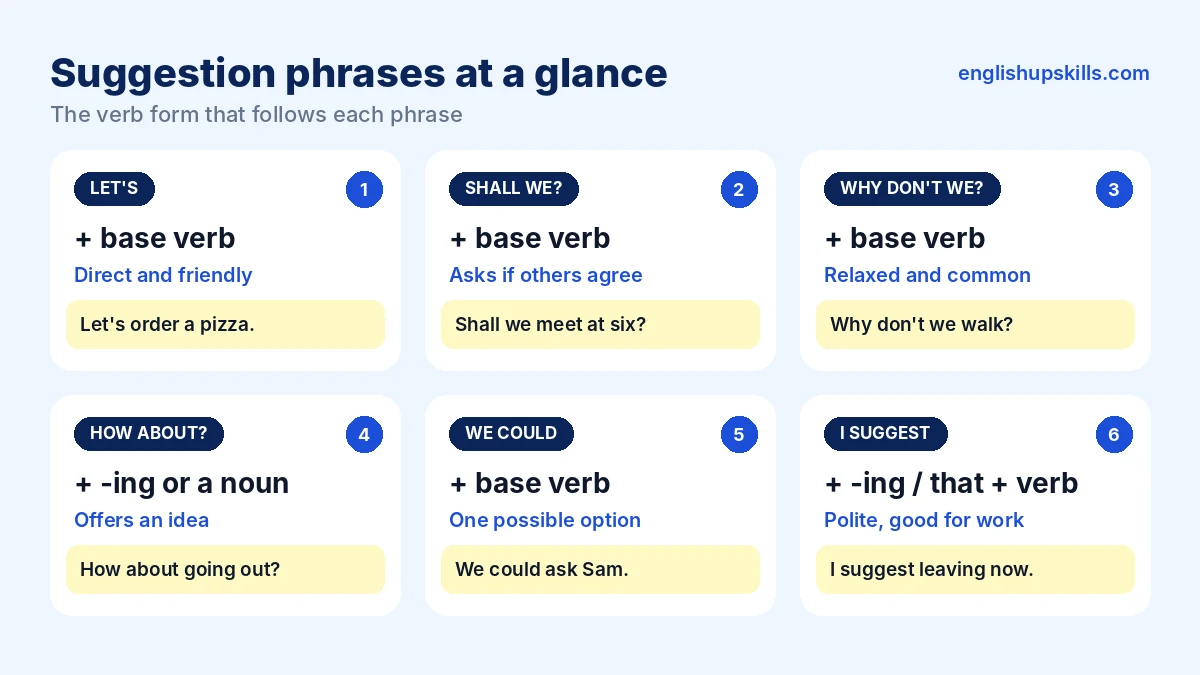
- Let’s + base verb: Let’s order a pizza.
- Shall we + base verb?: Shall we meet at six?
- Why don’t we + base verb?: Why don’t we take the train?
- How about / What about + -ing or a noun: How about going to the park?
- We could + base verb: We could ask Sam for help.
- I suggest + -ing, or I suggest (that) + person + base verb: I suggest we leave early.
The grammar of suggestions: what follows each phrase
Most mistakes with suggestions are not about vocabulary. They happen because learners use the wrong verb form after the phrase. Some phrases take the base verb (go, try, ask), some take the -ing form (going, trying, asking) and some take to + verb. Use this table as your reference.
| Phrase | Followed by | Example |
|---|---|---|
| Let’s | base verb | Let’s go for a walk. |
| Shall we …? | base verb | Shall we start? |
| Why don’t we / you …? | base verb | Why don’t you call her? |
| Why not …? | base verb | Why not try again? |
| How about …? | -ing or noun | How about meeting on Sunday? |
| What about …? | -ing or noun | What about a quick coffee? |
| We could / You could | base verb | We could book a table. |
| It might be a good idea | to + verb | It might be a good idea to check first. |
| If I were you, I’d | base verb | If I were you, I’d wait. |
| I suggest / I recommend | -ing, or (that) + person + base verb | I suggest asking the teacher. |
Notice that Let’s already contains “we” (it is short for “let us”), so we never say “Let’s we go”. The negative is Let’s not + base verb: Let’s not argue about it.
50 useful phrases for making suggestions
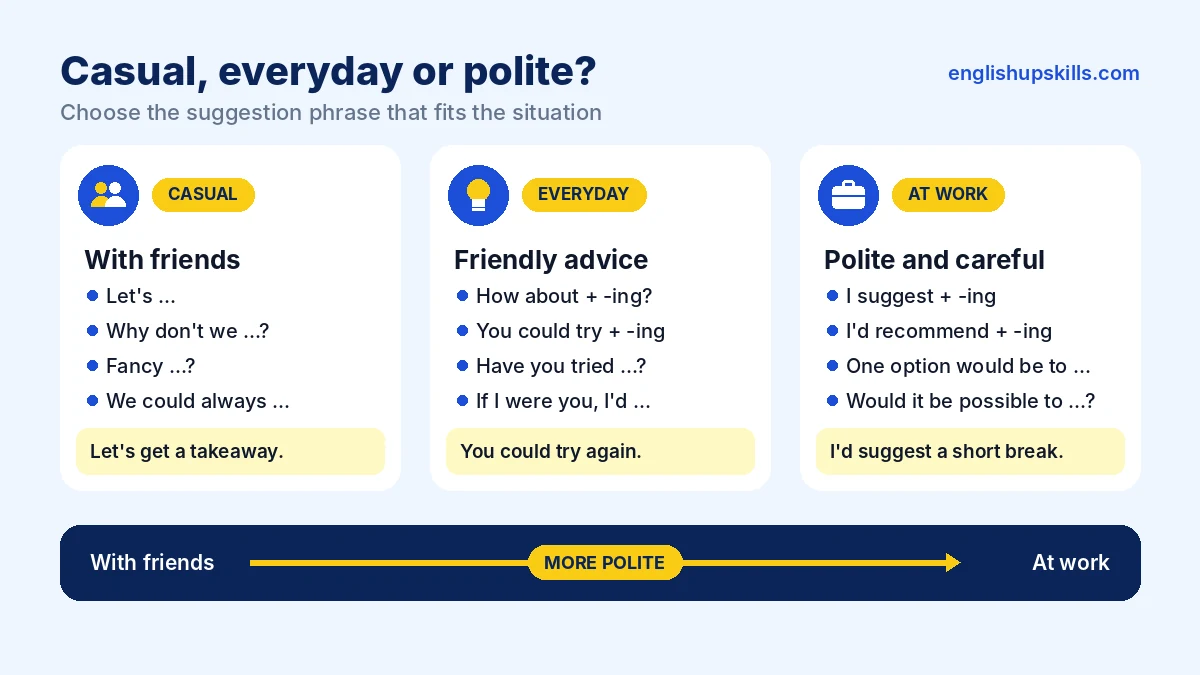
The phrases below are grouped by situation, from relaxed chats with friends to polite suggestions at work. Each phrase has a short example you can copy and adapt.
Casual suggestions with friends and family (1–10)
| Phrase | Example |
|---|---|
| 1. Let’s … | Let’s get a takeaway tonight. |
| 2. Let’s not … | Let’s not stay out too late. |
| 3. Why don’t we …? | Why don’t we watch a film? |
| 4. How about …? | How about going to the beach? |
| 5. What about …? | What about inviting Sara too? |
| 6. Shall we …? | Shall we meet outside the station? |
| 7. Fancy …? (informal UK) | Fancy a cup of tea? |
| 8. We could always … | We could always take the bus. |
| 9. Why not …? | Why not ask your brother? |
| 10. I know! Let’s … | I know! Let’s have a picnic. |
Everyday suggestions and advice (11–18)
These phrases are neutral. You can use them with almost anyone, and they work well when you are giving friendly advice.
| Phrase | Example |
|---|---|
| 11. Maybe we could … | Maybe we could leave a bit earlier. |
| 12. Perhaps you could … | Perhaps you could call her tomorrow. |
| 13. You could try … + -ing | You could try restarting your phone. |
| 14. Have you thought about … + -ing? | Have you thought about joining a club? |
| 15. Have you tried …? | Have you tried the new café on High Street? |
| 16. It might be a good idea to … | It might be a good idea to book early. |
| 17. If I were you, I’d … | If I were you, I’d take the job. |
| 18. You should … | You should ask your teacher for extra practice. |
Could, might and should are modal verbs, so the next verb is always in the base form. You can read more about them in our guide to modal verbs. Remember that should is stronger than could: “You could” offers one possible idea, while “You should” tells someone what you think is right.
Polite and professional suggestions at work (19–27)
In meetings, emails and phone calls, people usually make suggestions more carefully. These phrases sound polite and confident at the same time. They pair well with the phrases in our guide to giving opinions in English.
| Phrase | Example |
|---|---|
| 19. I suggest (that) we … | I suggest we move the meeting to Friday. |
| 20. I’d suggest … + -ing | I’d suggest starting with the budget. |
| 21. I’d recommend … + -ing | I’d recommend checking the figures again. |
| 22. May I suggest …? | May I suggest a short break? |
| 23. Might I suggest …? (very formal) | Might I suggest an alternative? |
| 24. One option would be to … | One option would be to hire a freelancer. |
| 25. It would be worth … + -ing | It would be worth asking the client first. |
| 26. Would it be possible to …? | Would it be possible to extend the deadline? |
| 27. My suggestion would be to … | My suggestion would be to test it with a small group. |
Many of these phrases also work well on the phone. For more polite language for calls, see our telephone English phrases.
Soft and tentative suggestions (28–35)
Sometimes you want to suggest something without sounding pushy, for example to your manager, a teacher or someone you have just met. These phrases make your idea sound like an option, not an order.
| Phrase | Example |
|---|---|
| 28. I was wondering if we could … | I was wondering if we could start a little later. |
| 29. What if we …? | What if we split the work between us? |
| 30. Wouldn’t it be better to …? | Wouldn’t it be better to wait until Monday? |
| 31. Do you think we should …? | Do you think we should tell him? |
| 32. How would you feel about … + -ing? | How would you feel about working from home on Fridays? |
| 33. It’s just an idea, but … | It’s just an idea, but we could share a taxi. |
| 34. I’m not sure, but maybe … | I’m not sure, but maybe we need a bigger room. |
| 35. Would you consider … + -ing? | Would you consider changing the date? |
Asking for suggestions (36–42)
Good conversations go both ways. Use these questions to invite other people’s ideas.
| Phrase | Example |
|---|---|
| 36. What do you suggest? | We’ve missed the last train. What do you suggest? |
| 37. Any ideas? / Any suggestions? | I need a present for my mum. Any ideas? |
| 38. What should we do about …? | What should we do about the noise? |
| 39. What would you recommend? | It’s my first time here. What would you recommend? |
| 40. Where shall we …? | Where shall we go for lunch? |
| 41. What would you do if you were me? | I’ve got two job offers. What would you do if you were me? |
| 42. Have you got any ideas for …? | Have you got any ideas for the party? |
Responding to suggestions (43–50)
Knowing how to answer is just as important as knowing how to suggest. Phrases 43–46 accept an idea; phrases 47–50 say no politely.
| Phrase | Example |
|---|---|
| 43. That’s a great idea. | That’s a great idea. I’ll bring some snacks. |
| 44. Sounds good to me. | Six o’clock? Sounds good to me. |
| 45. Why not? | A walk by the river? Why not? |
| 46. Good thinking! | Take umbrellas? Good thinking! |
| 47. That sounds good, but … | That sounds good, but I’m busy on Saturday. |
| 48. I’m not sure that’s a good idea. | I’m not sure that’s a good idea. It might rain. |
| 49. I’d rather not, if you don’t mind. | I’d rather not drive tonight, if you don’t mind. |
| 50. Maybe another time. | Not tonight, thanks. Maybe another time. |
A useful tip: when you say no, add a short reason or a new idea. “That sounds good, but I’m busy. How about Sunday?” is much friendlier than a simple “No”.
How to use “suggest” and “recommend” correctly
The verbs suggest and recommend cause more mistakes than any other suggestion phrase, because they do not follow the pattern “verb + person + to + verb”. There are three correct patterns.
| Pattern | Example |
|---|---|
| suggest + -ing | I suggest leaving now. |
| suggest (that) + person + base verb | I suggest (that) you leave now. |
| suggest (that) + person + should + base verb | I suggest that you should leave now. |
| suggest + noun (+ to + person) | Can you suggest a good hotel to me? |
Recommend works in the same way: I recommend booking early or I recommend that you book early. In British English, “should” is common after suggest and recommend. In more formal English, especially American English, the base verb is used for every person: The doctor recommended that she rest.
Common mistakes when making suggestions
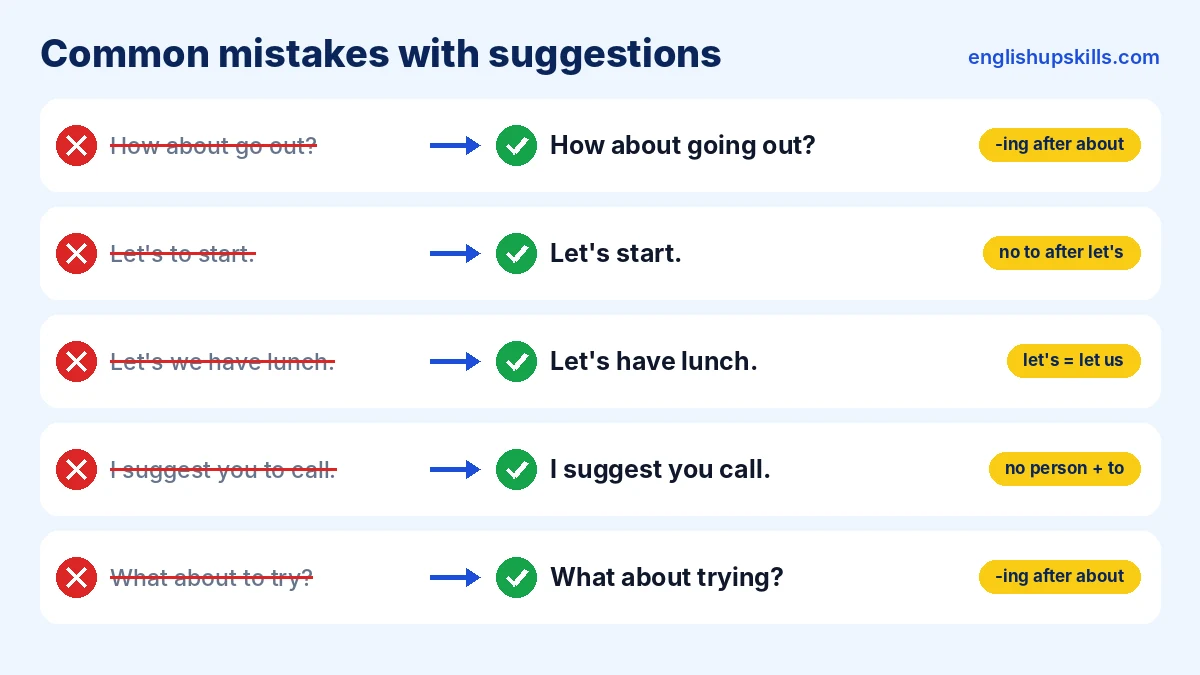
| Wrong | Correct | Why |
|---|---|---|
| How about go to the cinema? | How about going to the cinema? | How about and what about take -ing or a noun. |
| Let’s to start. | Let’s start. | Let’s is followed by the base verb, without to. |
| Let’s we have lunch. | Let’s have lunch. | Let’s already means “let us”, so we is not needed. |
| Why don’t we going out? | Why don’t we go out? | Why don’t we is followed by the base verb. |
| I suggest you to call him. | I suggest you call him. / I suggest calling him. | Suggest never takes person + to + verb. |
| Can you suggest me a restaurant? | Can you suggest a restaurant? / Can you recommend a restaurant? | Suggest does not take the person directly after it. |
| What about to try again? | What about trying again? | What about takes -ing. |
A short dialogue: making plans at the weekend
Read this short conversation and notice how the speakers suggest, accept and politely refuse ideas.
| Speaker | Line |
|---|---|
| Amir | The weather looks lovely on Saturday. Shall we do something? |
| Lucy | Definitely. How about going to the coast? |
| Amir | That sounds good, but it’s a long drive. What if we went to the lake instead? |
| Lucy | Good thinking! We could take a picnic. |
| Amir | Let’s ask Priya too. |
| Lucy | Sounds good to me. Why don’t you message her now? |
Notice that “What if we went” uses the past form to make the idea sound softer. “What if we go” is also correct and a little more direct.
Practice exercise: choose the correct form
Complete each sentence with the correct form of the verb in brackets.
- How about ______ (have) dinner at my place?
- Let’s ______ (not / tell) anyone yet.
- Why don’t we ______ (ask) the teacher?
- I suggest ______ (take) a taxi.
- It might be a good idea ______ (leave) early.
- Shall we ______ (sit) by the window?
- Have you thought about ______ (learn) a new language?
- I’d recommend that you ______ (book) in advance.
Answers: 1. having, 2. not tell, 3. ask, 4. taking, 5. to leave, 6. sit, 7. learning, 8. book (or should book).
For extra listening practice, watch the British Council’s short video lesson on making suggestions and listen for the phrases you learned here.
Frequently asked questions
What is the most common way to make a suggestion in English?
In everyday speech, Let’s + base verb is the most common: “Let’s go.” Why don’t we…? and How about…? are also very common. In formal situations, people often use I suggest or I’d recommend.
Is “How about” followed by -ing or the base verb?
How about is followed by the -ing form or a noun: “How about meeting at five?” or “How about a sandwich?” Never use the base verb after it, so “How about meet” is wrong.
Can I say “I suggest you to do something”?
No. This is one of the most common mistakes. Say “I suggest you do it”, “I suggest that you should do it” or “I suggest doing it”.
What is the difference between “Let’s” and “Shall we”?
Let’s makes a direct suggestion: “Let’s go.” Shall we asks the other person if they agree: “Shall we go?” Shall we is a little softer, and it is especially common in British English.
How do I make a polite suggestion at work?
Use a tentative phrase such as “I was wondering if we could…”, “One option would be to…” or “Would it be possible to…?” These sound helpful rather than bossy, which is important with managers and clients.
How can I say no to a suggestion politely?
Thank the person or show interest first, then give a short reason: “That sounds good, but I’m busy on Friday.” Offering a different idea, such as “How about Monday instead?”, keeps the conversation friendly.
Conclusion
Making suggestions in English becomes easy once you know which verb form follows each phrase: the base verb after Let’s, Shall we, Why don’t we and could; the -ing form after How about and What about; and either -ing or that + base verb after suggest. Start with the six phrases in the quick answer, practise them in real conversations this week, then add the softer and more professional phrases as your confidence grows. If you are preparing for an exam, our list of IELTS speaking phrases will help you use these structures in Part 3 discussions.