
Many learners can read and write well but freeze when a neighbour, a colleague or a stranger at a bus stop says, “Lovely day, isn’t it?” Small talk in English is the short, friendly chat people have before (or instead of) a serious conversation. It is not about sharing important information. It is about being polite, showing interest and making the other person feel comfortable.
The good news is that small talk follows a pattern. Once you know the phrases for each stage, you can handle almost any everyday conversation with confidence.
Quick answer: how to make small talk in English
- Open with a greeting or a light comment: “Hi, how’s it going?” or “Busy day today, isn’t it?”
- Ask an open question: “How was your weekend?”
- Listen and react: “Really? That sounds great!”
- Ask a follow-up and share a little about yourself: “Where did you go? I went to the coast last month.”
- Close politely: “Anyway, I’d better get going. It was nice talking to you!”
In this guide you will learn 60 natural phrases for every stage, safe topics, the mistakes learners often make, and a short practice exercise with answers.
What is small talk?
Small talk is light, informal conversation about everyday subjects such as the weather, the weekend, food, travel or work. People use it when they meet someone new, wait in a queue, arrive at a meeting early or bump into a neighbour. In the UK, the US, Australia and many workplaces around the world, small talk is the normal way to start a relationship before talking about anything serious.
Think of small talk as a warm-up. A football player does not run onto the pitch and shoot straight away; they warm up first. In the same way, small talk warms up a conversation so that both people feel relaxed.
Why small talk matters for English learners
- It builds relationships. Colleagues, clients and classmates remember people who are friendly and easy to talk to.
- It makes interviews and exams easier. Many job interviews and the IELTS Speaking test begin with simple questions about your home, studies or hobbies. That is small talk.
- It gives you speaking practice every day. Each short chat is a free mini-lesson.
- It reduces nervousness. When you have ready-made phrases, you think less about grammar and more about the person in front of you.
If you want a full plan for speaking practice, read our guide on how to improve your spoken English.
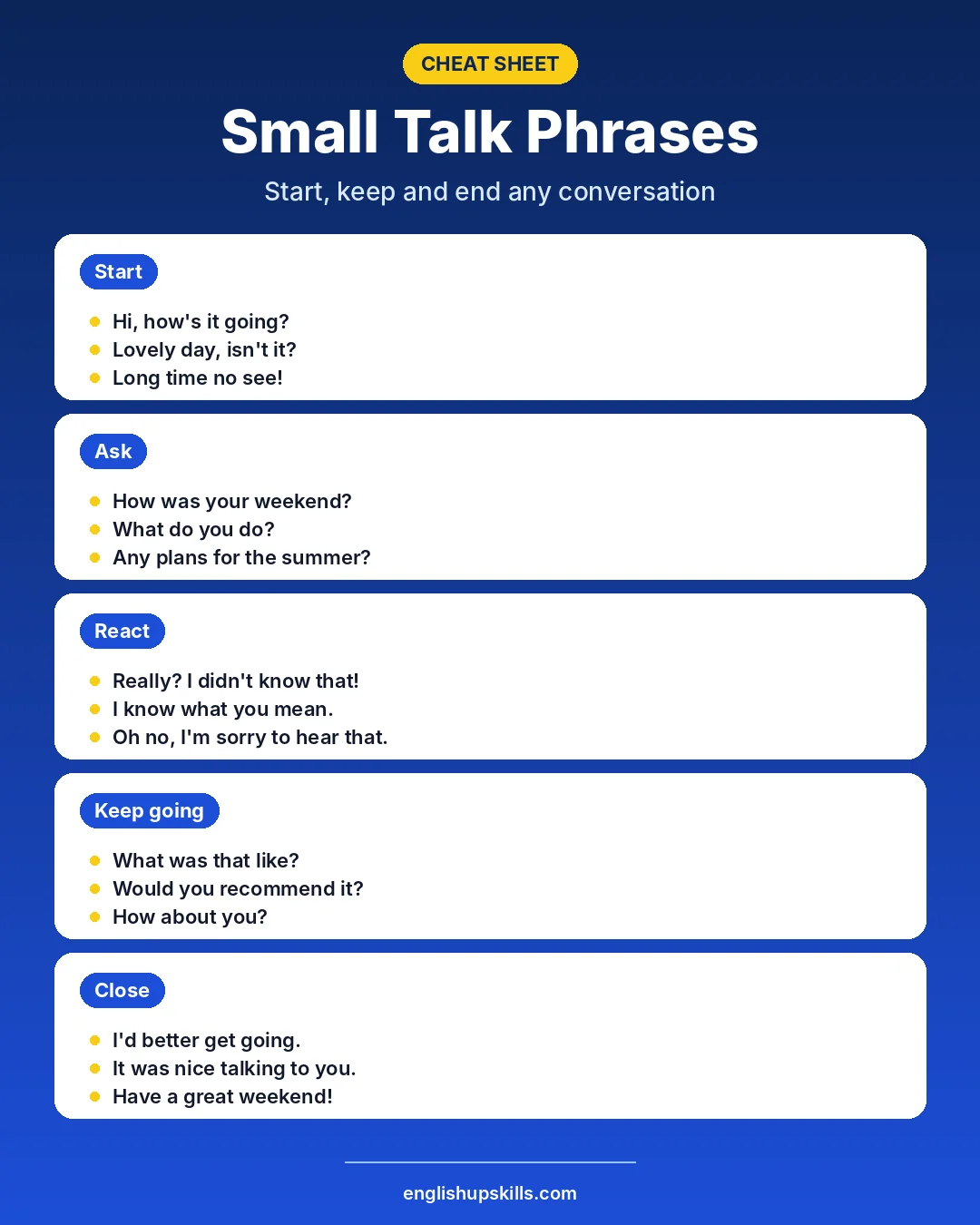
The 5 stages of a small talk conversation
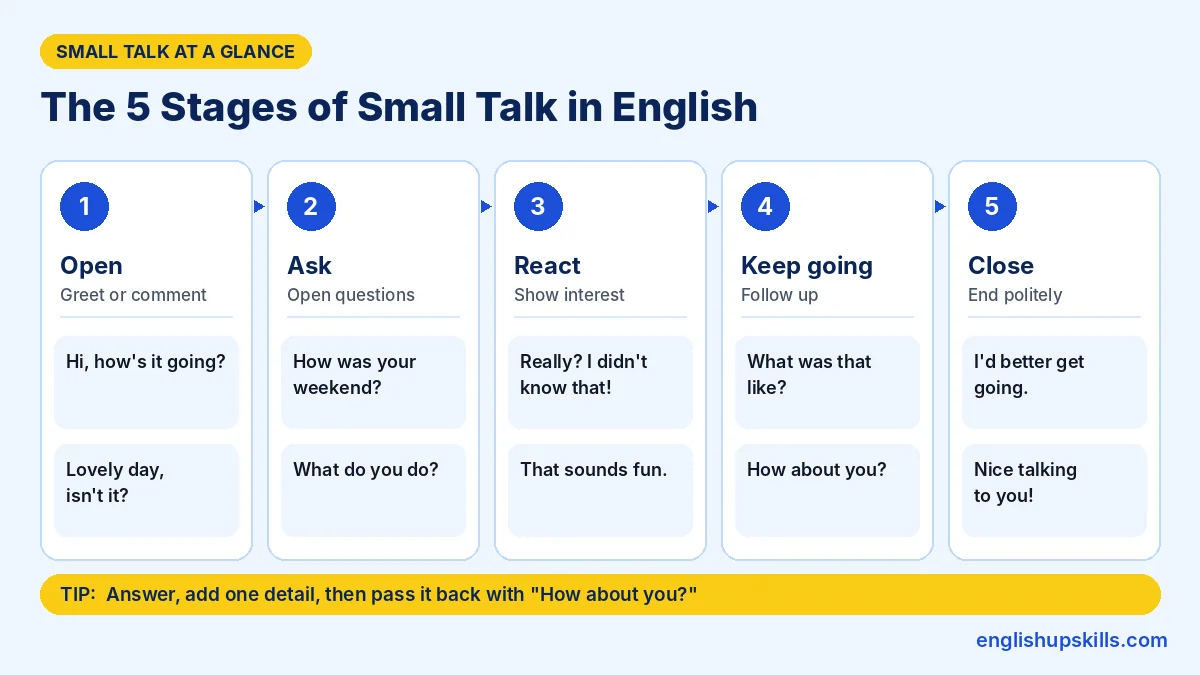
| Stage | What you do | Example |
|---|---|---|
| 1. Open | Greet or comment on the situation | Hi, how are you doing? |
| 2. Ask | Ask an easy, open question | How was your weekend? |
| 3. React | Show you are listening | Oh, nice! That sounds fun. |
| 4. Keep going | Follow up and share something | What was the best part? |
| 5. Close | End politely | It was great to catch up. |
1. Phrases to start a conversation (12)
Use these to open a chat. Comments about the shared situation (the weather, the queue, the event) are the easiest openers, because the other person can always answer.
| Phrase | When to use it |
|---|---|
| Hi, how are you? | Friends, colleagues, neighbours |
| Nice to meet you. I’m Sara. | Meeting someone for the first time |
| Lovely weather today, isn’t it? | Almost anywhere, especially in the UK |
| It’s freezing this morning! | A cold or rainy day |
| Is this seat taken? | Cafés, trains, waiting rooms |
| How do you know the host? | Parties and weddings |
| Have you been here before? | Restaurants, events, new places |
| This queue is moving slowly, isn’t it? | Shops, banks, airports |
| So, what’s new? | Someone you already know |
| Long time no see! | A friend you haven’t seen for a while |
| Are you enjoying the event? | Conferences and workshops |
| I love your bag. Where did you get it? | A friendly, light compliment |
Tip: Questions ending in isn’t it?, aren’t they? or don’t you think? are called question tags. They invite the other person to agree and keep talking.
2. Easy questions to ask (12)
Open questions start with what, where, how or why and need more than a yes or no. They give the other person something to talk about.
| Topic | Question |
|---|---|
| Weekend | How was your weekend? / Any plans for the weekend? |
| Work | What do you do? / How’s work these days? |
| Study | What are you studying? |
| Home | Where are you from originally? |
| Hobbies | What do you like to do in your free time? |
| Food | Have you tried the new café on the corner? |
| Travel | Have you been anywhere nice recently? |
| Holidays | Are you going away this summer? |
| Films and TV | Have you watched anything good lately? |
| Sport | Did you see the match last night? |
Notice the tenses. How was your weekend? uses the past simple because the weekend is finished. Have you been anywhere nice recently? uses the present perfect because the time period (recently) continues to now. Our guide to the 12 tenses in English explains these patterns in detail.
3. Phrases to react and show interest (12)
Listening is half of small talk. Short reactions tell the speaker you are interested and encourage them to continue.
| Feeling | Phrase |
|---|---|
| Interest | Really? I didn’t know that! |
| Interest | Oh, that’s interesting. |
| Agreement | I know what you mean. |
| Agreement | Absolutely! / Same here. |
| Happiness | That’s great news! |
| Happiness | Lucky you! |
| Sympathy | Oh no, I’m sorry to hear that. |
| Sympathy | That sounds stressful. |
| Surprise | No way! Are you serious? |
| Understanding | That makes sense. / Fair enough. |
4. Phrases to keep the conversation going (12)
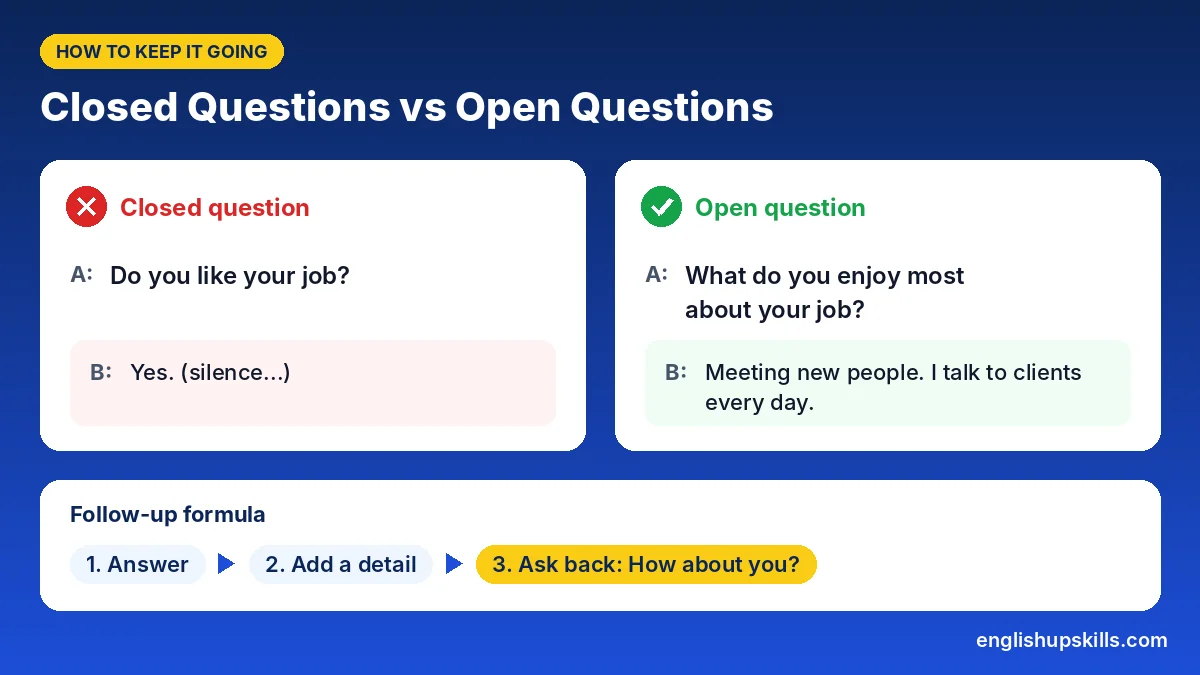
The biggest problem learners describe is silence after the first answer. The solution is simple: ask a follow-up question, then add a little about yourself.
| Purpose | Phrase |
|---|---|
| Ask for more detail | What was that like? |
| Ask for more detail | How did you get into that? |
| Ask for an opinion | What did you think of it? |
| Ask for a recommendation | Would you recommend it? |
| Turn the question back | How about you? / What about you? |
| Share something | Actually, I’ve just started learning to cook too. |
| Change the topic | By the way, I wanted to ask you… |
| Return to a topic | Anyway, as I was saying… |
| Buy time to think | Let me think… / That’s a good question. |
| Find common ground | Oh, me too! Which team do you support? |
Example dialogue
A: How was your weekend?
B: Pretty good, thanks. I went hiking with my brother.
A: Oh, nice! Where did you go?
B: Just to the hills outside town. The view was amazing.
A: I’ve never been there. Is it a difficult walk?
B: Not really. You should try it. How about you? Did you do anything fun?
See how each speaker answers, adds detail, then passes the conversation back? That simple rhythm keeps a chat alive. The British Council’s lesson on keeping a conversation going practises several of these phrases in a short video.
5. Phrases to end a conversation politely (12)
Ending suddenly can sound rude. Give a short reason, then say something warm.
| Situation | Phrase |
|---|---|
| You need to leave | Anyway, I’d better get going. |
| You need to leave | Sorry, I have to run — I’ve got a meeting. |
| At an event | I’ll let you get back to the party. |
| At an event | I’m going to grab a drink. Catch you later! |
| Warm goodbye | It was nice talking to you. / Nice chatting with you! |
| Warm goodbye | It was great to catch up. |
| New contact | It was lovely to meet you. |
| New contact | Let’s keep in touch. |
| Future plan | See you on Monday! |
| Future plan | Have a great weekend! / Take care! |
Safe and unsafe topics
| Usually safe | Usually best to avoid with new people |
|---|---|
| Weather, weekend plans, hobbies | Salary and money |
| Food, films, music, sport | Politics and religion |
| Travel, holidays, the local area | Weight, age and appearance |
| Work or study (in general) | Relationships and private family matters |
Common small talk mistakes (and how to fix them)
| Wrong | Correct | Why |
|---|---|---|
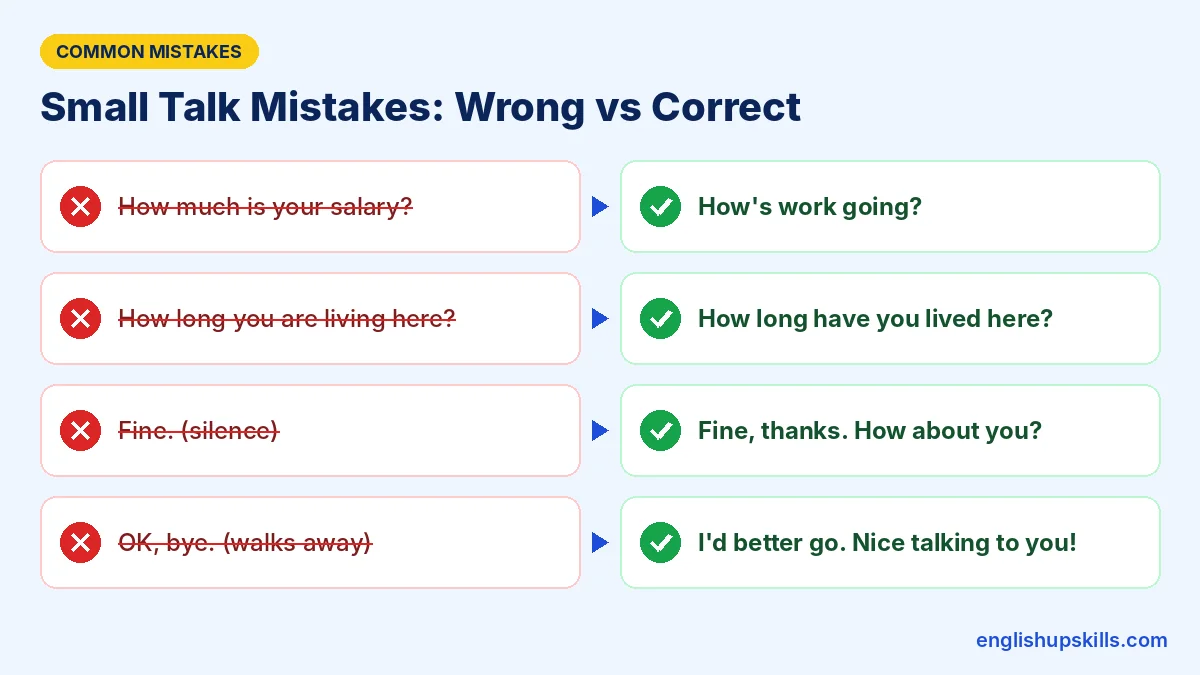
| How much is your salary? | How’s work going? | Money questions feel too personal with new people. |
| A: How are you? B: Fine. (silence) | Fine, thanks. How about you? | Always pass the question back. |
| How was your weekend? — Yes. | It was great, thanks. I visited my aunt. | Open questions need more than yes or no. |
| Do you like your job? | What do you enjoy most about your job? | Closed questions end the chat quickly. |
| I am fine, and you? | I’m good, thanks. And you? | Contractions sound natural in speech. |
| You look tired. / You’ve put on weight. | You look well! | Comments on appearance can offend. |
| How long you are living here? | How long have you lived here? | Use question word order and the present perfect. |
| OK, bye. (walks away) | Anyway, I’d better go. Nice talking to you! | A warm closing sounds polite. |
Word-order mistakes like “How long you are living here?” are very common. Review the present tenses and our basic English grammar rules to make your questions accurate. Also watch for pairs like lose/loose and advice/advise in written chats — see our list of commonly confused words.
Practice exercise
Choose the best reply or fill the gap.
- A: How was your holiday? B: ______ (a) Yes. (b) It was amazing, thanks. We went to Spain.
- Make this question open: Did you like the film? → ______
- A: I failed my driving test again. B: ______ (a) Lucky you! (b) Oh no, I’m sorry to hear that.
- Correct the question: How long you are working here?
- Choose a polite closing: (a) Anyway, I’d better get going. Nice talking to you! (b) OK, I go now.
- Add a question tag: It’s really cold today, ______?
- A: I’ve just started learning the guitar. B: Oh, nice! ______ (a) How did you get into that? (b) OK.
- Which topic is best with a new colleague? (a) their salary (b) their weekend plans
Answers
- (b) It was amazing, thanks. We went to Spain.
- What did you think of the film?
- (b) Oh no, I’m sorry to hear that.
- How long have you been working here? (or How long have you worked here?)
- (a) Anyway, I’d better get going. Nice talking to you!
- isn’t it
- (a) How did you get into that?
- (b) their weekend plans
Frequently asked questions
What is small talk in English?
Small talk is short, light conversation about everyday topics such as the weather, weekends, hobbies or work. People use it to be friendly and build a connection before discussing anything serious.
How do I start small talk with a stranger?
Comment on something you both share, such as the weather, the queue or the event, and then ask an easy open question. For example: “Busy here today, isn’t it? Do you come here often?”
What should I say when someone asks “How are you?”
Give a short, positive answer and pass the question back: “I’m good, thanks. How about you?” A long or very negative answer is unusual unless the person is a close friend.
How can I stop a conversation going silent?
Use the follow-up rhythm: answer, add one detail, then ask a related question. Phrases such as “What was that like?” and “How about you?” are very useful.
What topics should I avoid in small talk?
With people you do not know well, avoid salary, politics, religion, weight, age and private family matters. Stick to safe subjects like food, travel, films and weekend plans.
How can I practise small talk in English?
Learn five phrases a week and use them in real situations: with shop staff, classmates or colleagues. You can also record short practice dialogues and listen back to check your pronunciation.
Conclusion
Small talk in English is not about perfect grammar or clever ideas. It is about opening with a friendly line, asking open questions, reacting warmly, keeping the conversation moving and closing politely. Start with five phrases from each stage, use them this week, and you will notice how quickly everyday conversations become easier. For more speaking tips, read our guide on how to improve your spoken English.