
We use the past tense every day: to tell stories, describe what happened at work, explain a mistake or share a memory. English has four past tenses, and each one shows a slightly different relationship between an action and time. Once you understand what each one does, choosing the right one becomes much easier.
This guide explains all four past tenses with simple rules, sentence structures, real examples and the mistakes learners make most often. If you have already read our guides to the present tense and the future tense, this completes the set.
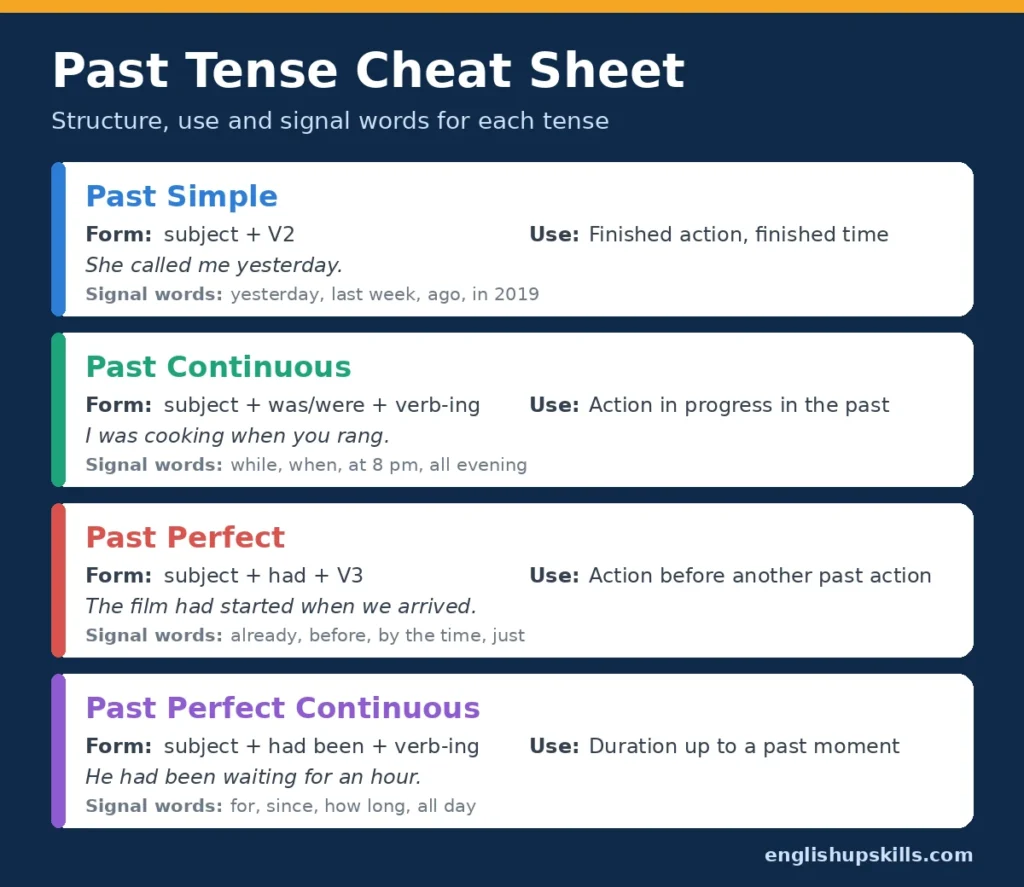
The 4 Past Tenses at a Glance
| Tense | Structure | Example | Main use |
|---|---|---|---|
| Past simple | subject + past form (V2) | She called me yesterday. | A finished action at a finished time |
| Past continuous | subject + was/were + verb-ing | I was cooking at 7 pm. | An action in progress in the past |
| Past perfect | subject + had + past participle (V3) | The film had started when we arrived. | An action before another past action |
| Past perfect continuous | subject + had been + verb-ing | He had been waiting for an hour. | The duration of an action before a past moment |
1. Past Simple
The past simple is the most common past tense. We use it for actions that started and finished at a specific time in the past. The time is often stated (yesterday, last week, in 2019, two hours ago) or clear from context.
Structure
- Positive: subject + past form → I watched a film last night.
- Negative: subject + did not (didn’t) + base verb → I didn’t watch the news.
- Question: Did + subject + base verb? → Did you watch the match?
Regular and irregular verbs
Regular verbs add -ed: work → worked, play → played, stop → stopped, study → studied. Irregular verbs have their own past forms, and you simply need to learn them: go → went, see → saw, buy → bought, take → took, write → wrote, be → was/were.
When to use it
- A completed action: We moved to Manchester in 2021.
- A series of actions in order: She opened the door, turned on the light and sat down.
- Past habits: When I was a child, I walked to school every day.
- Past states: He lived in London for ten years. (He doesn’t live there now.)
Common time expressions: yesterday, last night, last year, ago, in 2015, when I was young, on Monday.
2. Past Continuous
The past continuous (also called the past progressive) describes an action that was in progress at a particular moment in the past. It focuses on the activity itself, not its completion.
Structure
- Positive: subject + was/were + verb-ing → They were playing football.
- Negative: subject + wasn’t/weren’t + verb-ing → I wasn’t sleeping.
- Question: Was/Were + subject + verb-ing? → Were you working at 9 o’clock?
Use was with I, he, she, it and were with you, we, they.
When to use it
- An action in progress at a specific time: At 8 pm, I was having dinner.
- An action interrupted by another (past simple): I was walking home when it started to rain.
- Two actions happening at the same time: While she was reading, he was cooking.
- Setting the scene in a story: The sun was shining and the birds were singing.
Tip: Use while before the longer, continuous action and when before the shorter action that interrupts it.
3. Past Perfect
The past perfect shows that one past action happened before another past action. Think of it as “the past of the past”. It makes the order of events clear.
Structure
- Positive: subject + had + past participle → She had left before I arrived.
- Negative: subject + hadn’t + past participle → We hadn’t eaten all day.
- Question: Had + subject + past participle? → Had you met him before?
When to use it
- The earlier of two past actions: When I got to the station, the train had already gone.
- Explaining a past situation: He was tired because he hadn’t slept well.
- Reported speech: She said she had finished the report.
- Third conditional: If I had known, I would have helped.
Common time expressions: already, just, never, before, after, by the time, until.
Note: When before or after already shows the order, the past simple is also correct: I had breakfast before I left and I had had breakfast before I left are both acceptable.
4. Past Perfect Continuous
The past perfect continuous describes an action that had been continuing for a period of time up to a certain point in the past. It emphasises duration, and it often explains a result.
Structure
- Positive: subject + had been + verb-ing → I had been studying for three hours.
- Negative: subject + hadn’t been + verb-ing → She hadn’t been feeling well.
- Question: Had + subject + been + verb-ing? → How long had they been living there?
When to use it
- Duration before a past event: We had been waiting for 40 minutes when the bus finally came.
- The cause of a past result: His eyes were red because he had been crying.
Common time expressions: for, since, how long, all day, before.
Past Simple vs Past Continuous
This is the pair learners mix up most. The past simple shows a complete action; the past continuous shows an action in progress. Compare:
- I read a book last night. (I probably finished it.)
- I was reading a book last night. (I was in the middle of it; maybe I didn’t finish.)
- When the phone rang, I answered it. (First the phone rang, then I answered.)
- When the phone rang, I was taking a shower. (The shower was already in progress.)
Common Mistakes with the Past Tense
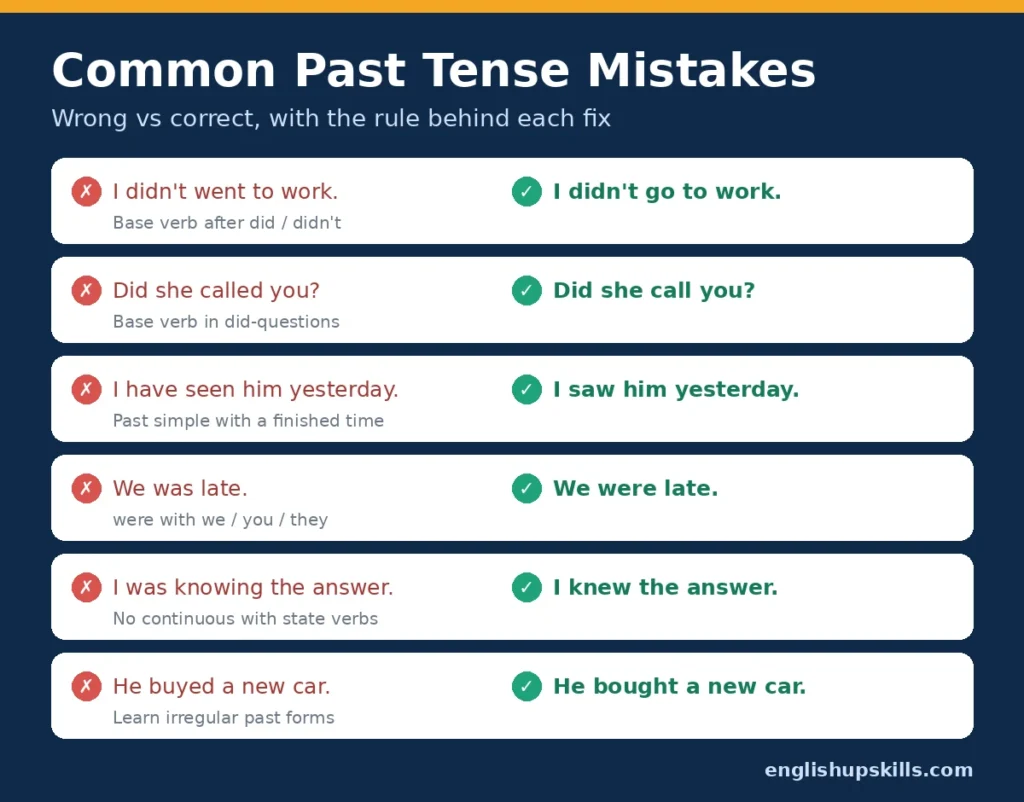
- ❌ I didn’t went to work. ✅ I didn’t go to work. After did/didn’t, always use the base verb.
- ❌ Did she called you? ✅ Did she call you?
- ❌ I have seen him yesterday. ✅ I saw him yesterday. Use the past simple, not the present perfect, with a finished time like yesterday.
- ❌ We was late. ✅ We were late.
- ❌ I was knowing the answer. ✅ I knew the answer. State verbs (know, believe, like, own, understand) are rarely used in continuous forms.
- ❌ He buyed a new car. ✅ He bought a new car. Check irregular verbs.
For more ways to spot and fix errors like these, see our guide to sentence correction rules.
Quick Practice
Choose the correct form of the verb in brackets. Answers are below.
- I ______ (see) Sarah at the supermarket yesterday.
- They ______ (watch) TV when the power went out.
- By the time we arrived, the concert ______ (finish).
- She was exhausted because she ______ (run) for an hour.
- ______ you ______ (go) to the party last Saturday?
Answers: 1. saw 2. were watching 3. had finished 4. had been running 5. Did … go
Frequently Asked Questions
How many past tenses are there in English?
There are four: past simple, past continuous, past perfect and past perfect continuous. Together with the four present and four future tenses, they make up the 12 tenses in English.
Which past tense is used most often?
The past simple. It is the default tense for talking about finished events, and it is the one you will use most in everyday conversation and writing.
Is “used to” a past tense?
“Used to” is not a separate tense, but it is a common way to talk about past habits and states that are no longer true: I used to play the piano. It has a similar meaning to the past simple for habits.
Conclusion
Each past tense answers a different question. The past simple says what happened, the past continuous says what was happening, the past perfect says what had already happened, and the past perfect continuous says how long something had been happening. Practise them in short stories about your own day, and they will soon feel natural.