
Giving opinions in English is one of the most useful speaking skills you can learn. You need it in class discussions, job interviews, meetings, IELTS Speaking and everyday chats with friends. Many learners only know I think and use it in every sentence. That works, but it can sound flat. In this guide you will learn 60 natural phrases for giving your opinion, grouped by how strong, polite or formal they are, with a clear example for each.
If you want a wider plan for speaking practice, read our guide on how to improve spoken English after this lesson.
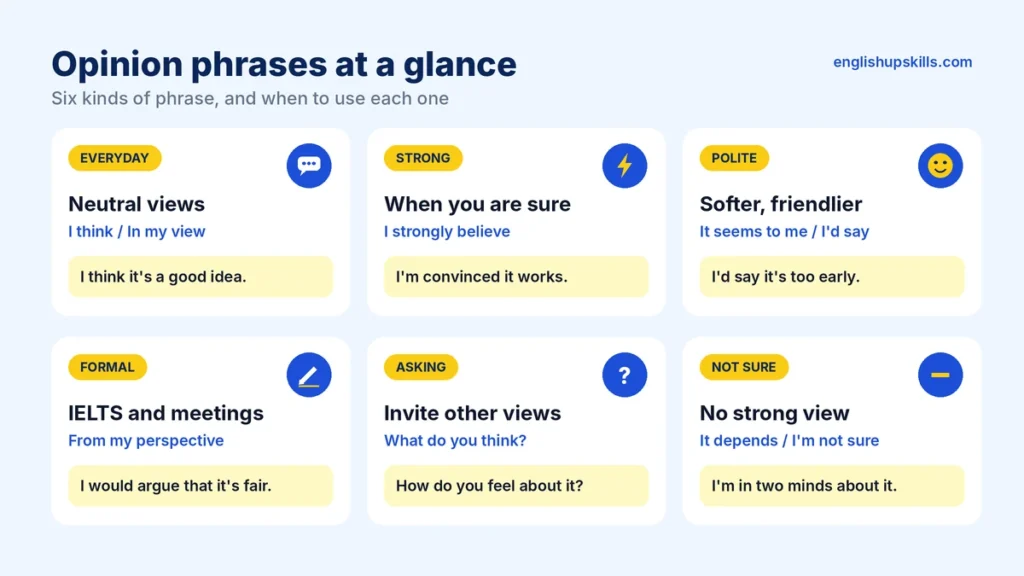
Quick answer — the most common ways to give an opinion in English:
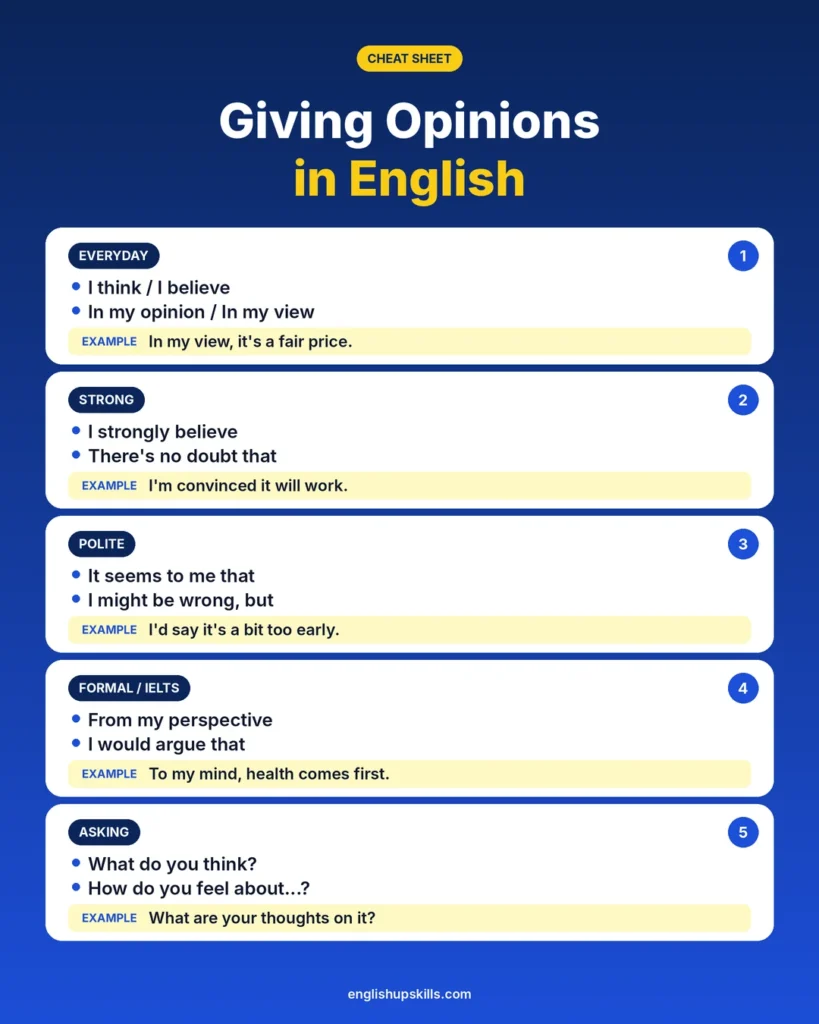
- I think / I believe — neutral, everyday opinions
- In my opinion / In my view — clear and a little more formal
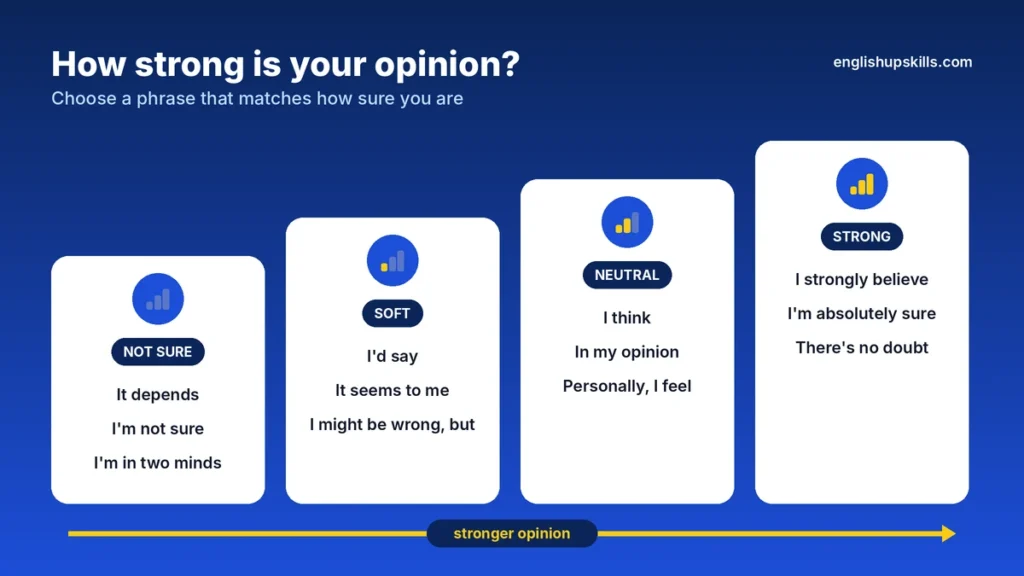
- I’m absolutely sure that / I strongly believe — strong opinions
- It seems to me that / I’d say — softer, polite opinions
- What do you think? / How do you feel about…? — asking for someone else’s opinion
- I’m not sure / It depends — when you have no strong view
How to give an opinion: the basic structure
A good opinion in spoken English has three parts: an opinion phrase, your idea, and a reason. The reason is what makes you sound confident and thoughtful, not just the phrase you choose.
| Part | What it does | Example |
|---|---|---|
| 1. Opinion phrase | Shows that this is your view, not a fact | In my opinion, |
| 2. Your idea | Says what you think | online classes are useful |
| 3. Reason | Explains why, using because, as or since | because you can study at your own pace. |
| 4. Example (optional) | Makes the reason real | For example, I watch lessons again before tests. |
Two grammar points matter here. First, most opinion phrases are followed by a full clause with a subject and a verb: I think that it is too expensive, not “I think too expensive”. Second, the word that is optional after think, believe, feel and say. I think it’s a good idea and I think that it’s a good idea are both correct.
1. Everyday opinion phrases (neutral)
Use these in normal conversation with friends, classmates and colleagues. They are safe in almost any situation.
| Phrase | Example |
|---|---|
| I think (that)… | I think the new café is better than the old one. |
| I believe (that)… | I believe everyone should learn to cook. |
| I feel (that)… | I feel the film was a bit too long. |
| In my opinion,… | In my opinion, football is more exciting than cricket. |
| In my view,… | In my view, the meeting should start earlier. |
| Personally, I think… | Personally, I think summer is the best season. |
| For me,… | For me, the price is the most important thing. |
| As far as I’m concerned,… | As far as I’m concerned, the plan is fine. |
| If you ask me,… | If you ask me, this phone is overpriced. |
| The way I see it,… | The way I see it, we need more time. |
Tip: If you ask me and The way I see it sound relaxed and friendly. Keep them for informal chats rather than formal writing.
2. Strong opinion phrases
Use these when you feel very sure. They are good for debates and discussions, but use them carefully with people you do not know well, because they can sound forceful.
| Phrase | Example |
|---|---|
| I strongly believe (that)… | I strongly believe children should play outside every day. |
| I’m absolutely sure (that)… | I’m absolutely sure she will pass the exam. |
| I’m convinced (that)… | I’m convinced this is the right decision. |
| I really feel (that)… | I really feel we should ask for help. |
| There’s no doubt that… | There’s no doubt that smoking is harmful. |
| I’m certain (that)… | I’m certain the shop closes at six. |
| Without a doubt,… | Without a doubt, this is the best book I’ve read this year. |
| I have no doubt (that)… | I have no doubt he is telling the truth. |
| It’s obvious (to me) that… | It’s obvious to me that the team needs a new coach. |
| I’m positive (that)… | I’m positive I locked the door. |
3. Polite and softer opinion phrases
In British English especially, people often soften their opinions so they do not sound rude or bossy. These phrases are perfect at work, with older people and when you disagree with someone. Modal verbs such as would and might make an opinion gentler; see our lesson on modal verbs in English for more.
| Phrase | Example |
|---|---|
| It seems to me (that)… | It seems to me that the report needs more detail. |
| I’d say (that)… | I’d say the second option is cheaper. |
| I tend to think (that)… | I tend to think smaller classes work better. |
| I might be wrong, but… | I might be wrong, but I think the train leaves at ten. |
| I may be mistaken, but… | I may be mistaken, but isn’t the deadline Friday? |
| It looks to me like… | It looks to me like the printer is broken again. |
| I would suggest (that)… | I would suggest we wait until Monday. |
| I’m inclined to think (that)… | I’m inclined to think he forgot about the meeting. |
| I suppose (that)… | I suppose it’s better than nothing. |
| I guess (that)… | I guess we could try a different route. |
4. Formal opinion phrases for IELTS, essays and meetings
These phrases are useful in IELTS Speaking Part 3, presentations, formal emails and essays. They show a wide range of language, which examiners and employers notice.
| Phrase | Example |
|---|---|
| From my point of view,… | From my point of view, public transport should be free. |
| From my perspective,… | From my perspective, remote work saves a lot of time. |
| It is my belief that… | It is my belief that education should be practical. |
| I am of the opinion that… | I am of the opinion that taxes on sugar are fair. |
| My view is that… | My view is that the city needs more parks. |
| I would argue that… | I would argue that social media does more harm than good. |
| It could be argued that… | It could be argued that tourism damages local culture. |
| As I see it,… | As I see it, the main problem is cost. |
| To my mind,… | To my mind, honesty matters more than talent. |
| Speaking for myself,… | Speaking for myself, I prefer to work in silence. |
Note: It could be argued that is not really your own opinion. It presents a view that some people hold, so it is very useful for discussing both sides of an argument.
5. Phrases for asking for opinions
A real conversation goes both ways. After you give your view, invite the other person to share theirs.
| Phrase | Example |
|---|---|
| What do you think? | I like the blue one. What do you think? |
| What’s your opinion on…? | What’s your opinion on the new timetable? |
| How do you feel about…? | How do you feel about working on Saturdays? |
| What are your thoughts on…? | What are your thoughts on the proposal? |
| What’s your view? | We could hire two people. What’s your view? |
| Do you agree? | It’s too cold for a picnic. Do you agree? |
| Would you say (that)…? | Would you say the course was worth the money? |
| Where do you stand on…? | Where do you stand on school uniforms? |
| Any thoughts? | That’s my plan. Any thoughts? |
| I’d love to hear your opinion. | I’d love to hear your opinion before we decide. |
6. When you have no strong opinion
Sometimes you are not sure, or you can see both sides. It is fine to say so, and it sounds honest and mature.
| Phrase | Example |
|---|---|
| I’m not sure. | I’m not sure. Both hotels look good. |
| It depends. | It depends on the weather. |
| I can see both sides. | I can see both sides of the argument. |
| I don’t have a strong opinion about it. | I don’t have a strong opinion about it, to be honest. |
| I haven’t really thought about it. | I haven’t really thought about it before. |
| On the one hand… on the other hand… | On the one hand it’s cheap; on the other hand it’s far away. |
| I have mixed feelings about… | I have mixed feelings about moving abroad. |
| It’s hard to say. | It’s hard to say who will win. |
| I’m in two minds about… | I’m in two minds about buying a car. |
| That’s a difficult question. | That’s a difficult question. Let me think. |
The phrase I’m in two minds is very British and very natural. It means you cannot decide between two choices.
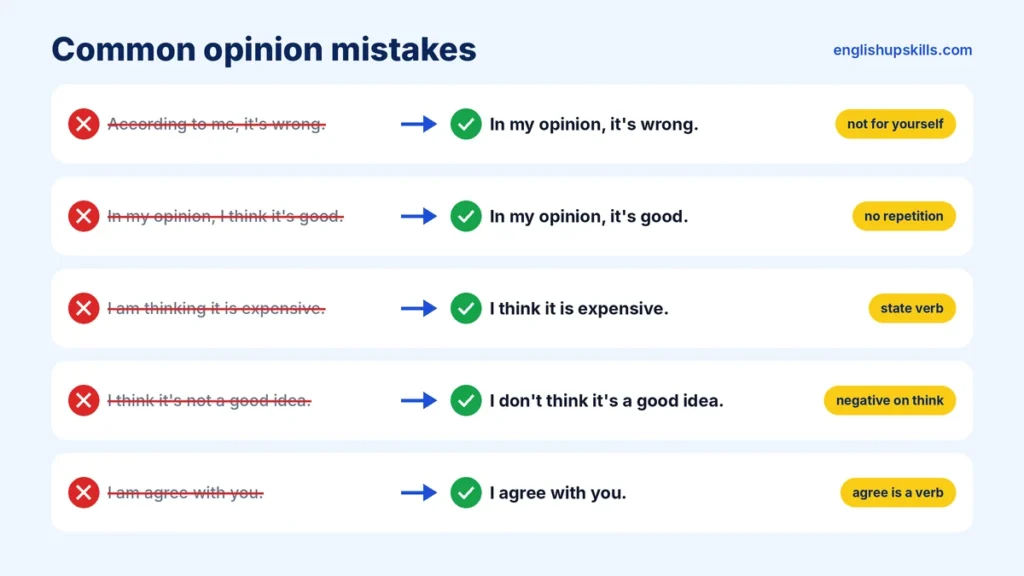
Common mistakes when giving opinions
These are the errors teachers hear most often. Check your own speaking against this table. Several are tense and verb-form mistakes; our guide to present tenses explains why stative verbs like think are not normally used in the continuous form for opinions.
| Wrong | Correct | Why |
|---|---|---|
| According to me, it’s wrong. | In my opinion, it’s wrong. | According to is used for other people or sources, not yourself. |
| In my opinion, I think it’s good. | In my opinion, it’s good. | Both phrases mean the same, so using both is repetition. |
| I am thinking it is expensive. | I think it is expensive. | Think is a state verb when it means have an opinion, so use the simple form. |
| I think it’s not a good idea. | I don’t think it’s a good idea. | English usually puts the negative on think, not on the second verb. |
| I am agree with you. | I agree with you. | Agree is a verb; it does not need am. |
| In my point of view, it’s fine. | From my point of view, it’s fine. | The fixed phrase is from my point of view. |
Practice exercise
Choose the best phrase to complete each sentence. Answers are below.
- ______, the new library is fantastic. (In my opinion / According to me)
- I ______ it will rain today, so leave your umbrella at home. (don’t think / think not)
- I’m ______ about the job offer. I can’t decide. (in two minds / absolutely sure)
- ______ the new rules at work? (What do you think about / What you think about)
- I ______ wrong, but I think the shop is closed. (might be / am being)
- ______, I prefer tea to coffee. (Personally / Personal)
- There’s ______ doubt that exercise is good for you. (no / not)
- I ______ with your idea completely. (agree / am agree)
Answers: 1. In my opinion 2. don’t think 3. in two minds 4. What do you think about 5. might be 6. Personally 7. no 8. agree
Frequently asked questions
What is the most common way to give an opinion in English?
I think is the most common phrase by far. It is neutral, short and correct in almost every situation. To sound more natural, mix it with In my opinion, I feel and I’d say, and always add a reason.
Is “according to me” correct English?
No, not for your own opinion. Use according to for other people or sources: according to the BBC or according to my teacher. For yourself, say in my opinion or in my view.
How can I give my opinion politely?
Use softening phrases such as It seems to me that, I’d say and I might be wrong, but. A polite tone, a reason and a question at the end, such as What do you think?, also help a lot.
Which opinion phrases are best for IELTS Speaking?
In Part 3, use a range of phrases: From my perspective, I would argue that, It could be argued that and I’m inclined to think. Do not memorise long scripts; examiners prefer natural answers. See our full list of IELTS speaking phrases for more.
What is the difference between “I think” and “I believe”?
They are very similar. I believe can sound a little stronger or more serious, and it is often used for values and principles: I believe everyone deserves a second chance. I think is more everyday.
How do I say I have no opinion?
Say I don’t have a strong opinion about it, It depends or I can see both sides. These sound honest and polite. Avoid just saying “I don’t know” with no explanation, because it can stop the conversation.
Conclusion
Giving opinions in English is not about one perfect phrase. Choose a phrase that matches how sure you are and who you are talking to, add a clear reason, and invite the other person to respond. Start with three or four phrases from this list, use them this week, then add more. For your next step, learn to avoid mix-ups such as affect and effect in our guide to commonly confused words. For more practice, the British Council has a lesson on useful language for giving your opinion.