
Introduction
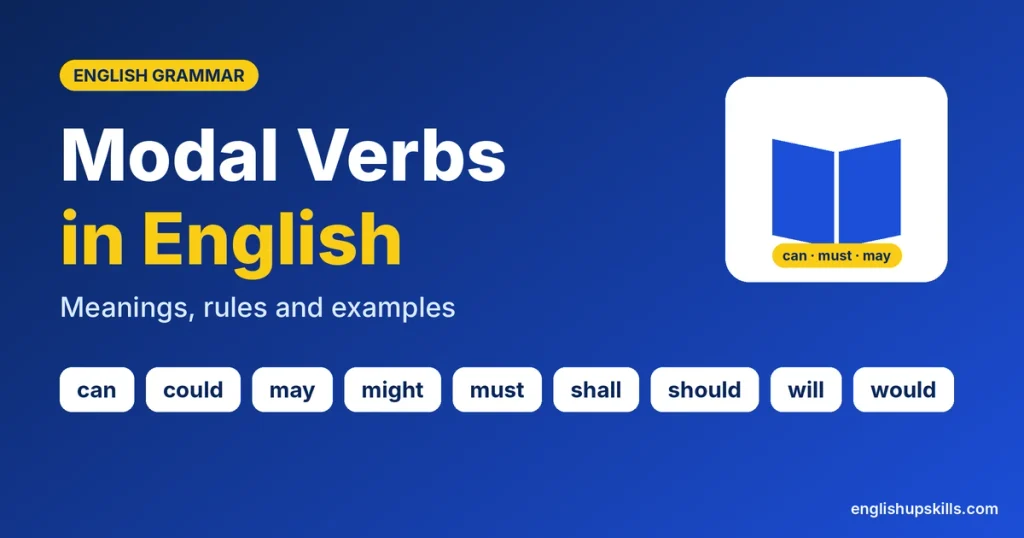
Modal verbs in English are small helping verbs such as can, must and should that change the meaning of the main verb. They tell the listener whether something is possible, necessary, allowed, advised or likely. Without them, you can only state facts. With them, you can ask politely, give advice, make rules and guess. This guide explains every common modal with clear tables, real examples and a short quiz, and it builds on our English grammar rules guide.
Quick answer: the 9 core modal verbs and their main jobs
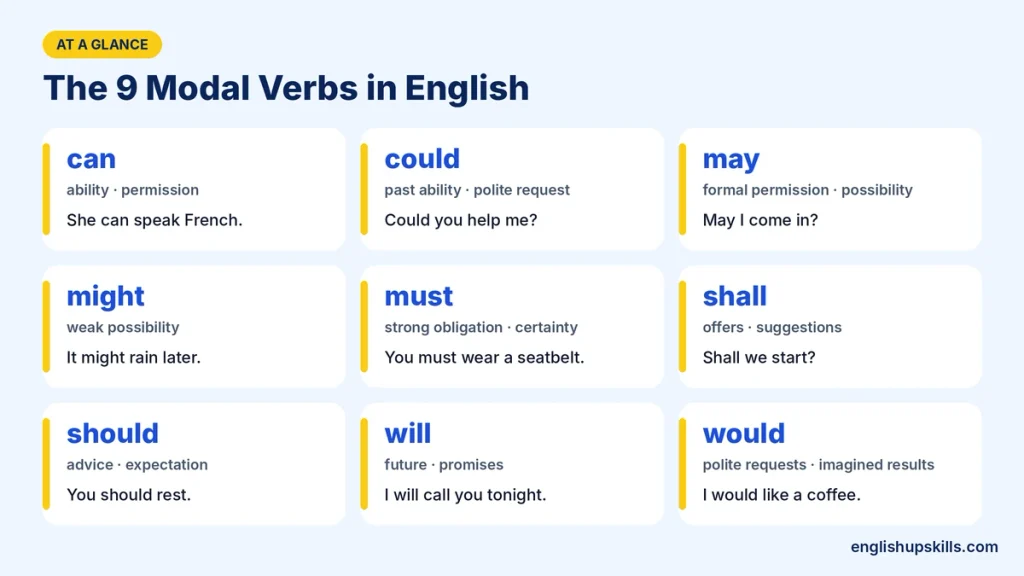
- can — ability, permission, possibility: She can swim.
- could — past ability, polite requests, possibility: Could you help me?
- may — formal permission, possibility: You may leave now.
- might — weak possibility: It might rain later.
- must — strong obligation, certainty: You must wear a seatbelt.
- shall — offers and suggestions (I/we): Shall we start?
- should — advice, expectation: You should see a doctor.
- will — future, promises, decisions: I will call you tonight.
- would — polite requests, imagined situations: I would like a coffee.
Phrases like have to, need to, ought to and be able to work in a similar way. They are called semi-modals, and we cover them below too.
What are modal verbs?
A modal verb is an auxiliary (helping) verb that adds a speaker’s attitude to the main verb. Compare I swim (a fact) with I can swim (ability), I must swim (obligation) and I might swim (possibility). The action is the same; the modal changes how we see it. The British Council’s LearnEnglish guide to modal verbs groups them by these jobs: certainty, ability, permission, requests, offers, suggestions and obligation.
5 golden rules of modal verbs
Modal verbs do not behave like normal verbs. Learn these five rules and most mistakes disappear.
| Rule | Correct | Wrong |
|---|---|---|
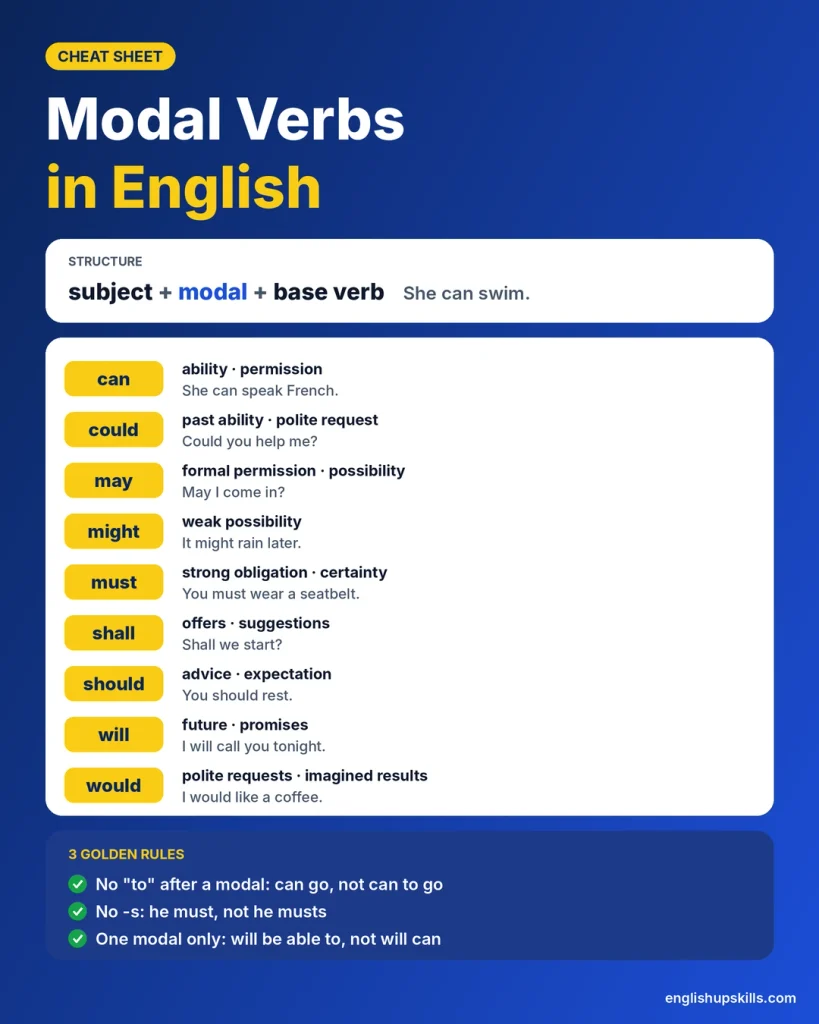
| 1. Use the base verb after a modal (no to) | She can drive. | She can to drive. |
| 2. No -s for he, she or it | He must go. | He musts go. |
| 3. Make negatives with not after the modal | You should not shout. | You don’t should shout. |
| 4. Make questions by moving the modal first | Can you hear me? | Do you can hear me? |
| 5. Only one modal at a time | I will be able to come. | I will can come. |
The sentence pattern is always the same:
| Sentence type | Structure | Example |
|---|---|---|
| Positive | subject + modal + base verb | They should study. |
| Negative | subject + modal + not + base verb | They shouldn’t study late. |
| Question | modal + subject + base verb? | Should they study now? |
| Past (perfect modal) | subject + modal + have + past participle | They should have studied. |
Common short forms: can’t (cannot), couldn’t, won’t (will not), wouldn’t, shouldn’t, mustn’t, mightn’t (rare in American English).
Can and could: ability, permission and requests
Can is the most useful modal. It shows present ability, informal permission and general possibility.
- Ability: My brother can speak three languages.
- Permission: Can I sit here?
- Possibility: Winters in London can be very wet.
Could is the past of can for general ability, and it is also the polite choice for requests.
- Past ability: I could read when I was four.
- Polite request: Could you send me the file, please?
- Possibility: That could be the answer.
Tip: for one specific success in the past, use was able to or managed to, not could: The fire spread fast, but everyone was able to escape.
May and might: possibility and formal permission
Both words show that something is possible but not certain. Might usually sounds a little less sure than may, and it is more common in everyday British speech.
| Use | May | Might |
|---|---|---|
| Possibility | The train may be late. | The train might be late. |
| Permission | May I come in? (formal) | Rare in modern English |
| Polite suggestion | — | You might want to check the date. |
In job interviews, emails and exams, May I ask a question? sounds more formal than Can I ask a question?. Both are correct.
Must, have to and mustn’t: obligation and certainty
Must shows strong obligation that often comes from the speaker, and it shows a confident guess.
- Obligation: I must finish this report tonight.
- Rule: Passengers must show their tickets.
- Certainty: You’ve worked all day. You must be tired.
Have to shows obligation that comes from outside, such as a rule, a boss or a timetable. It also gives us the past and future forms that must lacks: I had to wait and I will have to wait.
The negatives have very different meanings, which is why learners mix them up:
| Form | Meaning | Example |
|---|---|---|
| mustn’t | It is not allowed. Don’t do it. | You mustn’t smoke in the hospital. |
| don’t have to | It is not necessary. You can choose. | You don’t have to wear a tie on Fridays. |
| needn’t | It is not necessary (British, formal) | You needn’t bring anything. |
Should and ought to: advice and expectation
Should gives advice and opinions, and it shows what we expect to happen. Ought to means almost the same but is more formal and less common.
- Advice: You should practise speaking every day.
- Opinion: The government ought to build more homes.
- Expectation: The parcel should arrive by Monday.
- Regret (past): I should have left earlier. (I didn’t, and I’m sorry.)
On a scale of strength, should is softer than must and have to. Use should when the listener can still choose.
Will, would and shall: future, offers and politeness
Will talks about the future, promises, instant decisions and predictions. It is one of the main ways to form the future tense, which you can compare with the other forms in our 12 tenses in English guide.
- Prediction: It will be sunny tomorrow.
- Instant decision: The phone’s ringing. I‘ll get it.
- Promise: I won’t tell anyone.
Would is the past of will in reported speech, and it is the polite and hypothetical modal.
- Polite request: Would you open the window?
- Wants: I‘d like a table for two.
- Imagined situations: If I had more time, I would travel.
- Past habits: As a child, I would visit my grandmother every summer.
Shall is now used mainly with I and we for offers and suggestions, especially in British English: Shall I carry that for you? Shall we go?
Modal verbs in the past: modal + have + past participle
Most modals have no past form, so we talk about the past with modal + have + past participle. These “perfect modals” are common in IELTS speaking and everyday conversation.
| Form | Meaning | Example |
|---|---|---|
| should have + V3 | Regret or criticism: it was a good idea, but it didn’t happen | You should have told me. |
| could have + V3 | A past chance that was not taken | We could have won the match. |
| might / may have + V3 | A guess about the past | She might have missed the bus. |
| must have + V3 | A confident guess about the past | The ground is wet. It must have rained. |
| can’t have + V3 | It is impossible that this happened | He can’t have finished already. |
| would have + V3 | An imagined past result | I would have helped if you had asked. |
In speech, should have often sounds like “should’ve”. Never write “should of”; it is a very common spelling mistake.
Modal verbs by function: quick table
| Function | Modal verbs | Example |
|---|---|---|
| Ability | can, could, be able to | She can code in Python. |
| Permission | can, could, may | May I use your pen? |
| Request | can, could, would, will | Would you help me? |
| Offer and suggestion | shall, can, could | Shall I call a taxi? |
| Advice | should, ought to, had better | You‘d better hurry. |
| Obligation | must, have to, need to | We have to check in by 9. |
| Prohibition | mustn’t, can’t | You can’t park here. |
| Certainty | must, can’t, will | That can’t be true. |
| Possibility | may, might, could | He might be at home. |
Common mistakes with modal verbs
These are the errors examiners and teachers see most often. If you enjoy fixing sentences like these, try our sentence correction rules next.
| Wrong | Correct | Why |
|---|---|---|
| She can to swim. | She can swim. | No to after a modal (except ought to, have to). |
| He musts leave. | He must leave. | Modals never take -s. |
| I will can help you. | I will be able to help you. | Two modals cannot sit together. |
| Do you can come? | Can you come? | Questions start with the modal, not do. |
| You mustn’t pay; it’s free. | You don’t have to pay; it’s free. | Mustn’t means “not allowed”; use don’t have to for “not necessary”. |
| I should went there. | I should have gone there. | Past advice or regret = should + have + past participle. |
| He can swims well. | He can swim well. | The verb after a modal stays in its base form. |
| Yesterday I could finish the work on time. | Yesterday I was able to finish the work on time. | For one past success, use was able to or managed to. |
Practice exercise
Choose the best modal verb for each sentence.
- You ___ wear a helmet on a motorbike. It’s the law. (must / might)
- ___ I borrow your charger, please? (Could / Must)
- Take an umbrella. It ___ rain this afternoon. (might / mustn’t)
- You ___ bring food. Lunch is included. (mustn’t / don’t have to)
- When I was ten, I ___ run 5 km without stopping. (could / can)
- You look pale. You ___ see a doctor. (should / would)
- ___ we start the meeting now? (Shall / Must)
- She has three cars and a villa. She ___ be rich. (must / can’t)
- I ___ like a glass of water, please. (would / will)
- I failed the test. I ___ studied harder. (should have / must)
Answers: 1. must 2. Could 3. might 4. don’t have to 5. could 6. should 7. Shall 8. must 9. would 10. should have
FAQs about modal verbs
How many modal verbs are there in English? There are nine core modal verbs: can, could, may, might, must, shall, should, will and would. Many grammar books also include semi-modals such as ought to, have to, need to, had better and be able to.
Why don’t we use “to” after modal verbs? Modal verbs are followed by the bare infinitive, so we say I can go, not I can to go. Ought to and have to are the exceptions because the to is part of the phrase.
What is the difference between must and have to? Both show obligation. Must often comes from the speaker’s own feeling (I must call Mum), while have to comes from an outside rule (I have to wear a uniform). In the negative, mustn’t means “not allowed” and don’t have to means “not necessary”.
Is “could” the past tense of “can”? Yes, for general ability in the past: I could ride a bike at six. But could also has present uses, such as polite requests (Could you help?) and possibility (It could be true).
What is the difference between may and might? Both show possibility, and in most sentences you can use either. Might sounds slightly less certain and more informal. Only may is used for formal permission: May I come in?
Can two modal verbs be used together? Not in standard English. Instead of will can, use will be able to; instead of might must, use might have to.
Conclusion
Modal verbs are short, but they carry a lot of meaning. Remember the core rules: base verb after the modal, no -s, no do in questions, and one modal at a time. Then learn each modal by its job: ability, permission, possibility, advice, obligation and the future. Practise by writing five sentences a day about your own plans and rules, and say them aloud. For daily speaking practice, read our guide on how to improve your spoken English.