
If you say “I’m happy” ten times a day, you are not alone. Happy is one of the first adjectives every learner knows, and that is exactly why it starts to sound flat. Learning other words for happy helps you say how happy you are, why you are happy and how formal you want to sound. A small change, from happy to thrilled or relieved, makes your English more natural, more precise and more interesting to listen to.
In this guide you will find 60 synonyms for happy in six groups, each with a short meaning and an example sentence. You will also learn which words need “absolutely” instead of “very”, which ones are too informal for an email, and the prepositions that go with them. If you enjoyed our list of other words for said, this is the perfect next step.
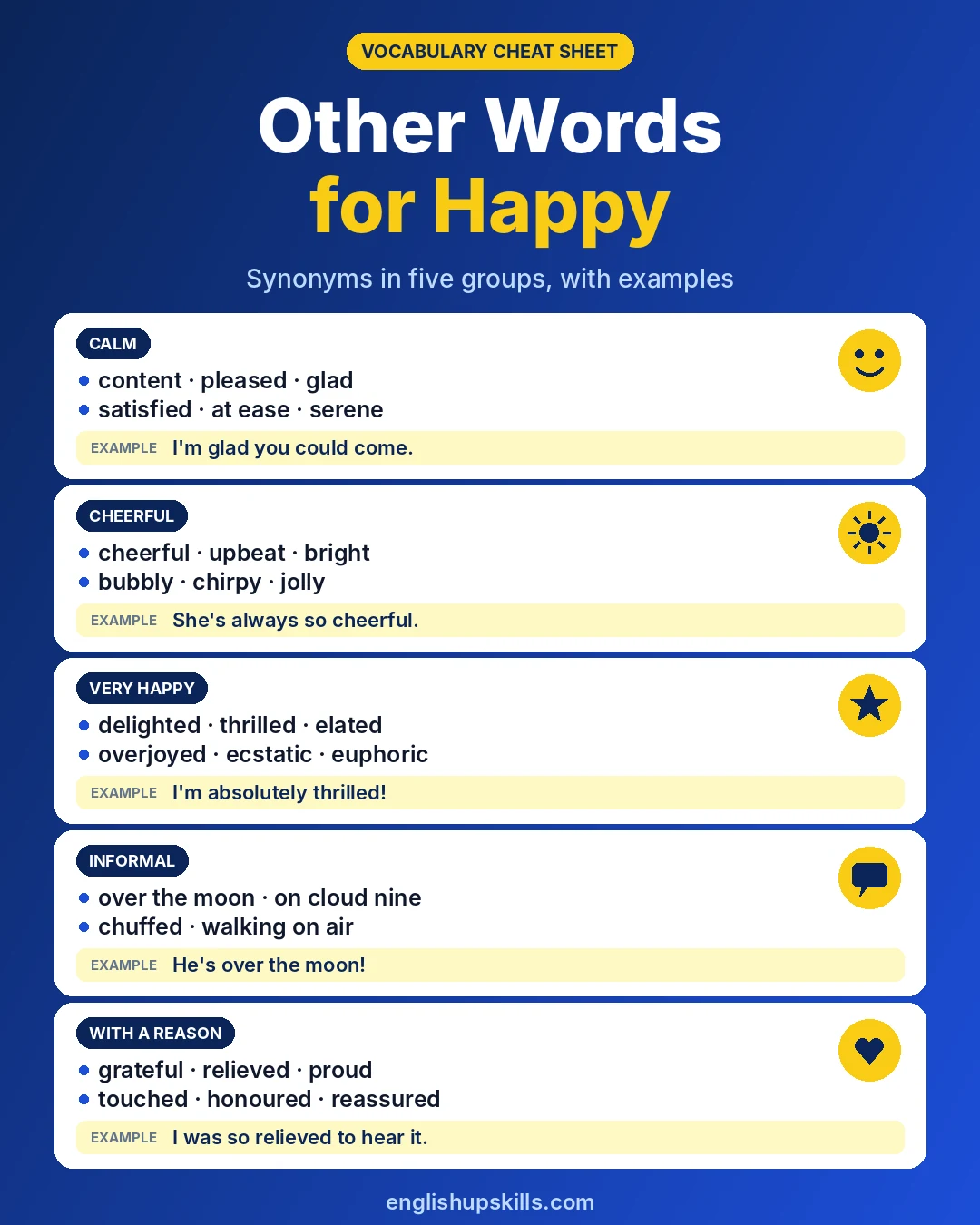
Quick answer: the 10 most useful other words for happy
- glad — happy about a situation (“I’m glad you came.”)
- pleased — happy and satisfied, polite and safe in any setting
- cheerful — happy in a bright, friendly way
- content — quietly happy with what you have
- delighted — very happy, good for formal emails
- thrilled — very happy and excited
- overjoyed — extremely happy, often after good news
- ecstatic — extremely happy, almost wild with joy
- over the moon — an informal idiom for very happy
- relieved — happy because something bad did not happen
How to choose the right word: strength and formality
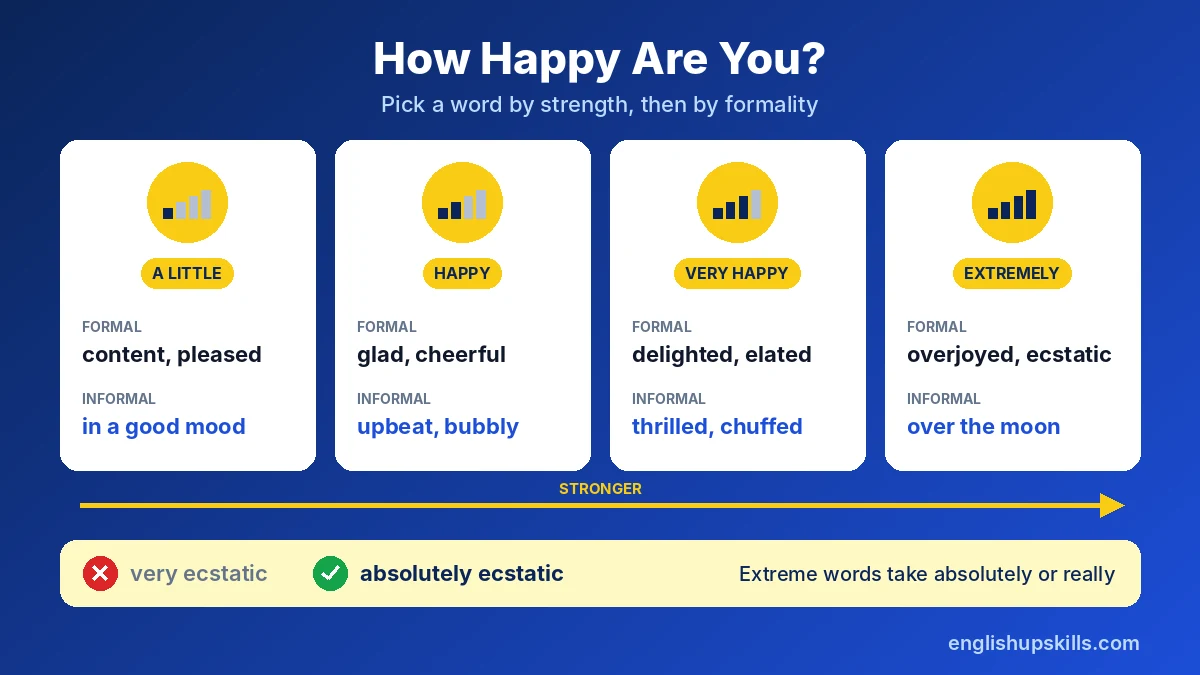
Not all happy words are equal. Before you pick one, ask two questions: How happy am I? and Who am I talking to? The table below sorts the most common words by both.
| Strength | Neutral or formal | Informal |
|---|---|---|
| A little happy | content, pleased, satisfied | in a good mood, chirpy |
| Happy | glad, cheerful, joyful | upbeat, bubbly |
| Very happy | delighted, elated, jubilant | thrilled, chuffed, made up |
| Extremely happy | overjoyed, ecstatic, euphoric | over the moon, on cloud nine |
A useful rule: in a work email, “I’m delighted to accept your offer” sounds professional, while “I’m over the moon about your offer” sounds like a text to a friend. The same idea applies when you are giving opinions in English: match your words to the situation.
1. Calm and satisfied happiness (10 words)
Use these when you feel quietly happy, peaceful or satisfied rather than excited.
| Word | Meaning | Example |
|---|---|---|
| content | happy with what you have | She is content with a simple life. |
| pleased | happy and satisfied | We are pleased with the results. |
| glad | happy about a situation | I’m glad the rain has stopped. |
| satisfied | happy because something is good enough | Are you satisfied with your new flat? |
| fulfilled | happy because your life feels useful | Teaching makes him feel fulfilled. |
| at ease | relaxed and comfortable | I felt at ease with my new team. |
| at peace | calm and free from worry | After the holiday she felt at peace. |
| serene | very calm and peaceful | The old man had a serene smile. |
| comfortable | relaxed in a situation | I’m comfortable speaking in meetings now. |
| relaxed | calm and not worried | Everyone looked relaxed at the picnic. |
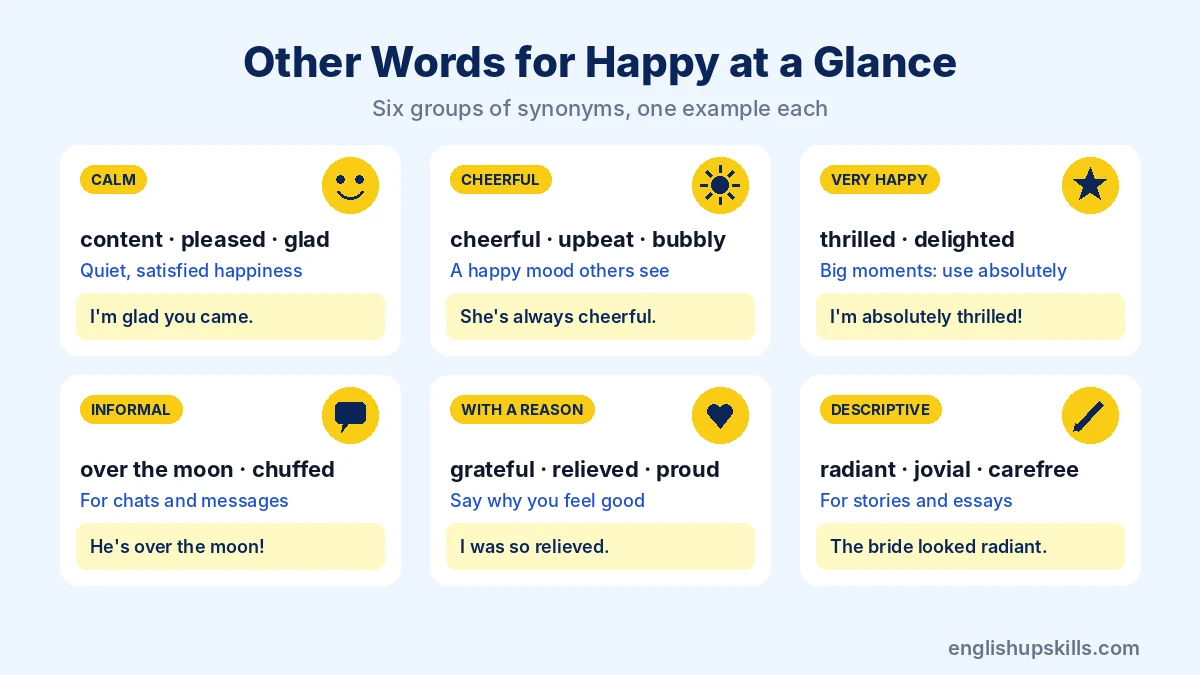
2. Cheerful, everyday happiness (10 words)
These words describe people who look or sound happy, or a happy mood that others can see.
| Word | Meaning | Example |
|---|---|---|
| cheerful | happy and friendly | The shop assistant was very cheerful. |
| upbeat | positive and hopeful | The manager gave an upbeat speech. |
| bright | lively and happy | She gave me a bright smile. |
| sunny | always happy and positive | My grandmother has a sunny personality. |
| chirpy | happy and lively (UK, informal) | You’re very chirpy this morning! |
| merry | happy, especially at celebrations | We wish you a merry Christmas. |
| jolly | happy and friendly (UK) | Our driver was a jolly man. |
| light-hearted | happy and not serious | It was a light-hearted chat about films. |
| bubbly | full of happy energy | Her bubbly laugh filled the room. |
| in a good mood | feeling happy right now | The boss is in a good mood today. |
3. Very happy: strong words for big moments (10 words)
These words are much stronger than happy. Many of them are extreme adjectives: they already mean “very happy”, so we usually do not put “very” in front of them. Instead, use absolutely or really. The British Council explains this pattern in its guide to gradable and non-gradable adjectives.
| Word | Meaning | Example |
|---|---|---|
| delighted | very pleased | I’m delighted to meet you. |
| thrilled | very happy and excited | The kids were thrilled with their gifts. |
| overjoyed | extremely happy | They were overjoyed at the news. |
| ecstatic | extremely happy and excited | The fans were absolutely ecstatic. |
| elated | very happy after a success | She felt elated after the interview. |
| euphoric | extremely happy, often for a short time | The crowd was euphoric after the goal. |
| jubilant | very happy because of a victory | Jubilant students threw their caps. |
| exhilarated | very happy and full of energy | We felt exhilarated after the ride. |
| blissful | perfectly happy and calm | We spent a blissful week by the sea. |
| joyful | full of joy | It was a joyful wedding day. |
4. Informal words and idioms for happy (10 words)
These are great in conversation, messages and stories, but avoid them in formal writing.
| Word or idiom | Meaning | Example |
|---|---|---|
| over the moon | extremely happy | He’s over the moon about his new job. |
| on cloud nine | extremely happy | She’s been on cloud nine since the wedding. |
| on top of the world | very happy and confident | After passing, I felt on top of the world. |
| walking on air | so happy you feel light | He was walking on air all week. |
| in seventh heaven | perfectly happy | With a book and tea, I’m in seventh heaven. |
| tickled pink | very pleased and amused | Mum was tickled pink by the card. |
| chuffed | pleased (UK, informal) | I’m well chuffed with my score. |
| made up | very pleased (UK, informal) | She’s made up for her sister. |
| stoked | very excited and happy (US/AUS, informal) | We’re stoked about the trip. |
| happy as Larry | very happy (UK) | Give him a football and he’s happy as Larry. |
5. Happy because of something: thanks, relief and pride (10 words)
Sometimes happiness has a clear reason. These words tell the listener exactly why you feel good.
| Word | Meaning | Example |
|---|---|---|
| grateful | happy and thankful for help | I’m grateful for your support. |
| thankful | glad that something good happened | We’re thankful nobody was hurt. |
| relieved | happy that a worry has ended | I was relieved to hear the news. |
| proud | happy about your own or someone’s success | Her parents are proud of her. |
| appreciative | showing thanks | The audience was very appreciative. |
| touched | happy and emotional because of kindness | I was touched by your letter. |
| gratified | pleased by a good result (formal) | We were gratified by the response. |
| honoured | proud and pleased to be chosen | I’m honoured to speak here today. |
| heartened | encouraged and happier | We were heartened by the support. |
| reassured | less worried and calmer | The doctor’s words reassured me. |
6. Descriptive and literary words for happy (10 words)
Use these in essays, stories and descriptions to paint a picture of a happy person or scene.
| Word | Meaning | Example |
|---|---|---|
| joyous | full of joy (formal) | It was a joyous celebration. |
| gleeful | happy in an excited, sometimes cheeky way | He gave a gleeful laugh. |
| jovial | cheerful and friendly | Our jovial host told jokes all night. |
| buoyant | happy and confident | The team was in a buoyant mood. |
| exuberant | full of energy and happiness | The exuberant children ran outside. |
| radiant | showing great happiness in the face | The bride looked radiant. |
| beaming | smiling widely with happiness | He was beaming with pride. |
| carefree | happy with no worries | We had a carefree summer. |
| high-spirited | lively and full of fun | The high-spirited class cheered. |
| contented | happy and peaceful (before a noun) | The baby gave a contented sigh. |
Note: use content after a verb (“She is content”) and contented before a noun (“a contented cat”).
Prepositions that go with happy words
Many learners know the word but choose the wrong preposition. Learn these patterns as small chunks.
| Pattern | Use it for | Example |
|---|---|---|
| happy / pleased / satisfied with + thing | something you have or received | I’m pleased with my new laptop. |
| happy / glad / pleased for + person | someone else’s good news | I’m so happy for you! |
| happy / thrilled / excited about + event | a situation or plan | We’re thrilled about the trip. |
| delighted / glad / relieved + to + verb | reacting to news | I was relieved to hear that. |
| overjoyed / delighted at + news | a piece of news (formal) | She was overjoyed at the result. |
| proud of + person or thing | success | I’m proud of my students. |
| grateful to + person / for + thing | thanks | I’m grateful to you for your help. |
Common mistakes with other words for happy
These errors appear again and again in learners’ writing and speaking. Like many commonly confused words, they are easy to fix once you see the pattern.
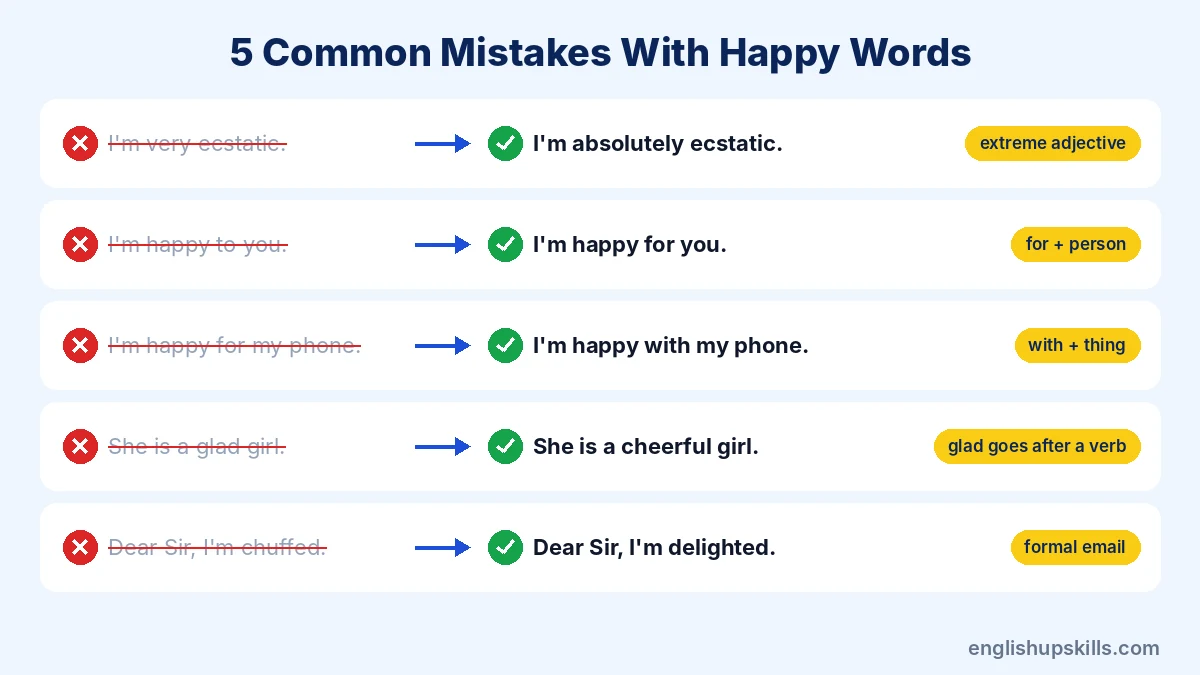
| Wrong | Correct | Why |
|---|---|---|
| I’m very ecstatic. | I’m absolutely ecstatic. | Ecstatic is an extreme adjective, so use absolutely or really, not very. |
| I’m happy to you. | I’m happy for you. | Use for with a person who has good news. |
| I’m happy for my new phone. | I’m happy with my new phone. | Use with for something you own or received. |
| She is a glad girl. | She is a cheerful girl. | Glad usually comes after a verb, not before a noun. |
| He is content to his job. | He is content with his job. | Content takes with + noun, or to + verb. |
| Dear Sir, I’m chuffed to apply. | Dear Sir, I’m delighted to apply. | Chuffed is informal; use delighted or pleased in formal writing. |
| We were relieved for the result. | We were relieved about the result. | Use relieved about + noun, or relieved to + verb. |
| I am very happy and very happy. | I am thrilled and grateful. | Repeating happy is weak; choose words that show strength and reason. |
Practice exercise: choose the best word
Choose the best word from the box for each sentence. Use each word once.
Word box: relieved, thrilled, content, grateful, over the moon, cheerful, proud, delighted
- Thank you so much for your help. I’m really ______.
- Dear Ms Khan, I am ______ to accept the position.
- The test was easier than I feared. I was so ______.
- Our neighbour is always ______ and says hello to everyone.
- He doesn’t want a big house. He’s ______ with a small flat.
- Mate, I passed my driving test. I’m ______!
- Her parents were very ______ of her exam results.
- The children were ______ when they saw the snow.
Answers: 1. grateful 2. delighted 3. relieved 4. cheerful 5. content 6. over the moon 7. proud 8. thrilled
FAQs about other words for happy
What is another word for very happy?
Good choices are delighted, thrilled, overjoyed and ecstatic. In informal speech you can say over the moon or on cloud nine. Remember to say “absolutely ecstatic”, not “very ecstatic”.
What is a formal word for happy?
Pleased and delighted are the safest formal words. For example: “We are pleased to inform you” or “I am delighted to accept.” Gratified and joyous are also formal but less common.
What is the difference between glad and happy?
Glad usually describes how you feel about a particular situation: “I’m glad you called.” Happy can describe a situation or a general state: “She is a happy person.” We rarely put glad before a noun.
Is chuffed British English?
Yes. Chuffed means very pleased and is common in informal British English, often as “well chuffed”. Americans are more likely to say stoked or psyched in the same situation.
Which happy words are good for IELTS Speaking?
Examiners reward precise, natural vocabulary. Try thrilled, relieved, content and idioms like over the moon when you describe past experiences. Combine them with our IELTS speaking phrases to sound fluent.
Can I use joyful and joyous in the same way?
They are very close. Joyful describes a person or event full of joy and is more common. Joyous is more formal and literary, and usually describes events: “a joyous occasion”.
Conclusion
Happy is a good word, but it is not the only one. Choose content or pleased for quiet happiness, cheerful for a friendly mood, thrilled or overjoyed for big moments, relieved or grateful when there is a clear reason, and idioms like over the moon when you are chatting with friends. Pick five new words from this list, use them in real sentences this week, and you will soon hear the difference. For more daily practice, read our guide on how to improve your spoken English.