
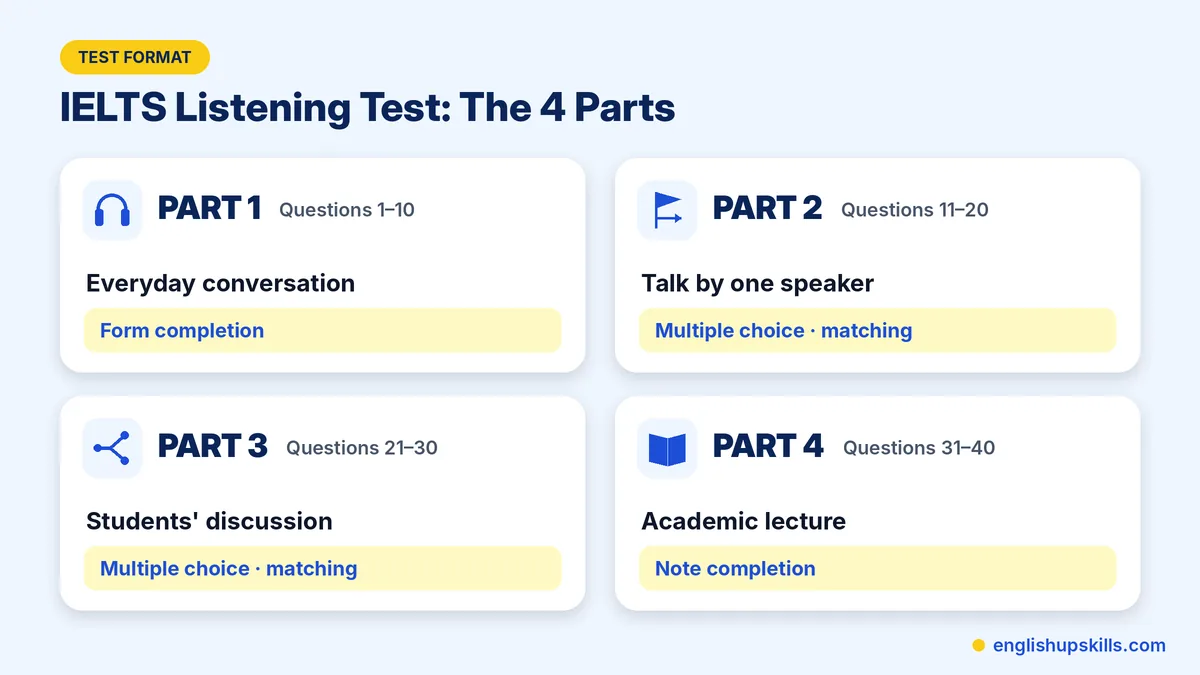
This free IELTS listening practice test follows the format of the real exam: four parts, 40 questions and about 17 minutes of audio, recorded with clear British voices. Play each part once, answer the questions as you listen, then check your score with the answer key and read the full transcript to see where you went wrong.
The test is original practice material written for EnglishUpSkills. It is not an official IELTS test, but the four-part structure, question types and level are designed to match what you will meet on test day. For the official format, see the British Council IELTS test format page.
Quick facts about this test:
- 4 parts, 40 questions – one mark per question
- About 17 minutes of audio, with time to read the questions before each section
- Question types: form completion, multiple choice, matching and note completion
- Answer key, band score guide and full transcript at the end of the page
How to Take This Practice Test
- Find a quiet place and use headphones if you can.
- Get a pen and paper, or write your answers in a notes app, numbered 1 to 40.
- Play each recording only once and do not pause it – in the real exam you hear the audio one time only.
- Use the pauses in the recording to read the next questions and underline key words.
- Check your spelling: in IELTS, a misspelt answer is marked wrong.
- When you finish all four parts, open the answer key and count your score.
Part 1: Questions 1–10
Complete the form below. Write ONE WORD AND/OR A NUMBER for each answer.
Riverside Community Centre – Course Enrolment Form
| Detail | Information |
|---|---|
| Course | Example: Beginners’ pottery |
| Name | Daniel (1) ____________ |
| Address | 42 (2) ____________ Road |
| Phone number | (3) ____________ |
| Day of class | (4) ____________ |
| Start time | (5) ____________ pm |
| Length of course | (6) ____________ weeks |
| Cost for local residents | £ (7) ____________ |
| Students must bring | an (8) ____________ |
| Heard about the course from | the local (9) ____________ |
| Parking | car park behind the (10) ____________ |
Part 2: Questions 11–20
Questions 11–15
Choose the correct letter, A, B or C.
- 11. Before it became a nature reserve, the site was
A. a farm
B. a quarry
C. a golf course - 12. Today, the volunteers will mainly
A. plant trees
B. repair fences
C. clear paths - 13. Lunch today will be
A. provided by the reserve
B. bought at the café
C. brought by the volunteers - 14. All volunteers must wear
A. gloves
B. boots
C. hats - 15. The most important species on the reserve is a type of
A. butterfly
B. owl
C. frog
Questions 16–20
Where on the reserve is each of the following? Choose FIVE answers from the box and write the correct letter, A–E, next to questions 16–20.
| Letter | Area of the reserve |
|---|---|
| A | North Meadow |
| B | Lake Trail |
| C | Woodland |
| D | Visitor Centre |
| E | Old Quarry Face |
- 16. picnic tables ______
- 17. bird hide ______
- 18. tool shed ______
- 19. first aid point ______
- 20. pond-dipping platform ______
Part 3: Questions 21–30
Questions 21–25
Choose the correct letter, A, B or C.
- 21. Why did Maya and Tom choose green roofs as their topic?
A. Their tutor suggested it.
B. Maya became interested during a trip.
C. There was a lot of research available. - 22. What was the main problem with their first survey?
A. Too few people answered it.
B. The questions were not clear.
C. They asked the wrong group of people. - 23. They agree that the most convincing benefit of green roofs is
A. lower energy bills.
B. reduced flooding.
C. more wildlife. - 24. What does Tom think about the Chicago case study?
A. It is out of date.
B. It is too technical.
C. It is not relevant to their town. - 25. For their presentation, they decide to
A. make a short video.
B. build a model.
C. use only photographs.
Questions 26–30
Who will do each task? Write the correct letter, A, B or C, next to questions 26–30. A = Maya, B = Tom, C = both Maya and Tom
- 26. contact the city council ______
- 27. redesign the questionnaire ______
- 28. analyse the cost data ______
- 29. write the introduction ______
- 30. make the presentation slides ______
Part 4: Questions 31–40
Complete the notes below. Write ONE WORD ONLY for each answer.
Lecture notes: Sleep and Memory
- During deep sleep, the brain replays information learned during the (31) ____________.
- The hippocampus works like a temporary (32) ____________: it records new information quickly but has little space.
- Important information is moved to the (33) ____________ for long-term storage.
- Study: one group learned words in the morning and was tested in the (34) ____________ without sleep; the group that slept remembered about 40% more.
- REM sleep is especially important for (35) ____________ and solving puzzles.
- In teenagers, the brain produces the hormone (36) ____________ later at night.
- Short sleep is linked to poorer (37) ____________ in class.
- Naps: about 20 minutes is ideal; longer naps can cause a feeling of (38) ____________.
- Screens give off (39) ____________ light, which delays sleep.
- Main recommendation: keep a regular (40) ____________.
Answer Key
Finished all four parts? Open the answer key below and give yourself one mark for each correct answer.
Show the answer key (Questions 1–40)
| Q | Answer | Q | Answer | Q | Answer | Q | Answer |
|---|---|---|---|---|---|---|---|
| 1 | Hartley | 11 | B | 21 | B | 31 | day |
| 2 | Elmfield | 12 | C | 22 | B | 32 | notebook |
| 3 | 07841 365902 | 13 | A | 23 | B | 33 | cortex |
| 4 | Thursday | 14 | B | 24 | A | 34 | evening |
| 5 | 6.30 / 6:30 | 15 | A | 25 | B | 35 | creativity |
| 6 | 8 / eight | 16 | A | 26 | A | 36 | melatonin |
| 7 | 95 | 17 | B | 27 | B | 37 | concentration |
| 8 | apron | 18 | E | 28 | C | 38 | confusion |
| 9 | newspaper | 19 | D | 29 | A | 39 | blue |
| 10 | library | 20 | C | 30 | B | 40 | schedule |
Why the Tricky Answers Are Correct
- Q4 – Thursday: the speaker mentions Tuesday first, but that class is full. IELTS often gives a wrong option first, then corrects it.
- Q5 – 6.30: the class “used to start at seven”, but this term it starts at six thirty. Listen for words like used to, but and actually.
- Q7 – 95: £110 is the full price; Daniel pays £95 because he lives locally.
- Q11 – B: people assume it was farmland, “but in fact” it was a quarry.
- Q20 – C: you might expect the platform at the lake, but it is at the pond in the Woodland.
- Q24 – A: Tom says the study is “not too technical” – the problem is that it is from 2003.
- Q28 – C: Tom suggests they analyse the cost data together, and Maya agrees.
Your Approximate Band Score
IELTS converts your raw score out of 40 into a band score. The table below shows the approximate conversion often used for the Listening test. Treat it as a guide only, because this is a practice test.
| Correct answers (out of 40) | Approximate band |
|---|---|
| 39–40 | 9 |
| 37–38 | 8.5 |
| 35–36 | 8 |
| 32–34 | 7.5 |
| 30–31 | 7 |
| 26–29 | 6.5 |
| 23–25 | 6 |
| 18–22 | 5.5 |
| 16–17 | 5 |
| 13–15 | 4.5 |
| 10–12 | 4 |
Full Transcript
Read the transcript after you have checked your answers. Find each answer in the text and notice the words around it – this is one of the fastest ways to improve your listening.
Show the Part 1 transcript
Sarah: Good morning, Riverside Community Centre. Sarah speaking. How can I help you?
Daniel: Oh, hello. I saw that you’re running some evening courses this term, and I’d like to sign up for the beginners’ pottery course, if there are still places.
Sarah: Let me have a look. Yes, we’ve still got a few places on the beginners’ pottery. I can take your details now, if you like.
Daniel: Great, thanks.
Sarah: So, could I have your name, please?
Daniel: It’s Daniel. Daniel Hartley.
Sarah: Could you spell your surname for me?
Daniel: Sure. It’s H, A, R, T, L, E, Y.
Sarah: Thank you. And your address?
Daniel: It’s forty-two Elmfield Road. That’s E, L, M, and then field, as in a field of grass.
Sarah: Forty-two Elmfield Road. Lovely. And what’s the best number to contact you on?
Daniel: My mobile is probably best. It’s oh-seven-eight-four-one, three-six-five, nine-oh-two.
Sarah: Let me read that back. Oh-seven-eight-four-one, three-six-five, nine-oh-two.
Daniel: That’s right.
Sarah: Now, we run the beginners’ class on two evenings. The Tuesday group is actually full now, I’m afraid, but there are spaces on Thursday.
Daniel: Thursday is fine. Tuesdays would have been difficult for me anyway.
Sarah: Good. The class used to start at seven, but this term it starts a little earlier, at six thirty, and it finishes at half past eight.
Daniel: Six thirty. OK, I can get there for that if I leave work on time.
Sarah: And the course runs for eight weeks in total. Some of our other courses are ten weeks, but pottery is eight.
Daniel: And how much does it cost?
Sarah: The full price is one hundred and ten pounds. But do you live in the Riverside area?
Daniel: Yes, I do.
Sarah: Then you get the local residents’ discount, so it’s ninety-five pounds for you.
Daniel: Oh, that’s good. Does that include the clay and everything?
Sarah: Yes, all the clay and tools are included, and we fire your pieces in our own kiln. The only thing you need to bring is an apron, because it can get quite messy. You don’t need special shoes or anything like that.
Daniel: An apron. I’ll remember that.
Sarah: Just one more question for our records. How did you hear about the course? Was it from our website?
Daniel: No, actually, I saw an advert in the local newspaper last week.
Sarah: The newspaper. That’s useful to know, thanks. And is there anything else you’d like to ask?
Daniel: Yes, is there anywhere to park? I’ll be driving straight from work.
Sarah: The car park at the front of the building is usually full in the evenings, so it’s best to use the car park behind the library. It’s free after six o’clock, and it’s only a two-minute walk.
Daniel: Behind the library. Perfect. Thanks very much for your help.
Sarah: You’re welcome, Daniel. See you on Thursday.
Show the Part 2 transcript
Mark: Good morning, everyone, and welcome to Hillside Nature Reserve. My name is Mark, and I’m one of the rangers here. Thank you all for giving up your Saturday to help us.
Mark: Before we start, let me tell you a little about the reserve. A lot of visitors assume that this land was always farmland, and it’s true that there were farms nearby. But in fact, the site itself was a stone quarry until nineteen eighty-five. When the quarry closed, the local council bought the land, and over the next few years it was slowly turned into the reserve you see today.
Mark: Now, about today’s work. Some of you may have heard that we’ll be planting trees, but that’s actually planned for next month, when the weather is wetter. And the broken fences along the main road are being repaired by contractors next week. So today, your main job will be clearing the paths. After the storms, many of them are blocked with branches and fallen leaves, and visitors can’t get through.
Mark: As for lunch, normally I’d send you to the café, but it’s closed this week for renovation. So the reserve will be providing sandwiches and drinks for everyone at one o’clock. You don’t need to bring anything.
Mark: On safety: we’ll give each of you a pair of gloves, so don’t worry if you didn’t bring any. Hats are a good idea if it gets sunny, but they’re up to you. What you must wear, though, is proper boots. The ground is very uneven, and we can’t let anyone work in trainers.
Mark: Finally, wildlife. Many people come here to see our barn owls, and they are beautiful. But from a conservation point of view, the most important species we have is a small blue butterfly. It’s very rare in this part of the country, and the reserve is one of only a few places where it still breeds.
Mark: Right, let me explain where things are on the reserve, so you know where to go during the day.
Mark: If you want to eat your lunch outside, the picnic tables are in the North Meadow. It’s a lovely open space, and on a clear day you can see the hills from there.
Mark: For anyone interested in birds, the bird hide is on the Lake Trail. It’s a small wooden building where you can sit quietly and watch the ducks and herons without disturbing them.
Mark: Now, the tool shed. All the rakes and saws you’ll need today are kept in the shed at the bottom of the Old Quarry Face, so that’s where we’ll meet first, in about ten minutes.
Mark: If anyone has an accident, however small, please go straight to the first aid point. It’s inside the Visitor Centre, next to the reception desk.
Mark: And one more thing. School groups love our pond-dipping platform, where children catch little water creatures in nets. You might expect to find that at the lake, but in fact the lake is too deep, so the platform is at the small pond in the Woodland.
Mark: OK. If there are no questions, let’s head down to the tool shed.
Show the Part 3 transcript
Tom: So, Maya, our tutor wants a progress update on Friday. Shall we go through where we are with the green roofs project?
Maya: Good idea. I still think we made the right choice of topic, by the way. Dr Evans suggested we look at electric buses, remember, and there’s a lot more research on that.
Tom: True, but you were so enthusiastic after your trip.
Maya: I was. When I saw those green roofs in Copenhagen last summer, whole buildings covered in grass and flowers, I just knew I wanted to find out more. That’s really why we picked it.
Tom: OK. So, the first survey. Only forty people answered it, which isn’t many.
Maya: No, but forty is actually enough for a small project. The real problem was the questions themselves. Half the people didn’t understand what we meant by a living roof, so their answers didn’t make sense.
Tom: You’re right. The questions just weren’t clear enough. We asked the right group of people, though, local residents.
Maya: Yes, that part was fine.
Tom: Now, the benefits. I know a lot of articles focus on lower energy bills, because the roofs keep buildings warm in winter.
Maya: They do, but the savings are quite small for most homes. And the wildlife argument is nice, but it’s hard to measure. I think the strongest evidence is about flooding. The plants soak up rainwater, so less water runs into the drains during storms.
Tom: I agree. The flooding data is the most convincing, especially with the floods we had in town last year.
Maya: What about the Chicago case study? I thought it was really detailed.
Tom: It is detailed, and it’s not too technical, but it’s from two thousand and three. So many things have changed since then, especially the materials. I think it’s just too old to rely on.
Maya: Fair enough. We could mention it briefly, but find something more recent.
Tom: And the presentation. Should we make a short video?
Maya: Videos take ages to edit. And photos on their own might be a bit dull. What if we build a small model of a roof, with real soil and plants, and show how it holds water?
Tom: That would be much more memorable. Let’s do the model.
Tom: OK, let’s divide up the remaining tasks. Someone needs to contact the city council to ask how many green roofs there are in town.
Maya: I’ll do that. I’ve already spoken to someone in their planning office, so I can email her.
Tom: Great. Then the questionnaire needs redesigning, with clearer questions this time.
Maya: Could you take that one? You’re better at writing simple questions than I am.
Tom: Sure, I’ll redesign it this week.
Maya: What about the cost data? There’s a huge spreadsheet from the building company.
Tom: That’s a big job. I think we should analyse it together, maybe on Wednesday afternoon in the library.
Maya: Agreed. And the written report, I’m happy to write the introduction, since I’ve done most of the background reading.
Tom: Perfect. Then I’ll make the slides for the presentation. I’ve got a template we can use.
Maya: Great. I think we’re in good shape for Friday.
Show the Part 4 transcript
Lecturer: Good afternoon, everyone. Today I’m going to talk about the link between sleep and memory, and why it matters so much for students like you.
Lecturer: For a long time, people thought of sleep as a time when the brain simply switched off. We now know that this is far from true. During deep sleep, the brain is actually very active. It replays the information we learned during the day, almost like watching a recording again, and this repetition makes the memory stronger.
Lecturer: A key part of this process takes place in an area of the brain called the hippocampus. You can think of the hippocampus as a kind of temporary notebook. It records new information quickly, but it doesn’t have much space. So, while we sleep, important information is gradually moved from the hippocampus to the cortex, the outer layer of the brain, where it can be stored for the long term.
Lecturer: Let me give you an example from research. In one well-known study, two groups of students learned a list of new words at nine in the morning. The first group was tested in the evening of the same day, without any sleep in between. The second group learned the words at nine in the evening and was tested the next morning, after a full night’s sleep. The students who had slept remembered around forty percent more words.
Lecturer: So far, I’ve talked about deep sleep. But the other main type, REM sleep, which is when we have most of our dreams, also plays a role. REM sleep seems to be especially important for creativity. In several experiments, people who had a period of REM sleep were much better at solving puzzles that needed new, unusual connections between ideas.
Lecturer: Now, this is where teenagers and young adults have a particular problem. During adolescence, the body clock shifts later. The brain starts producing the hormone melatonin, which makes us feel sleepy, later at night than it does in children or older adults. So a teenager who can’t fall asleep until midnight isn’t necessarily being lazy. Their biology is simply different.
Lecturer: Unfortunately, school and university timetables usually start early, so many students don’t get enough sleep. And short sleep is clearly linked to poorer concentration in class. Students who regularly sleep less than seven hours find it much harder to focus on long lectures or difficult texts.
Lecturer: What about naps? A short nap can be very helpful. Research suggests that around twenty minutes is ideal. If you sleep much longer than that, you may wake up from deep sleep, and this often causes a feeling of confusion that can last for half an hour or more.
Lecturer: Another major problem is screens. Phones, tablets and laptops give off blue light, and this type of light tells the brain that it’s still daytime. As a result, using screens late at night can delay sleep significantly.
Lecturer: So, what’s my main recommendation? It isn’t to sleep for ten hours a night. The most important thing is to keep a regular schedule, going to bed and getting up at roughly the same time every day, even at weekends. If you do that, your memory, and your exam results, will thank you.
7 Tips to Improve Your IELTS Listening Score
- Read ahead. Use every pause to read the next questions and predict the type of answer: a number, a name, a place or a noun.
- Listen for corrections. Speakers often change their minds. Words like actually, but, in fact and used to usually signal the real answer.
- Watch the word limit. If the instructions say ONE WORD ONLY, an answer of two words is wrong, even if the meaning is right.
- Practise spelling. Names, streets and common nouns are often spelt out in Part 1. Practise the English alphabet aloud until you can write letters quickly.
- Know your numbers. Practise phone numbers, prices and times, and the difference between pairs such as 15 and 50.
- Learn synonyms. The questions rarely use the same words as the audio. For example, the question says “out of date”, but the speaker says “too old to rely on”. Our guide to commonly confused words helps here.
- Listen every day. Podcasts, the news and the BBC are great practice. If you are also preparing for the speaking test, see our IELTS speaking phrases.
Frequently Asked Questions
How long is the IELTS Listening test?
The real recording lasts about 30 minutes. In the paper-based test you then get 10 minutes to transfer your answers to the answer sheet; in the computer-delivered test you get 2 minutes to check your answers.
Can I hear the recording twice in IELTS?
No. You hear each part only once, so practise the same way: play each part of this test once without pausing.
Do spelling and grammar matter in IELTS Listening?
Yes. A misspelt answer is marked wrong, and so is an answer that breaks the word limit. Both British and American spellings are accepted.
Is this practice test the same as the real IELTS test?
It follows the same four-part format, question types and level, but it is shorter than the real test and it is original practice material written by EnglishUpSkills, not an official IELTS test.
Conclusion
Regular practice with full-length tests is the best way to raise your IELTS listening score. Take this test once under exam conditions, check your answers, then study the transcript and listen again while you read. Note the types of questions you got wrong and focus on them next time. More IELTS listening practice tests are coming soon in our IELTS Preparation section.