
Looking for other words for very? You are not alone. “Very” is one of the most used words in English, and that is exactly the problem. When you say “very good”, “very bad” or “very tired” again and again, your English sounds flat. Examiners notice it, readers notice it, and so do the people you speak to every day.
The fix is simple: replace “very + adjective” with one stronger word. Instead of “very tired”, say exhausted. Instead of “very big”, say enormous. In this guide you will learn 60 stronger words to use instead of very, grouped by meaning, with a short definition and an example for each.
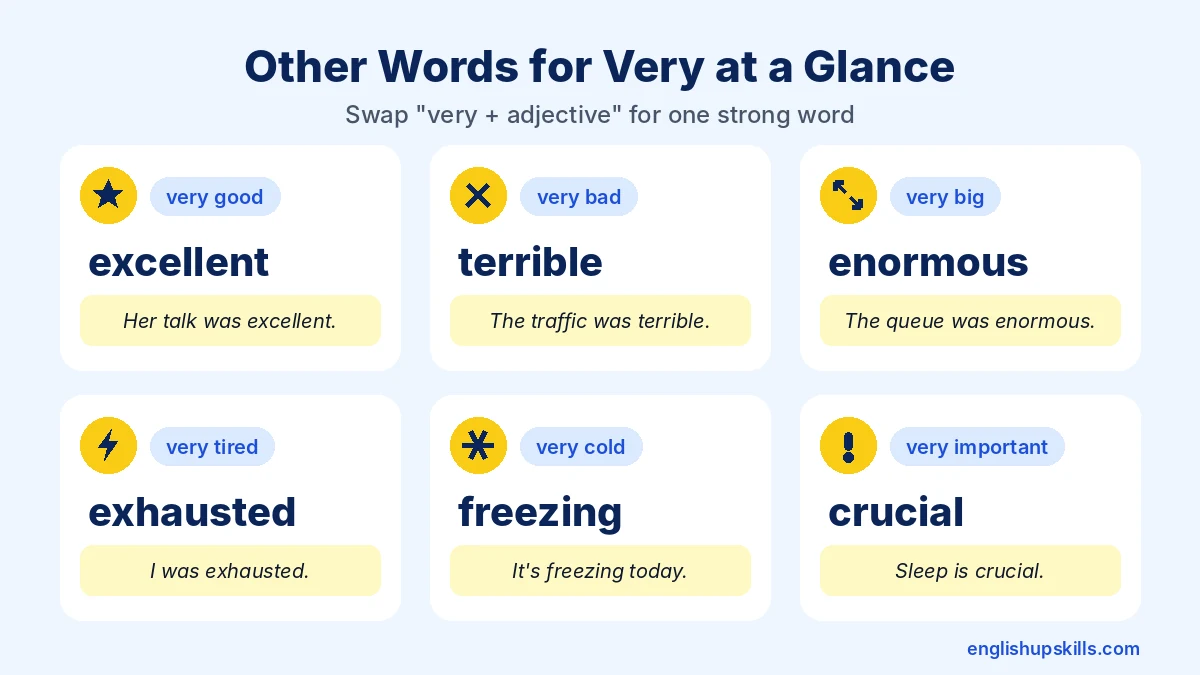
Quick answer — the 10 most useful words to use instead of very:
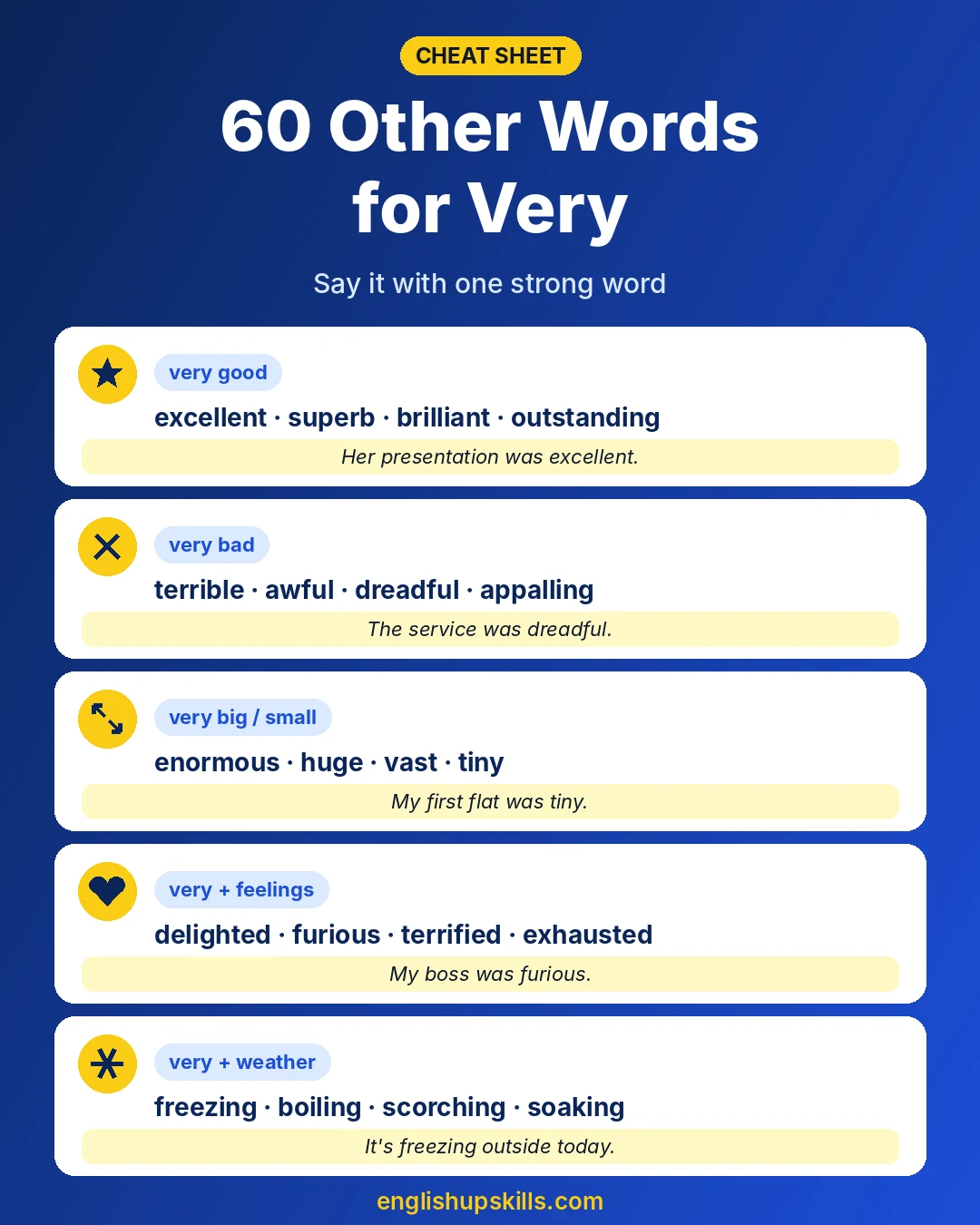
- very good → excellent
- very bad → terrible
- very big → enormous
- very small → tiny
- very tired → exhausted
- very happy → delighted
- very angry → furious
- very cold → freezing
- very important → crucial
- very interesting → fascinating
Why you should replace “very”
“Very” is not wrong. It is a normal, correct word, and you can still use it. The problem is overuse. A single strong word does three things that “very + adjective” cannot:
- It is shorter, so your sentence reads more smoothly.
- It is more precise. “Furious” tells the reader exactly how angry someone is.
- It shows a wider vocabulary, which matters in IELTS Speaking and Writing, job interviews and school essays.
Compare these two sentences:
- The film was very good and the ending was very sad.
- The film was outstanding and the ending was heartbreaking.
The second sentence is the same length but paints a much clearer picture.
How to use stronger words: the “very” rule
Before you look at the lists, learn one grammar rule. It will stop you making the most common mistake.
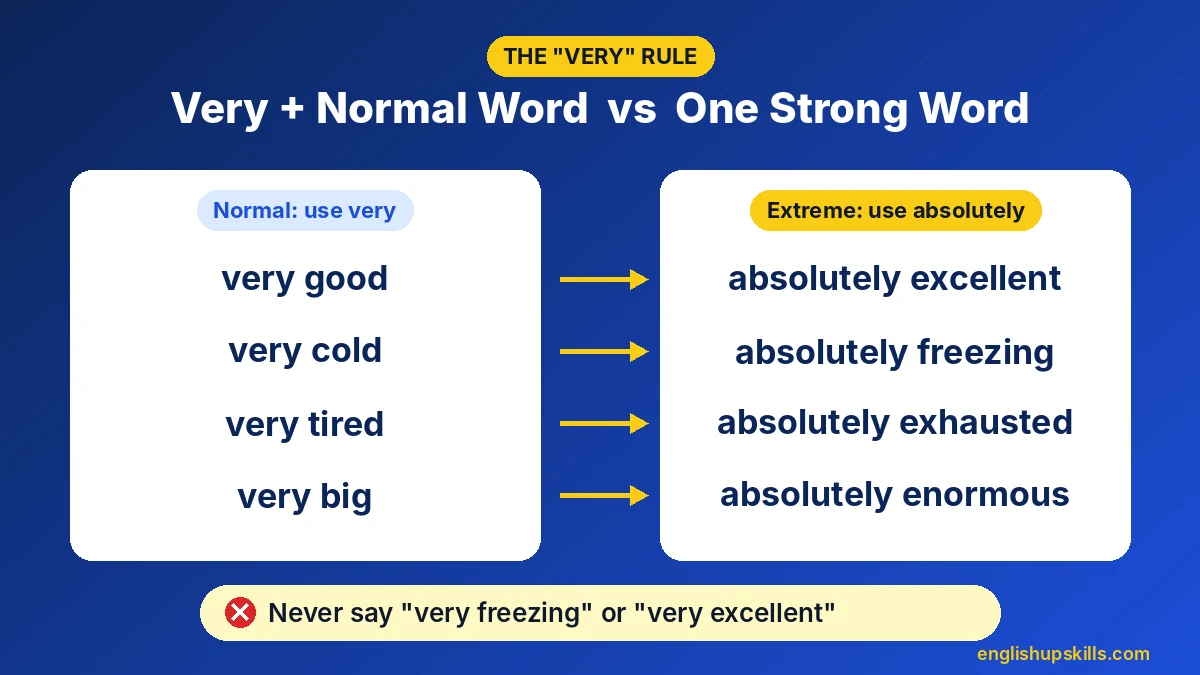
English adjectives come in two kinds:
| Type | What it means | Examples | Use with |
|---|---|---|---|
| Gradable (normal) | Can be more or less | good, cold, tired, big | very, really, extremely, quite |
| Extreme (non-gradable) | Already means “very” | excellent, freezing, exhausted, enormous | absolutely, really, completely |
So you can say “very cold” or “absolutely freezing”, but not “very freezing”. The extreme word already contains the meaning of “very”. The British Council explains this clearly in its guide to gradable and non-gradable adjectives.
Other words for very good
| Word | Meaning | Example |
|---|---|---|
| excellent | very good, of high quality | Her presentation was excellent. |
| outstanding | much better than others | He is an outstanding student. |
| superb | extremely good | The view from the hotel was superb. |
| brilliant | very good, clever (UK, informal) | That’s a brilliant idea! |
| exceptional | unusually good | She has exceptional writing skills. |
| wonderful | very good, very pleasant | We had a wonderful holiday. |
| fantastic | very good (informal) | The food was fantastic. |
| terrific | very good (informal) | You did a terrific job. |
| first-rate | of the best quality | The hospital has first-rate doctors. |
| marvellous | very good (UK spelling) | What a marvellous performance. |
Other words for very bad
| Word | Meaning | Example |
|---|---|---|
| terrible | very bad or unpleasant | The traffic was terrible this morning. |
| awful | very bad | I’ve got an awful headache. |
| dreadful | very bad, of poor quality | The service was dreadful. |
| horrible | very unpleasant | What a horrible smell! |
| appalling | shockingly bad | The living conditions were appalling. |
| atrocious | extremely bad | His handwriting is atrocious. |
| abysmal | extremely bad (results, quality) | The team’s results were abysmal. |
| dire | very serious or bad | The company is in dire trouble. |
| shocking | very bad and surprising | The prices here are shocking. |
| rotten | very bad (informal) | I had a rotten day at work. |
Other words for very big and very small
| Word | Meaning | Example |
|---|---|---|
| huge | very big | They live in a huge house. |
| enormous | very big | The elephant was enormous. |
| massive | very big and heavy | There was a massive queue outside. |
| gigantic | extremely big | A gigantic wave hit the boat. |
| vast | very big in area | Russia is a vast country. |
| immense | very great in size or amount | The project needs immense effort. |
| tiny | very small | My first flat was tiny. |
| minute (my-NYOOT) | extremely small | There was a minute mistake in the report. |
| minuscule | extremely small | The risk is minuscule. |
| microscopic | so small it is hard to see | The writing on the label was microscopic. |
Other words for very + feelings
| Word | Instead of | Example |
|---|---|---|
| delighted | very pleased | I’m delighted to meet you. |
| thrilled | very excited | The kids were thrilled with their presents. |
| heartbroken | very sad | She was heartbroken when her dog died. |
| devastated | very upset or shocked | He was devastated by the news. |
| furious | very angry | My boss was furious about the delay. |
| terrified | very scared | I’m terrified of spiders. |
| exhausted | very tired | After the marathon, I was exhausted. |
| astonished | very surprised | We were astonished by her talent. |
| starving | very hungry (informal) | I’m starving — let’s eat. |
| distraught | very worried and upset | The parents were distraught when their son went missing. |
For even more feeling words, see our list of other words for happy.
Other words for very + weather and senses
| Word | Instead of | Example |
|---|---|---|
| freezing | very cold | It’s freezing outside today. |
| boiling | very hot (informal) | This room is boiling. |
| scorching | very hot (weather) | It was a scorching summer afternoon. |
| soaking | very wet | I got soaking wet in the rain. |
| filthy | very dirty | Your shoes are filthy. |
| spotless | very clean | The kitchen was spotless. |
| deafening | very loud | The music was deafening. |
| delicious | very tasty | This soup is delicious. |
| gorgeous | very beautiful | What a gorgeous dress. |
| hideous | very ugly | That wallpaper is hideous. |
Other words for very + work, study and everyday life
| Word | Instead of | Example |
|---|---|---|
| crucial | very important | Sleep is crucial before an exam. |
| fascinating | very interesting | It was a fascinating documentary. |
| tedious | very boring | Filling in forms is tedious. |
| hilarious | very funny | His speech was hilarious. |
| effortless | very easy | She makes cooking look effortless. |
| gruelling | very difficult and tiring | It was a gruelling ten-hour shift. |
| rapid | very fast | The city has seen rapid growth. |
| packed | very crowded | The train was packed this morning. |
| ancient | very old | They visited an ancient temple. |
| priceless | very valuable | Her advice was priceless. |
Strong adverbs you can use instead of very
Sometimes no single adjective fits. In that case, swap “very” for a stronger adverb. Each one has its own natural partners.
| Adverb | Natural partners | Example |
|---|---|---|
| extremely | most gradable adjectives | The test was extremely difficult. |
| incredibly | positive or surprising qualities | She is incredibly talented. |
| highly | recommended, skilled, unlikely | This book is highly recommended. |
| deeply | grateful, sorry, moved | I’m deeply grateful for your help. |
| absolutely | extreme adjectives only | The view was absolutely stunning. |
| remarkably | unexpected qualities | The exam was remarkably easy. |
Using stronger words when you speak
In conversation, strong words make you sound more natural and more interested. Notice how these short replies sound livelier than a plain “very”:
- A: How was the concert? B: Incredible! The band was superb.
- A: Are you ready for dinner? B: Yes, I’m starving.
- A: Did you enjoy the course? B: It was fascinating, but the homework was tedious.
- A: How’s the weather in London? B: It’s freezing and I’m soaking wet.
- A: Did you hear the news? B: Yes, I was astonished.
Say these lines out loud a few times. Speaking practice helps new words move from your notebook into your everyday English.
Formal or informal? Choosing the right word
Not every strong word fits every situation. Some, like brilliant, starving and boiling, are friendly and informal. Others, like exceptional, crucial and appalling, sound more formal. Use this table to pick the right one.
| Instead of | Informal (chat, messages) | Neutral (everyday) | Formal (essays, emails) |
|---|---|---|---|
| very good | brilliant, fantastic | excellent, wonderful | exceptional, outstanding |
| very bad | rotten, awful | terrible, horrible | appalling, dire |
| very big | massive | huge, enormous | vast, immense |
| very tired | knackered (UK) | exhausted | fatigued |
| very hungry | starving | ravenous | famished |
| very important | a big deal | crucial | essential, vital |
A simple tip: if you are writing to a teacher, a manager or an examiner, choose from the neutral or formal columns. With friends, the informal words sound warm and natural.
Before and after: a short paragraph
Here is how much difference a few word swaps make. Read the “before” version first.
Before: Yesterday was a very bad day. The bus was very crowded, the office was very cold and my boss was very angry about a very small mistake. By the evening I was very tired.
After: Yesterday was a dreadful day. The bus was packed, the office was freezing and my boss was furious about a tiny mistake. By the evening I was exhausted.
The “after” paragraph uses fewer words, yet it is far more vivid. Try this with your own writing: underline every “very”, then ask whether one stronger word can replace it. You will not need to change every one, but replacing half of them is usually enough to transform the text.
Common mistakes with words instead of very
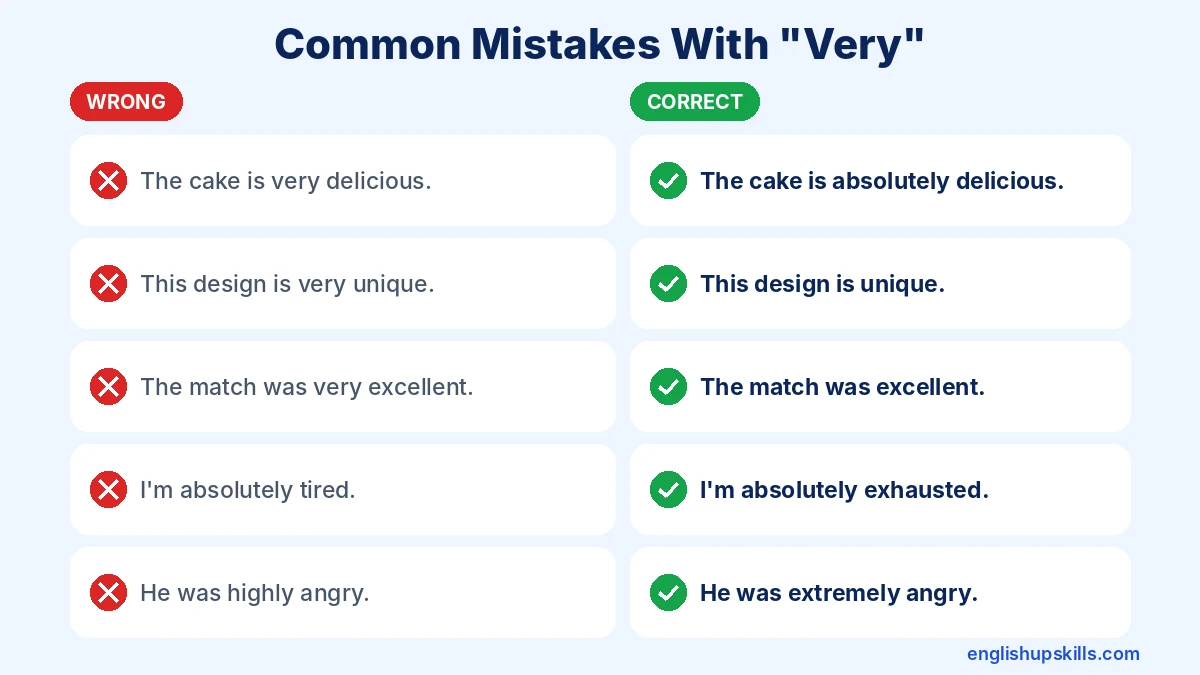
| Wrong | Correct | Why |
|---|---|---|
| The cake is very delicious. | The cake is absolutely delicious. | “Delicious” is extreme, so it can’t take “very”. |
| This design is very unique. | This design is unique. | “Unique” means one of a kind; it cannot be graded. |
| The match was very excellent. | The match was excellent. | “Excellent” already means very good. |
| I’m absolutely tired. | I’m absolutely exhausted. | “Absolutely” goes with extreme words, not normal ones. |
| He was highly angry. | He was extremely angry. | “Highly” doesn’t collocate with “angry”. |
| It’s very very big. | It’s enormous. | Repeating “very” sounds childish in writing. |
These small errors are common in exams. If you want more practice spotting them, read our sentence correction rules.
Practice exercise
Replace “very + adjective” with one word from the box.
Word box: exhausted, freezing, enormous, furious, hilarious, crucial, spotless, terrified
- After the night shift, Ali was very tired.
- Put on a coat — it’s very cold outside.
- The joke was very funny, and everyone laughed.
- My mother was very angry when I broke the vase.
- Grammar practice is very important for the exam.
- The cleaner left the bathroom very clean.
- Sara is very scared of flying.
- They bought a very big TV for the living room.
Answers:
- exhausted
- freezing
- hilarious
- furious
- crucial
- spotless
- terrified
- enormous
FAQs about other words for very
Is it wrong to use “very” in English?
No. “Very” is correct and natural. The problem is using it too often. Mix it with stronger single words to make your English more varied.
What can I say instead of “very good”?
Try excellent, outstanding, superb, brilliant or wonderful. “Excellent” works in formal writing; “brilliant” and “fantastic” are friendly and informal.
Can I say “very excellent” or “very delicious”?
No. Words such as excellent, delicious and freezing already mean “very”. Use “absolutely” or “really” with them instead, for example “absolutely delicious”.
What is a formal word for “very”?
In formal writing, use extremely, highly, exceptionally or remarkably. For example, “The results were exceptionally strong.”
Does using fewer “very”s help in IELTS?
Yes. IELTS examiners reward a wide and precise vocabulary. Saying “exhausted” instead of “very tired” shows lexical range, which can lift your Speaking and Writing scores. See our IELTS speaking phrases for more.
How do I remember these words?
Learn them in pairs (“very tired = exhausted”), use three new ones in conversation each day, and write them in a notebook with your own example sentences.
Conclusion
Replacing “very” is one of the quickest ways to make your English sound more natural and confident. Start with the top 10 words, remember the rule about extreme adjectives, and add a few new words every week. Next, build your range further with our guide to other words for said and our tips on how to improve spoken English.