
Looking for other words for said? You are in the right place. “Said” is the most common reporting verb in English, and it is never wrong. But when you use it in every line of a story, an essay or an email, your writing starts to sound flat. The right synonym tells the reader how someone spoke: loudly, quietly, happily, angrily or formally.
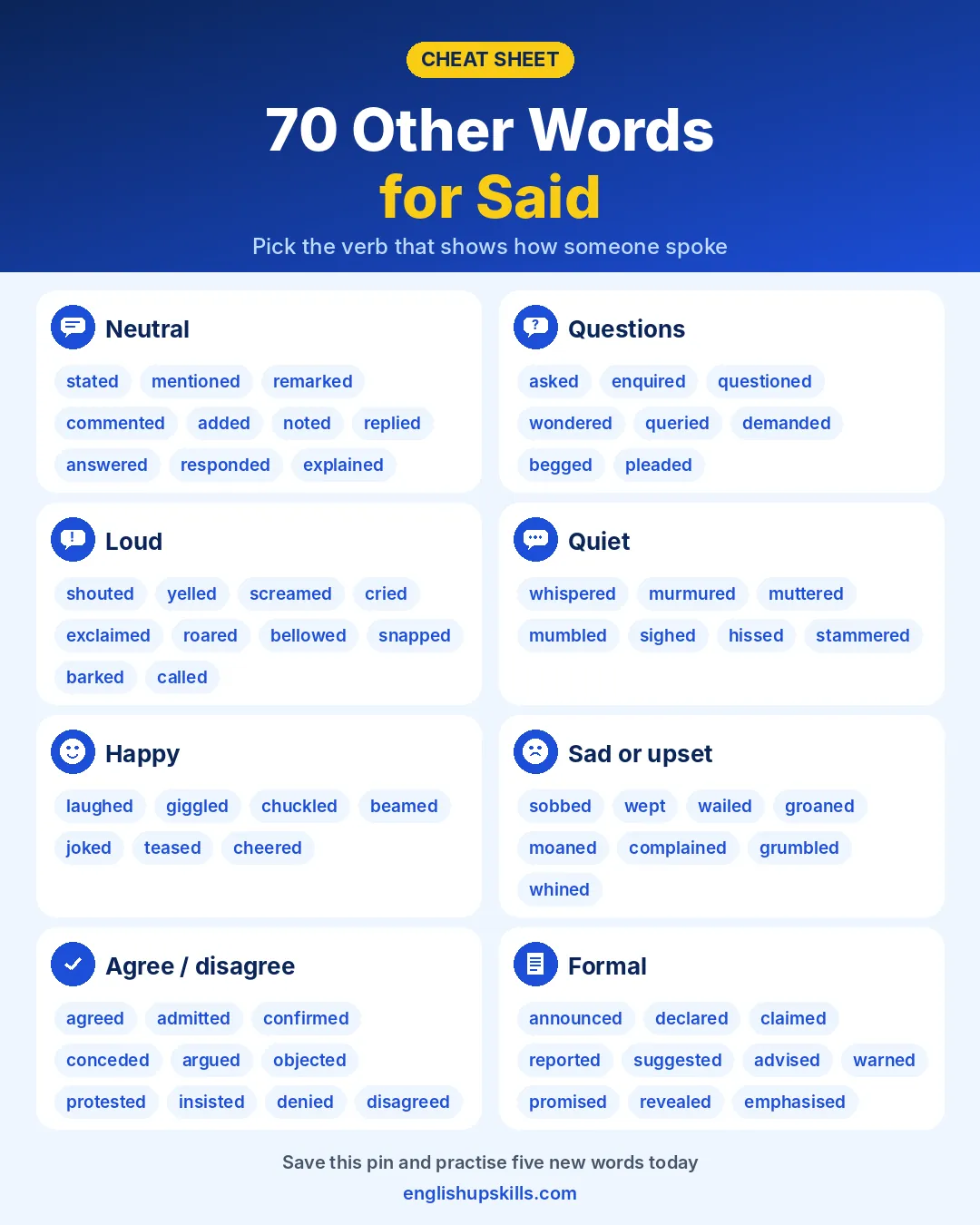
In this guide you will learn 70 useful words to use instead of said, grouped by meaning, with a short definition and an example for each. You will also learn the grammar and punctuation that go with them, the mistakes learners make most often, and a practice exercise to test yourself.
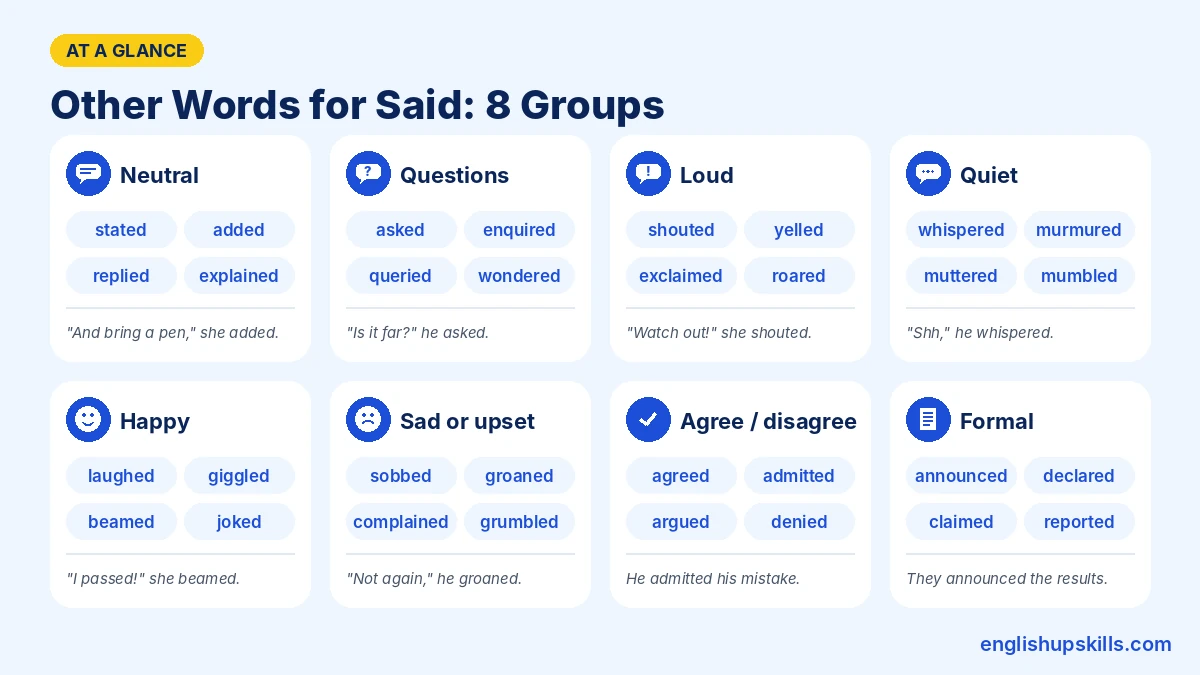
Quick answer: the 10 most useful other words for said
- asked – for questions
- replied – for answers
- explained – when giving a reason or details
- added – when saying something more
- shouted – when speaking very loudly
- whispered – when speaking very quietly
- exclaimed – when surprised or excited
- admitted – when agreeing that something bad is true
- suggested – when giving an idea
- announced – when telling many people officially
Is it wrong to use “said”?
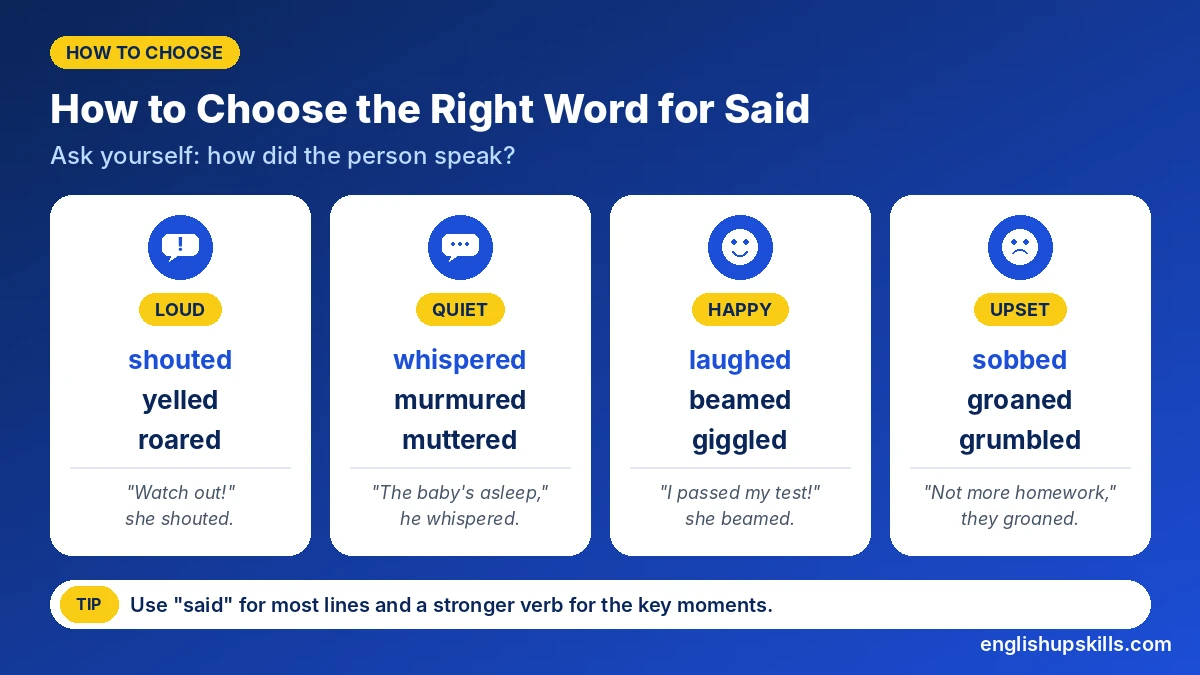
No. “Said” is neutral, clear and correct, and good writers use it often. Readers hardly notice it, which is exactly why it works: it keeps attention on the words being spoken. The problem is only repetition. Use a synonym when it adds real information about the speaker’s voice, feeling or purpose. If it adds nothing, keep said.
A simple rule: use “said” for most lines of dialogue and a stronger verb for the important moments.
Neutral words for said (everyday use)
Use these when you want to report speech without showing strong emotion. They are common in essays, reports, news and emails.
| Word | Meaning | Example |
|---|---|---|
| stated | said clearly or formally | The manager stated that the office would close at five. |
| mentioned | said briefly | She mentioned that her brother lives in Leeds. |
| remarked | made a short comment | “It’s colder than yesterday,” he remarked. |
| commented | gave an opinion | The teacher commented on my handwriting. |
| added | said something more | “And bring your passport,” she added. |
| noted | pointed out a fact | The report noted a rise in prices. |
| replied | said in answer | “I’m fine, thanks,” he replied. |
| answered | gave an answer | She answered the question politely. |
| responded | reacted in words | The company responded quickly to the complaint. |
| explained | made something clear | He explained why he was late. |
Words for said when asking questions
When the sentence is a question, “said” sounds odd. Choose one of these instead.
| Word | Meaning | Example |
|---|---|---|
| asked | put a question | “Where is the station?” she asked. |
| enquired | asked politely or formally | The receptionist enquired about my booking. |
| questioned | asked many questions | The police questioned the driver. |
| wondered | asked yourself or others gently | “Will it rain later?” he wondered. |
| queried | asked because of a doubt | She queried the total on the bill. |
| demanded | asked strongly | “Who broke this?” my father demanded. |
| begged | asked desperately | “Please don’t go,” the child begged. |
| pleaded | asked emotionally and seriously | He pleaded for one more chance. |
Words for said when someone speaks loudly
These verbs show volume, anger or excitement. They are most useful in stories.
| Word | Meaning | Example |
|---|---|---|
| shouted | said very loudly | “Watch out!” she shouted. |
| yelled | shouted, often in anger or fear | He yelled at the dog to stop. |
| screamed | shouted in a high voice | “Help!” she screamed. |
| cried | called out suddenly | “We’ve won!” they cried. |
| exclaimed | said with surprise or strong feeling | “What a beautiful view!” she exclaimed. |
| roared | shouted in a deep, powerful voice | “Get out!” the captain roared. |
| bellowed | shouted very deeply and loudly | The coach bellowed instructions from the side. |
| snapped | said suddenly and angrily | “Not now,” he snapped. |
| barked | gave a short, sharp order | “Sit down!” the officer barked. |
| called | spoke loudly to someone far away | “Dinner’s ready!” Mum called. |
Words for said when someone speaks quietly
| Word | Meaning | Example |
|---|---|---|
| whispered | spoke very softly | “The baby is sleeping,” she whispered. |
| murmured | spoke in a low, soft voice | He murmured a quiet thank you. |
| muttered | spoke quietly, often complaining | “This is so unfair,” she muttered. |
| mumbled | spoke unclearly | He mumbled something about homework. |
| sighed | spoke while breathing out sadly or tiredly | “Another Monday,” she sighed. |
| hissed | spoke in an angry, sharp whisper | “Be quiet!” he hissed. |
| stammered | spoke with pauses, often from nerves | “I-I didn’t mean it,” he stammered. |
Words for said that show happiness
| Word | Meaning | Example |
|---|---|---|
| laughed | spoke while laughing | “That’s hilarious!” he laughed. |
| giggled | laughed in a light, silly way | “You’ve got paint on your nose,” she giggled. |
| chuckled | laughed quietly | “I remember that day,” Grandad chuckled. |
| beamed | spoke with a big smile | “I passed my test!” she beamed. |
| joked | said something funny | “I’ll need a holiday after this holiday,” he joked. |
| teased | joked in a friendly way | “Nice hat,” my sister teased. |
| cheered | shouted happily | “Well done!” the crowd cheered. |
Words for said that show sadness or anger
| Word | Meaning | Example |
|---|---|---|
| sobbed | spoke while crying loudly | “I’ve lost my bag,” she sobbed. |
| wept | spoke while crying | “He was my best friend,” she wept. |
| wailed | cried out in pain or sadness | “My ice cream!” the boy wailed. |
| groaned | made a low sound of pain or annoyance | “Not more homework,” the class groaned. |
| moaned | complained in an unhappy voice | He moaned about the weather all day. |
| complained | said you are not happy | She complained that the food was cold. |
| grumbled | complained in a low voice | “The bus is late again,” he grumbled. |
| whined | complained in an annoying voice | “I’m bored,” the child whined. |
Words for said when agreeing or disagreeing
These verbs are very useful in essays and discussions because they show the speaker’s position.
| Word | Meaning | Example |
|---|---|---|
| agreed | said yes to an idea | “That’s a good plan,” she agreed. |
| admitted | said something true, often unwillingly | He admitted that he had made a mistake. |
| confirmed | said something is definitely true | The airline confirmed the new time. |
| conceded | accepted a point after arguing | “Fine, you’re right,” he conceded. |
| argued | gave reasons for an opinion | She argued that school should start later. |
| objected | said you disagree | Several parents objected to the new rule. |
| protested | disagreed strongly | “But I didn’t do anything!” he protested. |
| insisted | said firmly and would not change | She insisted on paying for dinner. |
| denied | said something is not true | He denied taking the money. |
| disagreed | had a different opinion | “I don’t think so,” she disagreed. |
Formal words for said (essays, reports and news)
| Word | Meaning | Example |
|---|---|---|
| announced | told people officially | The head teacher announced the results. |
| declared | said firmly and publicly | The chair declared the meeting closed. |
| claimed | said something without proof | He claimed that he had never been there. |
| reported | gave information about events | The newspaper reported heavy flooding. |
| suggested | gave an idea | She suggested meeting on Friday. |
| advised | told someone what they should do | The doctor advised him to rest. |
| warned | told someone about danger | The guide warned us not to swim there. |
| promised | said you will definitely do something | He promised to call later. |
| revealed | told something secret or new | The study revealed surprising results. |
| emphasised | gave special importance to something | The speaker emphasised the need for practice. |
Grammar tip: patterns after reporting verbs
Many words for said do not follow the same pattern as “said”. The British Council’s lesson on reporting verbs groups them by the structure that comes next. Here is a simple summary:
| Pattern | Common verbs | Example |
|---|---|---|
| verb + that-clause | said, stated, explained, admitted, claimed | She explained that the train was cancelled. |
| verb + to-infinitive | agreed, promised, refused, offered, decided | He promised to help me. |
| verb + object + to-infinitive | told, advised, warned, asked, persuaded | The teacher told us to sit down. |
| verb + -ing | suggested, denied, admitted, mentioned | She suggested taking a break. |
Two more points help a lot:
- Said vs told: we say something but tell someone something. Say “She told me the news”, not “She said me the news”. See our guide to commonly confused words in English for more pairs like this.
- Tense: reporting verbs are usually in the past simple in stories (she whispered, he replied). If you need a refresher, read our guide to the 12 tenses in English.
Punctuation with dialogue: put a comma inside the quotation marks before the reporting verb: “I’m tired,” she sighed. If the quote is a question or exclamation, use ? or ! instead of the comma: “Are you ready?” he asked.
Common mistakes with other words for said
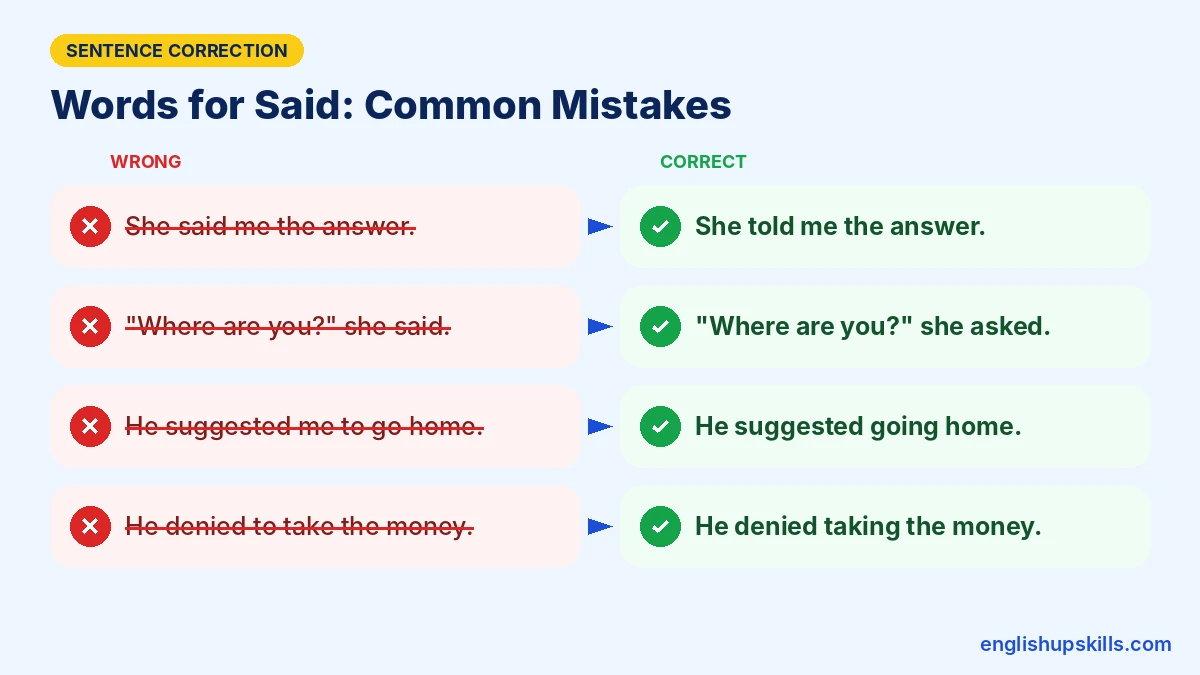
| Wrong | Correct | Why |
|---|---|---|
| She said me the answer. | She told me the answer. | “Say” does not take a person directly. Use tell + person. |
| “Where are you going?” she said. | “Where are you going?” she asked. | Use asked or enquired for questions. |
| He suggested me to go home. | He suggested that I go home. / He suggested going home. | Suggest is not followed by object + to-infinitive. |
| She explained me the rules. | She explained the rules to me. | Explain needs to before the person. |
| “I love it!” she whispered loudly. | “I love it!” she exclaimed. | The verb and the adverb contradict each other. |
| He denied to take the money. | He denied taking the money. | Deny is followed by the -ing form. |
| “Hello,” he smiled. | “Hello,” he said with a smile. | You cannot “smile” words, so many teachers prefer a real speaking verb. |
The last row is a style point. Verbs like smiled, nodded or shrugged are common in fiction, but in exams and formal writing it is safer to use a true speaking verb.
Practice exercise: choose the best word for said
Choose the best verb from the box for each sentence. Use each word once.
Box: asked, whispered, admitted, shouted, promised, complained, explained, replied
- “Fire! Everyone out!” the guard ______.
- “Can I borrow your pen?” Sara ______.
- “Shh, the film is starting,” she ______.
- He ______ that he had forgotten my birthday.
- “I’ll be home by ten,” my brother ______.
- “The soup is too salty,” the customer ______.
- The teacher ______ how photosynthesis works.
- “Yes, I’d love to come,” she ______.
Answers: 1. shouted · 2. asked · 3. whispered · 4. admitted · 5. promised · 6. complained · 7. explained · 8. replied
FAQs about other words for said
What is a better word for said?
It depends on the situation. Use asked for questions, replied for answers, explained for reasons, shouted for loud speech and whispered for quiet speech. In formal writing, stated, noted and claimed work well.
Is it bad to use said too much?
“Said” is correct and invisible to most readers, so using it often is fine. Repeating it in every line, especially in creative writing, can feel dull. Mix it with stronger verbs at important moments.
What are formal words for said?
Good formal choices include stated, declared, announced, noted, remarked, reported and emphasised. They are useful in essays, reports and IELTS Writing Task 2.
What is the difference between said and told?
Say is followed by the words or by that: She said (that) she was tired. Tell is followed by a person: She told me (that) she was tired.
What word can I use instead of said for happy speech?
Try laughed, beamed, giggled, chuckled, joked or cheered. Each shows a different kind of happiness.
Can I use these words when speaking English?
Yes, but in conversation people mostly use said, asked, told, shouted and whispered. The more descriptive verbs appear mainly in writing, especially stories and news.
Conclusion
Learning other words for said helps you write more clearly and more vividly. Keep said for most dialogue, then choose a stronger verb when you want to show volume, feeling or purpose. Check the pattern that follows the verb, and practise by rewriting a short story or email using five new words from this list.
For more help with accurate writing, read our sentence correction rules, and to put these verbs into practice when you talk, see how to improve spoken English.