
Many learners know both tenses but freeze when they have to choose. Should you say “I have read the book” or “I have been reading the book”? The rule behind present perfect vs present perfect continuous is simpler than it looks. Both tenses link the past to the present. The difference is what you want the listener to notice: the result or the activity.
This guide sits inside our bigger guide to the 12 tenses in English. Here is the quick answer before we go deeper:
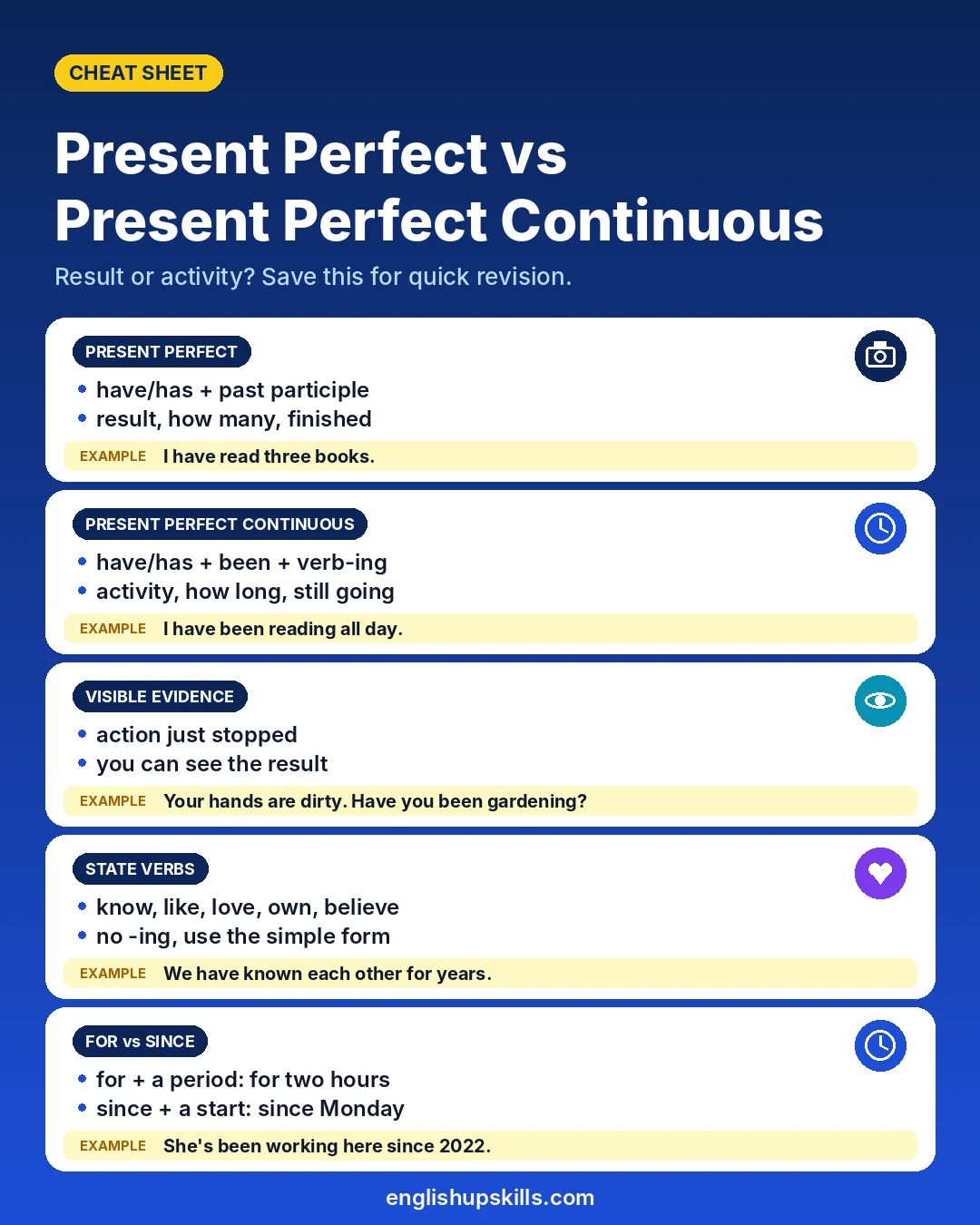
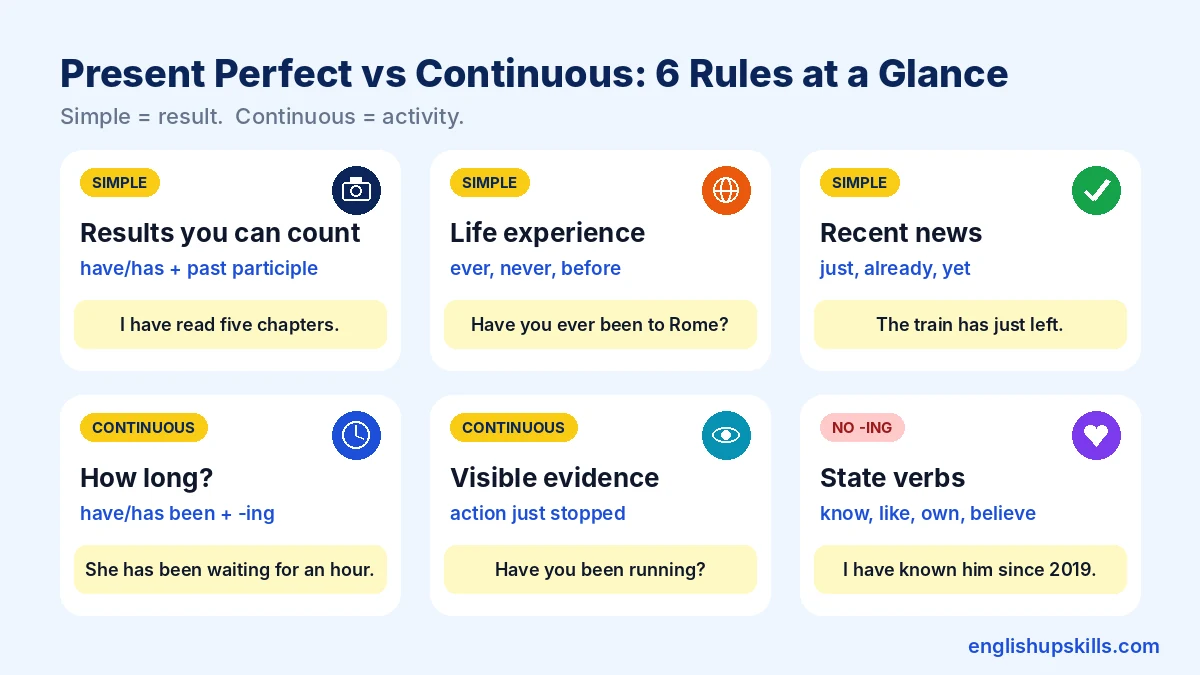
- Present perfect (have/has + past participle) focuses on the result, a finished action or how many: I have written three emails.
- Present perfect continuous (have/has been + -ing) focuses on the activity and how long: I have been writing emails all morning.
- Use the present perfect with how many / how much and with completed results.
- Use the present perfect continuous with how long, recent activity you can see evidence of, and temporary situations.
- State verbs (know, like, own, believe) usually stay in the present perfect: I have known her for years, not “I have been knowing her”.
The quick difference
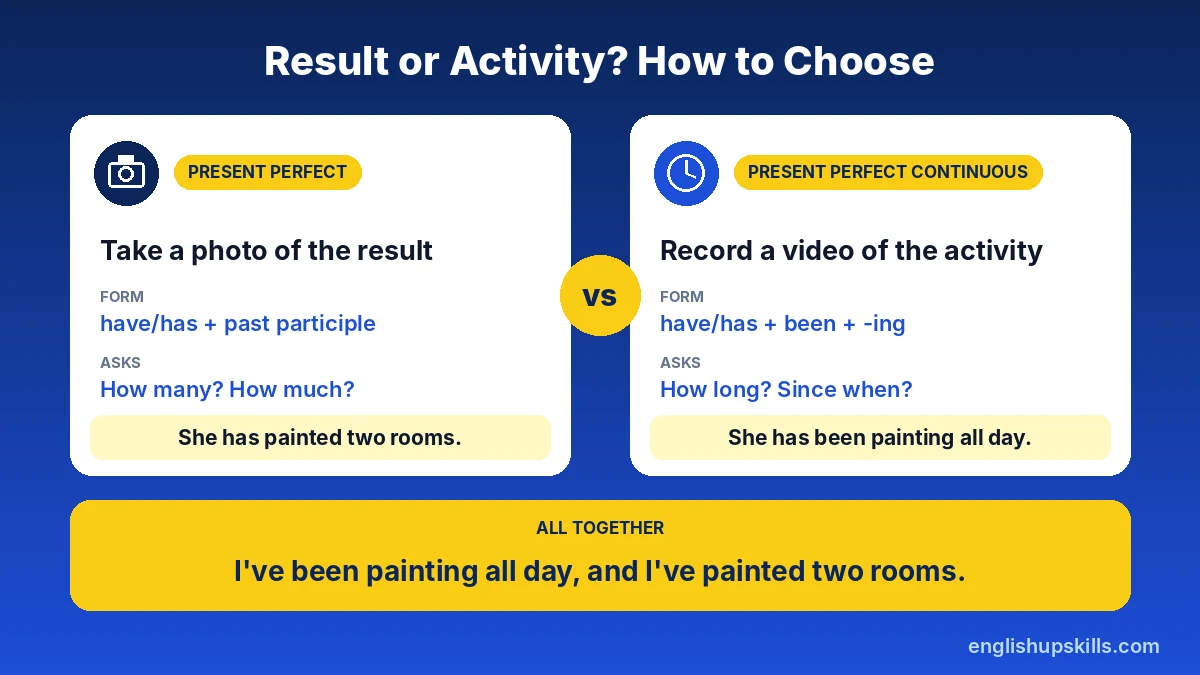
Think of a camera. The present perfect takes a photo of the result. The present perfect continuous records a video of the activity. Both tenses belong to the family of present tenses because they talk about now, even though the action started in the past.
| Present perfect | Present perfect continuous | |
|---|---|---|
| Form | have/has + past participle | have/has + been + verb-ing |
| Focus | the result or the finished action | the activity itself |
| Question it answers | How many? How much? | How long? |
| Finished? | usually yes, or a state that continues | often still going, or just stopped |
| Example | She has painted two rooms. | She has been painting since 9 am. |
The British Council explains the same idea in its lesson on present perfect simple and continuous: the simple form answers “how many”, while the continuous form answers “how long”.
How to form each tense
Present perfect: have/has + past participle
| Type | Structure | Example |
|---|---|---|
| Positive | subject + have/has + past participle | We have finished the report. |
| Negative | subject + haven’t/hasn’t + past participle | He hasn’t called me yet. |
| Question | Have/Has + subject + past participle? | Have you ever visited London? |
| Short answer | Yes, I have. / No, I haven’t. | Has she arrived? Yes, she has. |
Regular verbs add -ed (worked, played). Irregular verbs have their own forms (gone, written, eaten, seen), so it pays to learn the common ones.
Present perfect continuous: have/has been + verb-ing
| Type | Structure | Example |
|---|---|---|
| Positive | subject + have/has + been + verb-ing | They have been studying for two hours. |
| Negative | subject + haven’t/hasn’t + been + verb-ing | I haven’t been sleeping well. |
| Question | Have/Has + subject + been + verb-ing? | How long have you been waiting? |
| Short answer | Yes, I have. / No, she hasn’t. | Have you been running? Yes, I have. |
Notice that been never changes. It is the same for I, you, he, she, we and they. Only have/has changes.
When to use the present perfect
1. For results you can count
If you mention a number, an amount or a completed result, use the present perfect.
I have drunk four cups of coffee today.
Ali has saved enough money for a new phone.
2. For life experience
Use it with ever, never and before to talk about experiences at any time up to now.
Have you ever eaten sushi? I have never been to Canada.
3. For recent news and changes
Use it with just, already and yet when the result matters now.
The train has just left. Has the parcel arrived yet?
4. For states that started in the past and continue
With state verbs, the present perfect plus for or since shows a situation that is still true.
I have lived in Lahore since 2015. We have known each other for ten years.
When to use the present perfect continuous
1. To ask or say how long
This is the most common use. Add for (a period) or since (a starting point).
She has been learning English for six months.
It has been raining since this morning.
2. For recent activity with visible evidence
The action has just stopped, but you can see or feel the result.
Your eyes are red. Have you been crying?
I’m tired because I have been running.
3. For temporary situations
Use it when something is true for now but not permanent.
I have been staying with my cousin this week. Compare: I have lived here all my life (permanent).
4. For repeated actions over a period
The continuous form can show an action that has happened again and again.
He has been calling me every day.
Same verb, different meaning
With many action verbs, both tenses are correct, but they send different messages.
| Present perfect | Meaning | Present perfect continuous | Meaning |
|---|---|---|---|
| I have painted the kitchen. | the job is done | I have been painting the kitchen. | I was busy; there’s paint on my clothes; maybe not finished |
| She has read your report. | she finished it | She has been reading your report. | she started it; she may still be reading |
| They have fixed the car. | the car works now | They have been fixing the car. | the activity took time; the result isn’t clear |
| I have worked here for five years. | a long-term fact | I have been working here for five years. | similar meaning; stresses the ongoing activity |
With live, work, study and teach, plus for or since, both tenses are fine and the meaning hardly changes. The continuous form simply sounds a little more active or temporary.
Verbs that don’t take the continuous form
State verbs describe feelings, thoughts, senses and possession. They are not activities, so they normally stay in the present perfect even when you say how long.
| Group | Verbs | Example |
|---|---|---|
| Thinking | know, believe, understand, remember | I have known Sara since school. |
| Feeling | like, love, hate, want, prefer | He has always loved football. |
| Possession | have (own), own, belong | We have had this car for years. |
| Senses and being | seem, be, contain, mean | It has been cold all week. |
Note: “has been cold” is the present perfect of be, not the continuous tense. There is no verb-ing after it.
Common mistakes
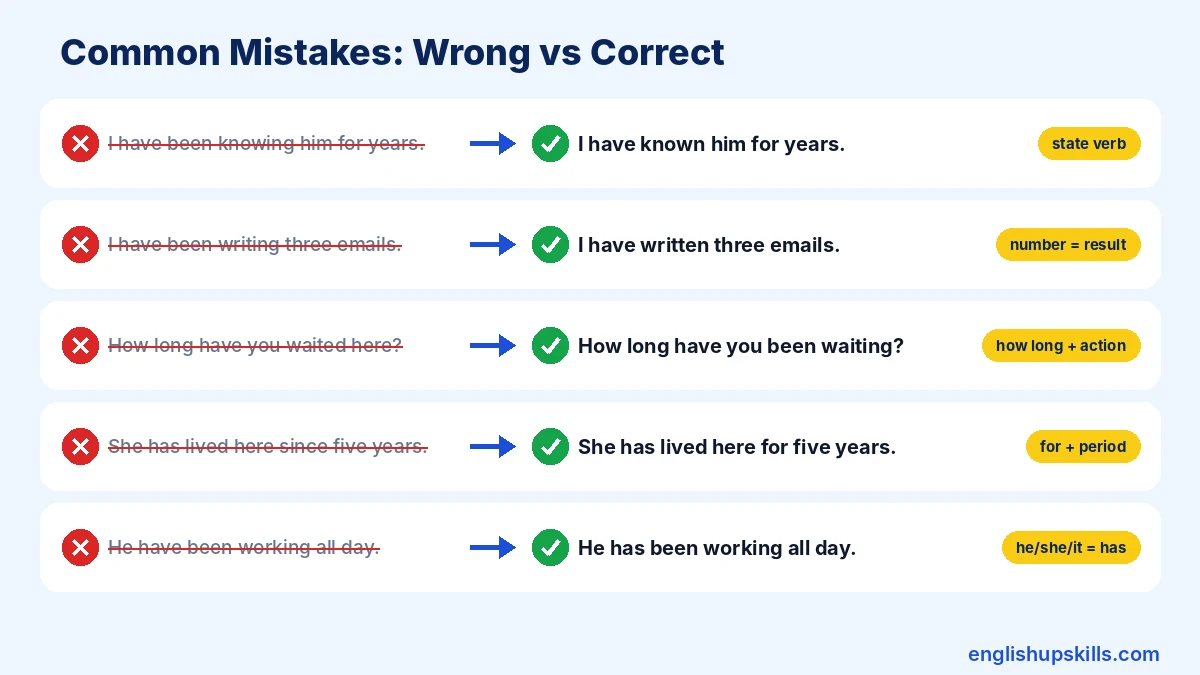
Most errors come from mixing up the focus or using the continuous with state verbs. Check your writing against these English grammar rules and the table below.
| Wrong | Correct | Why |
|---|---|---|
| I have been knowing him for years. | I have known him for years. | know is a state verb |
| I have been writing three emails. | I have written three emails. | a number means a result |
| How long have you waited here? | How long have you been waiting here? | how long + action prefers the continuous |
| She has been living here since five years. | She has been living here for five years. | for + a period, since + a starting point |
| I have been finish my homework. | I have finished my homework. | finished result, past participle |
| He have been working all day. | He has been working all day. | he/she/it takes has |
For and since: a quick reminder
Both tenses often use for and since, and learners mix them up a lot.
| Word | Use with | Examples |
|---|---|---|
| for | a length of time | for two hours, for a week, for ages, for ten years |
| since | a starting point | since Monday, since 2020, since 8 o’clock, since I was a child |
I have been waiting for twenty minutes. I have been waiting since 4 pm.
Using both tenses in real conversation
In everyday speaking, people often switch between the two tenses in the same conversation. A how long question usually comes first, then a how many question follows. Read this short dialogue between two colleagues and notice which tense each line uses.
| Speaker | Line | Tense |
|---|---|---|
| Sana | You look busy. What have you been doing? | present perfect continuous (activity) |
| Omar | I’ve been preparing slides for tomorrow’s meeting. | present perfect continuous (activity) |
| Sana | How long have you been working on them? | present perfect continuous (how long) |
| Omar | Since lunch. I’ve finished twelve slides so far. | present perfect (result, a number) |
| Sana | Have you sent them to the manager yet? | present perfect (result, yet) |
| Omar | Not yet. I haven’t checked the figures. | present perfect (result) |
In speech, we almost always use contractions: I’ve, you’ve, she’s, we’ve, they’ve. So “I have been waiting” usually sounds like I’ve been waiting. Be careful with she’s and he’s, because they can mean she is or she has. The word after it tells you which one: She’s been working (has) and She’s working (is).
A good habit is to answer a how long question with the continuous form, then add a result with the simple form. For example: I’ve been learning the guitar for a year, and I’ve learnt ten songs. This one sentence shows both tenses working together.
Practice exercise
Choose the present perfect or the present perfect continuous. If you want more practice spotting errors, try our sentence correction rules guide too.
- I (read) ___ five chapters so far.
- She (wait) ___ for the bus for half an hour.
- We (know) ___ each other since primary school.
- Why are your hands dirty? (you / work) ___ in the garden?
- They (build) ___ a new bridge. It opened last week.
- How long (you / learn) ___ English?
- He (lose) ___ his keys. He can’t get in.
- It (snow) ___ all night, and the roads are white.
Answers:
- have read (a number = result)
- has been waiting (how long)
- have known (state verb)
- Have you been working (visible evidence)
- have built (finished result)
- have you been learning (how long, ongoing activity)
- has lost (result now)
- has been snowing (activity over a period, visible effect)
FAQs
What is the main difference between present perfect and present perfect continuous?
The present perfect focuses on the result or a finished action, often with a number. The present perfect continuous focuses on the activity and how long it has lasted.
Can I use both tenses with for and since?
Yes. Use the continuous with action verbs (I have been working since 9) and the simple form with state verbs (I have known her since 2019).
Is “I have been knowing” correct?
No. Know is a state verb, so you should say I have known. The same is true for like, believe, own and understand.
Which tense do I use with “how many”?
Use the present perfect: How many pages have you written? Use the continuous with how long: How long have you been writing?
Does the present perfect continuous mean the action is unfinished?
Often, but not always. It can describe an action that is still going on, or one that has just stopped and left evidence, such as wet roads after rain.
Are these tenses used in British and American English?
Yes, both use them. British speakers tend to use the present perfect a little more for recent news, for example I’ve just eaten, where American speakers may say “I just ate”.
Conclusion
To choose between the present perfect and the present perfect continuous, ask one question: do I want to show the result or the activity? Results, numbers and states take the present perfect. Duration, recent activity and temporary situations take the present perfect continuous. Practise by saying a few sentences about your own day out loud, and use our tips to improve your spoken English so the right tense comes naturally.