
Conditional sentences in English talk about one thing that depends on another: if this happens, then that happens. You use them every day — to give advice, make plans, set rules, imagine a different life or regret something in the past. They are also one of the most tested grammar points in school exams, IELTS and job tests, because they show how well you control the 12 tenses in English.
The good news is that there are only four main patterns, and each one has a fixed tense pair. Learn the pairs and you can build almost any “if” sentence correctly.
Quick answer: the 4 types of conditionals
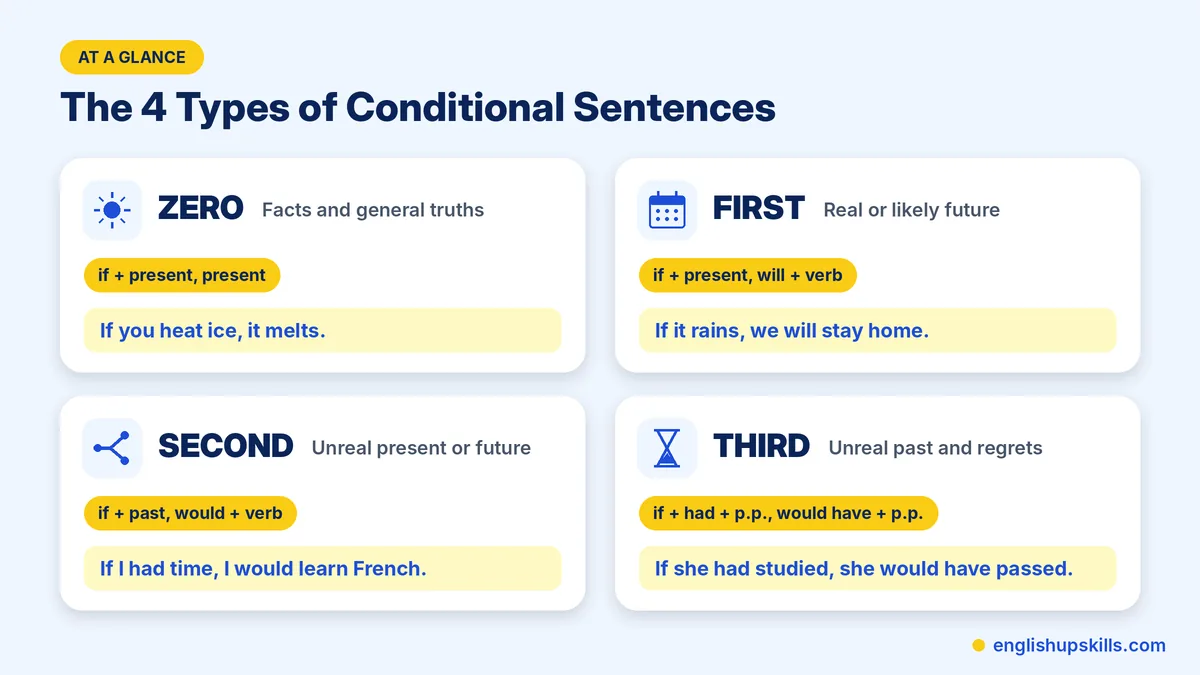
- Zero conditional — facts and general truths. If + present simple, present simple. If you heat ice, it melts.
- First conditional — real or likely future. If + present simple, will + base verb. If it rains, we will stay at home.
- Second conditional — unreal or unlikely present/future. If + past simple, would + base verb. If I had more time, I would learn French.
- Third conditional — unreal past (regrets). If + past perfect, would have + past participle. If she had studied, she would have passed.
- Bonus: mixed conditionals combine a past condition with a present result, or the other way round.
What is a conditional sentence?
A conditional sentence has two parts, called clauses:
| Part | Also called | What it does | Example |
|---|---|---|---|
| If clause | condition | says what must happen first | If you call me, … |
| Main clause | result | says what happens because of it | … I will pick you up. |
You can put either clause first. When the if clause comes first, put a comma after it. When the main clause comes first, you normally use no comma.
- If you need help, ask me.
- Ask me if you need help.
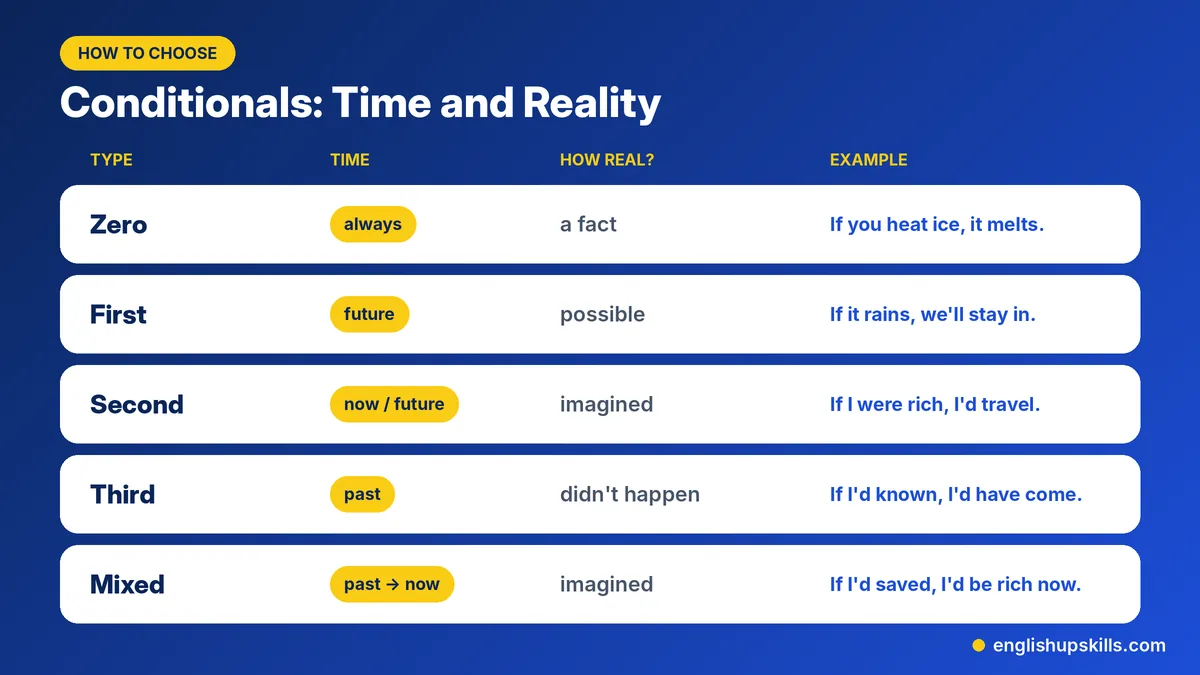
The type of conditional depends on two things: time (past, present or future) and how real the situation is (a fact, a real possibility, or something imagined). Keep these two questions in mind as you read each section.
Zero conditional: facts and general truths
Use the zero conditional for things that are always true when the condition happens: science facts, rules, habits and instructions. Both clauses use the present simple, so if you are comfortable with present tenses, this one is easy.
| If clause | Main clause | Example |
|---|---|---|
| if + present simple | present simple | If you mix red and blue, you get purple. |
| if + present simple | present simple | If I drink coffee at night, I can’t sleep. |
| if + present simple | imperative | If the alarm rings, leave the building. |
In the zero conditional, if means almost the same as when or whenever. When water reaches 100°C, it boils has the same meaning as If water reaches 100°C, it boils.
First conditional: real future possibilities
Use the first conditional for a situation in the future that is possible or likely. It is the conditional of plans, warnings, promises and offers. The if clause uses the present simple, even though it talks about the future — the future tense goes only in the main clause.
| If clause | Main clause | Example |
|---|---|---|
| if + present simple | will + base verb | If you study tonight, you will pass tomorrow. |
| if + present simple | won’t + base verb | If we leave now, we won’t miss the train. |
| if + present simple | can / may / might + base verb | If the weather is good, we might go to the beach. |
| if + present simple | imperative | If you see Ali, tell him to call me. |
You can also replace if with unless (= if not), as soon as, as long as and in case:
- Unless you hurry, you will be late. (= If you don’t hurry…)
- I’ll text you as soon as I arrive.
Second conditional: unreal present and future
Use the second conditional for situations that are imaginary, unlikely or impossible now or in the future. The past simple here does not mean past time — it shows that the idea is unreal.
| If clause | Main clause | Example |
|---|---|---|
| if + past simple | would + base verb | If I won the lottery, I would buy a house for my parents. |
| if + past simple | could + base verb | If she spoke English fluently, she could apply for that job. |
| if + were | would + base verb | If I were you, I would apologise. |
Were or was? In formal and exam English, use were for all subjects: If I were, if he were, if it were. In everyday speech many people say if I was, but If I were you is the fixed phrase for giving advice.
Compare the first and second conditional:
- If I get the job, I will move to Lahore. (I have an interview — it is possible.)
- If I got the job, I would move to Lahore. (I don’t think I will get it.)
Third conditional: unreal past and regrets
Use the third conditional to imagine a different past. The situation did not happen, so the result did not happen either. It is common for regrets, criticism and relief.
| If clause | Main clause | Example |
|---|---|---|
| if + had + past participle | would have + past participle | If I had left earlier, I would have caught the bus. |
| if + hadn’t + past participle | wouldn’t have + past participle | If he hadn’t helped me, I wouldn’t have finished on time. |
| if + had + past participle | could / might have + past participle | If we had booked early, we could have got cheaper tickets. |
The real meaning is the opposite: If I had left earlier, I would have caught the bus means I didn’t leave early, so I missed the bus.
Mixed conditionals
Sometimes the time of the condition and the time of the result are different. Then you mix the second and third conditionals.
| Type | Structure | Example | Meaning |
|---|---|---|---|
| Past condition → present result | if + past perfect, would + base verb | If I had taken the job, I would be rich now. | I didn’t take it, so I am not rich now. |
| Present condition → past result | if + past simple, would have + past participle | If she were more careful, she wouldn’t have lost her phone. | She is not careful, so she lost it. |
Mixed conditionals are less common, but they sound natural and are useful in IELTS Speaking when you talk about life choices.
All conditionals in one table
| Type | Time | How real? | If clause | Main clause |
|---|---|---|---|---|
| Zero | always | fact | present simple | present simple |
| First | future | possible | present simple | will + base verb |
| Second | present / future | unreal or unlikely | past simple | would + base verb |
| Third | past | unreal (did not happen) | past perfect | would have + past participle |
| Mixed | past → present | unreal | past perfect | would + base verb |
4 tips to choose the right conditional
- Ask about time first. Is the situation in the past, present or future? Past situations that did not happen always need the third (or a mixed) conditional.
- Then ask how real it is. A real chance points to the first conditional; a dream, a wish or an impossible idea points to the second.
- Never put will or would in the if clause. The if clause carries the “backshifted” tense: present for real future, past for unreal present, past perfect for unreal past.
- Use contractions when you speak. Native speakers say If I’d known, I’d have come — here the first ‘d is had and the second is would. Listening for these short forms will also help your IELTS Listening score.
Common mistakes with conditional sentences
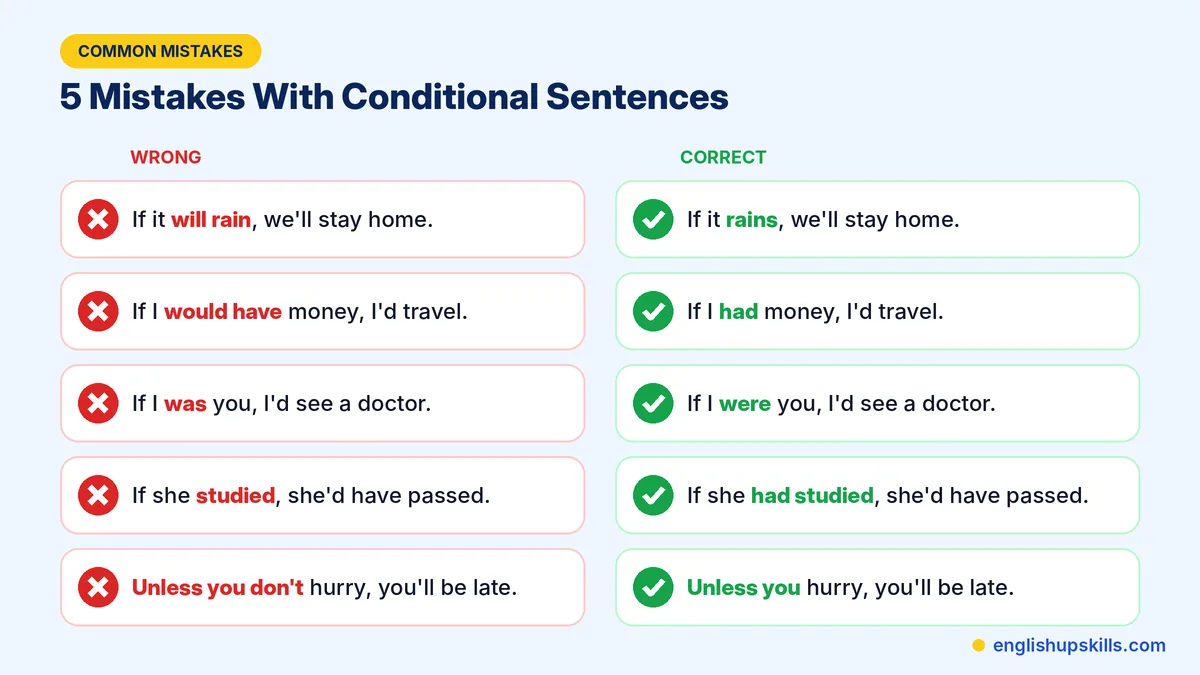
Most errors come from putting will or would in the wrong clause. Check your sentences against this table, and see our sentence correction rules for more practice of this kind.
| Wrong | Correct | Why |
|---|---|---|
| If it will rain, we will stay home. | If it rains, we will stay home. | No will in the if clause of a first conditional. |
| If I would have money, I would travel. | If I had money, I would travel. | Second conditional: past simple after if, not would. |
| If I was you, I would see a doctor. | If I were you, I would see a doctor. | If I were you is the correct fixed phrase for advice. |
| If she studied harder, she would have passed. | If she had studied harder, she would have passed. | Third conditional needs past perfect after if. |
| If I had known, I would came. | If I had known, I would have come. | Use would have + past participle for past results. |
| Unless you don’t hurry, you will be late. | Unless you hurry, you will be late. | Unless already means if not; don’t add another not. |
| If you heat ice it melts. | If you heat ice, it melts. | Use a comma when the if clause comes first. |
Practice exercise
Complete each sentence with the correct form of the verb in brackets. Then name the type of conditional.
- If you ______ (press) this button, the machine starts.
- If it ______ (not rain) tomorrow, we will play cricket.
- If I ______ (be) taller, I would play basketball.
- If they had taken a taxi, they ______ (not miss) the flight.
- If she ______ (know) the answer, she would tell us. (She doesn’t know it.)
- I will call you if I ______ (need) anything.
- If he had saved his money, he ______ (have) a car now.
- If we ______ (leave) earlier, we would have seen the start of the film.
Answers
- press — zero conditional
- doesn’t rain — first conditional
- were — second conditional
- wouldn’t have missed — third conditional
- knew — second conditional
- need — first conditional
- would have — mixed conditional (past condition, present result)
- had left — third conditional
Frequently asked questions
How many types of conditional sentences are there in English?
There are four main types: zero, first, second and third. Many teachers also add mixed conditionals as a fifth type, which combine the second and third patterns.
Can I use “will” after “if”?
Normally no. In first conditional sentences, use the present simple after if: If you come, I will cook. Will after if is only possible in special cases, such as polite requests: If you will wait here, I’ll find the manager.
What is the difference between the first and second conditional?
Both talk about the present or future. The first conditional is for real possibilities (If I have time, I will help). The second is for unreal or unlikely ideas (If I had time, I would help — but I don’t have time).
Is “If I was you” wrong?
It is common in informal speech, but If I were you is the standard form, and it is the safer choice in exams, essays and formal writing.
Can the if clause come second?
Yes. We will stay home if it rains is correct. When the main clause comes first, you usually don’t need a comma.
Which conditional is used for regrets?
The third conditional: If I had listened to my teacher, I would have done better. You can also use I wish + past perfect: I wish I had listened.
Conclusion
Conditional sentences in English follow clear patterns: the zero conditional for facts, the first for real future plans, the second for imagined situations and the third for a past that did not happen. Learn the tense pair for each type, keep will and would out of the if clause, and practise by writing two or three sentences of each type about your own life. To keep building your foundation, read our guide to English grammar rules next.