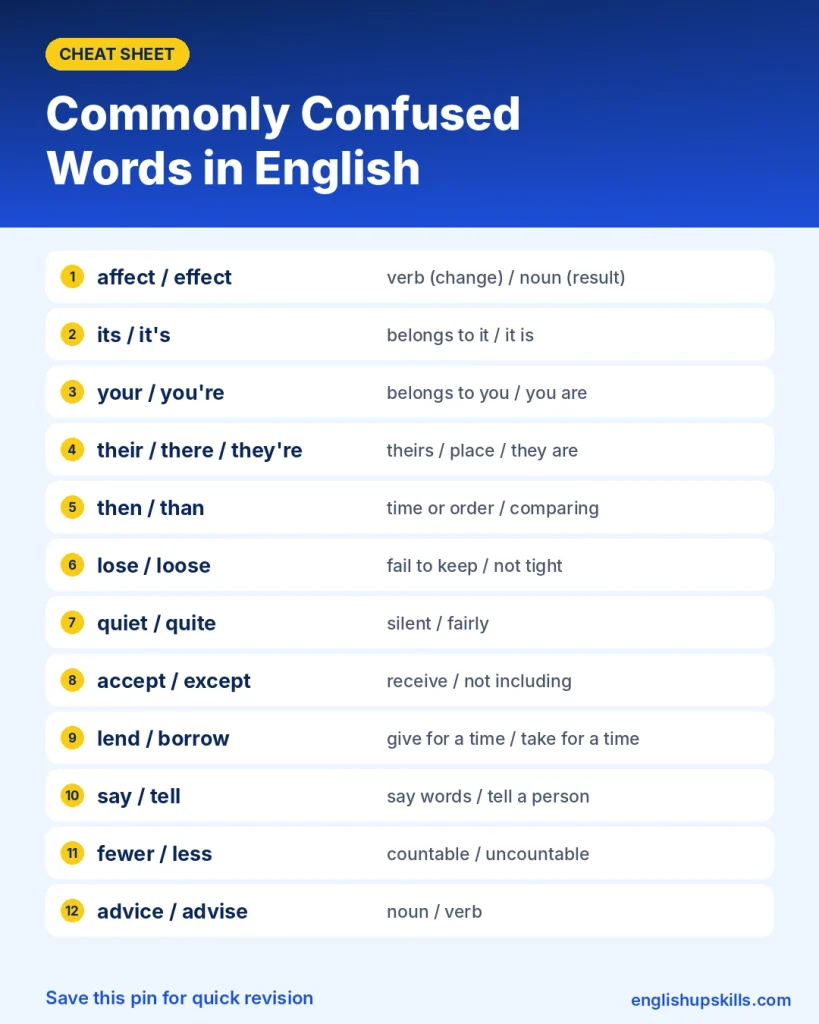

Commonly confused words in English are pairs of words that look alike, sound alike or have close meanings, so learners and even native speakers mix them up. Think of affect and effect, its and it’s, or lend and borrow. A spell checker will not catch most of these, because both words are real. The good news is that each pair follows a simple rule. Learn the rule once and the mistake disappears. If you are still building the basics, start with our guide to English grammar rules.
Quick answer: the 5 pairs people confuse most
- Affect is usually a verb; effect is usually a noun.
- It’s means it is or it has; its shows possession.
- Lend means give for a time; borrow means take for a time.
- Then is about time; than is for comparing.
- Lose means fail to keep; loose means not tight.
Below you will find all 20 pairs, with meanings, examples, memory tricks, a common-mistakes table and a short quiz.
What are commonly confused words?
Confusing words in English fall into three groups.
- Homophones sound exactly the same but have different spellings and meanings: their, there and they’re.
- Near-homophones sound almost the same: accept and except, quiet and quite.
- Related-meaning pairs are about the same idea from different angles: say and tell, bring and take, lend and borrow.
Knowing which group a pair belongs to helps you choose the right fix. For homophones, check the spelling and meaning. For related-meaning pairs, check the direction or the grammar pattern.
20 commonly confused words at a glance
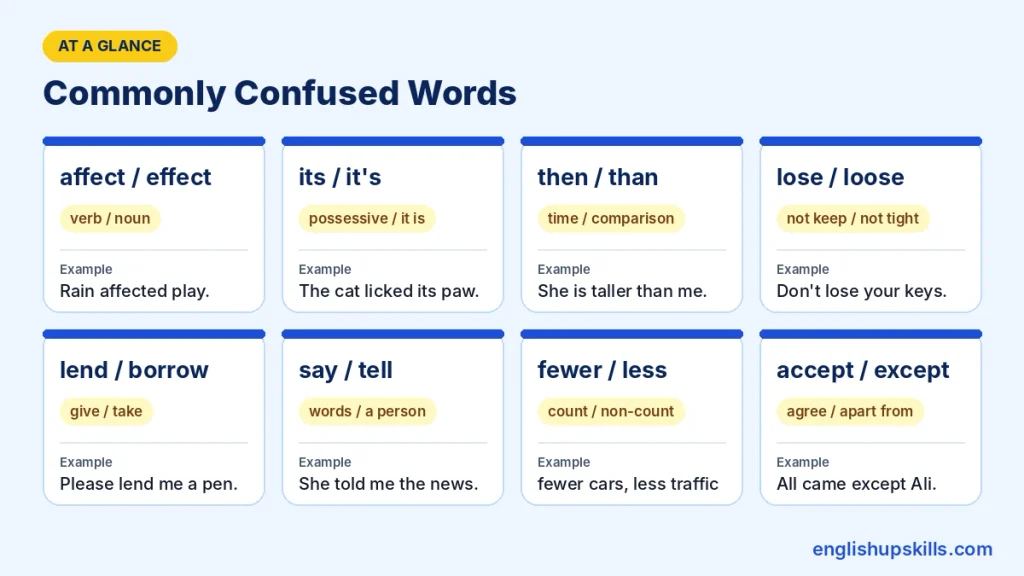
| Pair | Quick rule | Example |
|---|---|---|
| affect / effect | verb / noun | The rain affected the match. The effect was huge. |
| accept / except | receive / not including | I accept your offer. Everyone came except Ali. |
| its / it’s | possessive / it is | It’s cold. The dog wagged its tail. |
| your / you’re | possessive / you are | You’re late for your class. |
| their / there / they’re | possessive / place / they are | They’re putting their bags over there. |
| to / too | direction / also, very | I’m going to Lahore too. |
| then / than | time / comparison | Eat first, then study. She is taller than me. |
| lose / loose | fail to keep / not tight | Don’t lose your keys. My shirt is loose. |
| quiet / quite | silent / fairly | The library is quiet. The test was quite easy. |
| stationary / stationery | not moving / paper and pens | The bus was stationary. Buy some stationery. |
| complement / compliment | complete / praise | The sauce complements the rice. Thanks for the compliment. |
| principal / principle | head, main / rule, belief | The principal spoke. It’s a matter of principle. |
| lend / borrow | give / take (for a time) | Can you lend me a pen? Can I borrow a pen? |
| say / tell | say something / tell someone | She said hello. She told me the news. |
| bring / take | towards / away from the speaker | Bring it here. Take it home. |
| fewer / less | countable / uncountable | fewer mistakes, less time |
| lie / lay | no object / needs an object | I lie down. I lay the book on the table. |
| especially / specially | above all / for a purpose | I love fruit, especially mango. It was specially made. |
| advice / advise | noun / verb | Good advice. I advise you to rest. |
| practice / practise | noun / verb (UK) | Football practice. Practise every day. |
Homophones and near-homophones
These pairs cause the most spelling mistakes in emails, essays and social media posts.
Its or it’s?
It’s is a short form of it is or it has. Its is possessive, like his or her, and it never takes an apostrophe.
- It’s raining again.
- It’s been a long day.
- The company changed its logo.
Test: replace the word with it is. If the sentence still makes sense, write it’s.
Your or you’re?
You’re means you are. Your shows that something belongs to you.
- You’re my best friend.
- Is this your phone?
Their, there or they’re?
- Their = belonging to them: The students forgot their books.
- There = a place, or “there is/are”: There is a shop over there.
- They’re = they are: They’re coming at six.
To or too?
To shows direction or comes before a verb (to go, to eat). Too means also or more than enough.
- I want to learn English.
- This tea is too hot.
- Can I come too?
Then or than?
Then is about time or order. Than is used in comparisons.
- First we had lunch, then we went shopping.
- Speaking is harder than reading for many learners.
Lose or loose?
Lose (one o, sounds like looz) is a verb: fail to keep or fail to win. Loose (two os, rhymes with goose) is an adjective: not tight.
- Don’t lose hope.
- This screw is loose.
Quiet or quite?
Quiet (two syllables, qui-et) means silent. Quite (one syllable) means fairly or completely.
- Please be quiet.
- Her English is quite good.
Stationary or stationery?
Stationary with an a means not moving. Stationery with an e means paper, pens and envelopes. Memory trick: e for envelope.
Complement or compliment?
A complement completes something; notice the e in complete. A compliment is a kind remark; notice the i: I like your shoes.
Principal or principle?
A principal is the head of a school, or it means main: the principal reason. A principle is a rule or belief. Trick: a principle is a rule, and both end in -le.
Words with related meanings
These words are not spelt alike. Learners mix them up because they describe the same situation from different sides.
Affect or effect?
In everyday English, affect is a verb (to change or influence) and effect is a noun (the result). A simple way to remember: Affect is the Action, Effect is the End result.
- Lack of sleep affects your memory.
- Lack of sleep has a bad effect on your memory.
Accept or except?
Accept means receive or agree to. Except means not including.
- Please accept my apology.
- I like all vegetables except okra.
Lend or borrow?
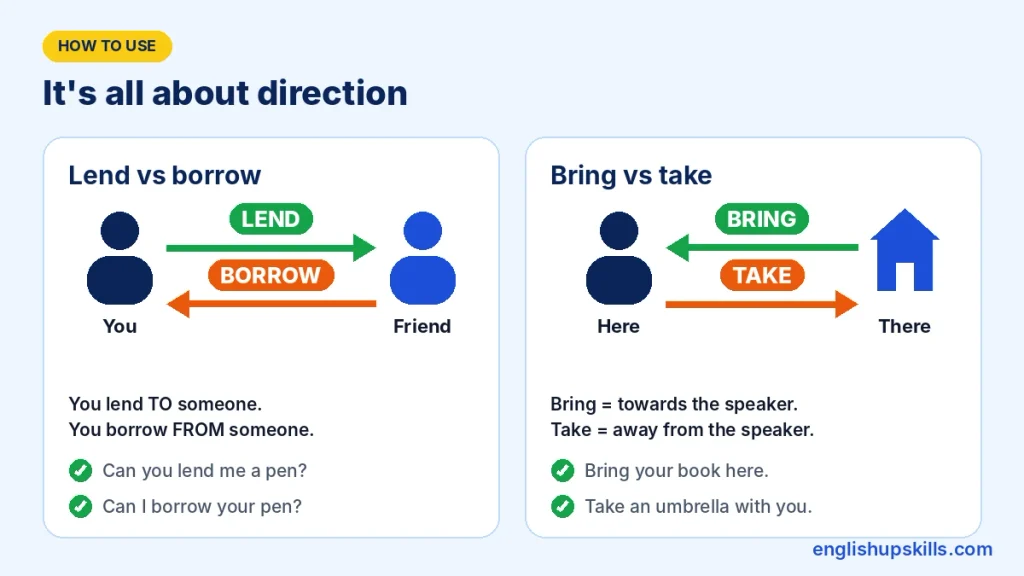
This pair is about direction. When you lend, the thing goes from you. When you borrow, the thing comes to you.
- Could you lend me 500 rupees? (you give)
- Could I borrow 500 rupees? (I take)
A very common error in South Asian English is “Can you borrow me your book?” The correct form is “Can you lend me your book?”
Say or tell?
Both verbs report speech, but the grammar differs. We tell somebody something. We say something, or say something to somebody.
| Verb | Pattern | Example |
|---|---|---|
| say | say + words | He said that he was tired. |
| say | say + words + to someone | He said sorry to me. |
| tell | tell + person + information | He told me that he was tired. |
| tell | fixed phrases | tell the truth, tell a lie, tell a story, tell the time |
Getting this right makes a big difference when you speak. For more speaking tips, read how to improve spoken English.
Bring or take?
Bring means move something towards the speaker or listener. Take means move it away.
- Bring your notebook to class tomorrow. (to where I am)
- Take an umbrella when you go out. (away from here)
Fewer or less?
Use fewer with countable nouns (fewer students, fewer chances). Use less with uncountable nouns (less water, less traffic). In speech many people say less people, but in exams and formal writing use fewer people.
Lie or lay?
Lie means rest flat and has no object: I need to lie down. Lay means put something down and always needs an object: Lay the plates on the table. The tricky part is that the past tense of lie is lay: Yesterday I lay in bed all morning.
| Verb | Present | Past | Past participle |
|---|---|---|---|
| lie (rest) | lie / lies | lay | lain |
| lay (put) | lay / lays | laid | laid |
| lie (not tell the truth) | lie / lies | lied | lied |
Especially or specially?
Especially means above all or particularly. Specially means for one particular purpose.
- I enjoy sports, especially cricket.
- This cake was specially made for Eid.
Noun or verb? Advice/advise and practice/practise
In British English, some pairs change one letter between noun and verb. The noun has a c, the verb has an s.
| Noun (c) | Verb (s) | Example |
|---|---|---|
| advice | advise | My teacher gave me some advice. She advised me to read more. |
| practice | practise | I go to cricket practice on Fridays. I practise English daily. |
| licence | license | You need a driving licence. The shop is licensed to sell medicine. |
Memory trick: ice is a noun, so advice and practice are nouns. American English uses practice for both, so follow the spelling style your school or exam expects.
Common mistakes with confused words
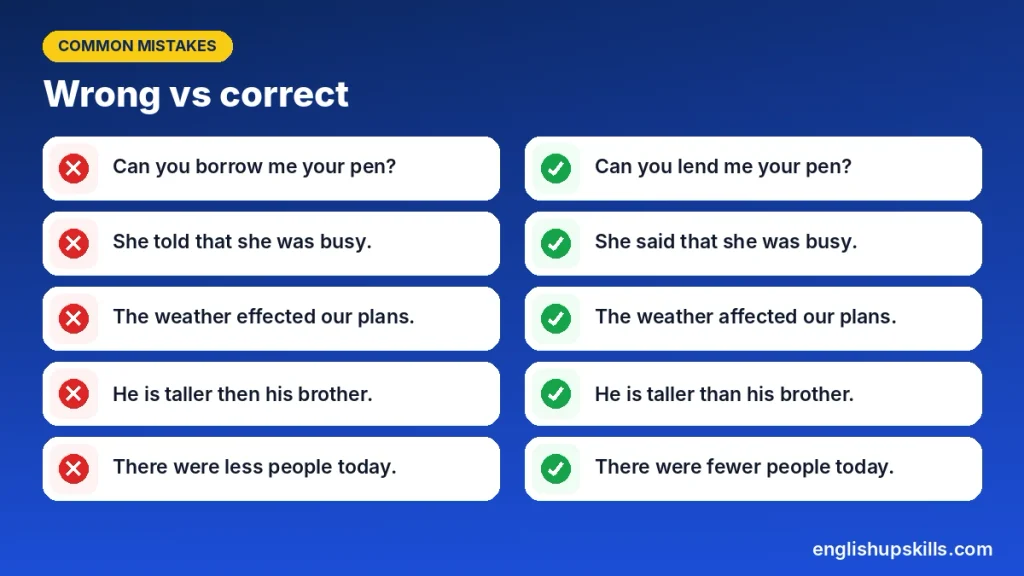
These are the errors examiners and teachers see most often. If you enjoy fixing errors like these, our sentence correction rules guide has many more.
| Wrong | Correct | Why |
|---|---|---|
| Can you borrow me your pen? | Can you lend me your pen? | You lend to someone; you borrow from someone. |
| She told that she was busy. | She said that she was busy. | Tell needs a person after it. |
| The weather effected our plans. | The weather affected our plans. | The verb is affect. |
| Its a good idea. | It’s a good idea. | It’s = it is. |
| He is taller then his brother. | He is taller than his brother. | Use than to compare. |
| I don’t want to loose my job. | I don’t want to lose my job. | Lose is the verb; loose means not tight. |
| There were less people today. | There were fewer people today. | People is countable. |
| I need some advises. | I need some advice. | Advice is an uncountable noun. |
| Everyone came accept Sara. | Everyone came except Sara. | Except means not including. |
Practice exercise
Choose the correct word in each sentence.
- Please don’t (loose / lose) the tickets.
- My brother is older (then / than) me.
- Can I (lend / borrow) your charger?
- (Its / It’s) important to sleep well.
- The new rules will (affect / effect) all students.
- She (said / told) me a funny story.
- The hall was very (quiet / quite) during the exam.
- I need to (practice / practise) my presentation.
- We had (fewer / less) homework this week.
- (Their / There / They’re) house is near the park.
Answers: 1. lose 2. than 3. borrow 4. It’s 5. affect 6. told 7. quiet 8. practise 9. less 10. Their
Score 8 or more? Well done. If not, read the tables again tomorrow and retake the quiz.
Frequently asked questions
What are the most commonly confused words in English?
The most common pairs are affect/effect, its/it’s, your/you’re, their/there/they’re, then/than, lose/loose and lend/borrow. Most errors happen with homophones, because they sound the same in speech.
How can I stop confusing similar words?
Learn one pair at a time, write your own example sentence for each word and use a memory trick, such as “Affect is the Action”. Then reread your writing slowly, looking only for these pairs.
Is it “effect a change” or “affect a change”?
Effect can also be a verb meaning to bring about, so “effect a change” means make a change happen. This use is formal and rare. In everyday English, use affect as the verb.
What is the difference between lie and lay?
Lie means rest and takes no object. Lay means put something down and needs an object. The past tense of lie is lay, which is why people confuse them. Our guide to the 12 tenses in English explains how past forms work.
Is “practise” British or American?
Practise as a verb is British spelling. In American English, practice is used for both the noun and the verb.
Are homophones and commonly confused words the same thing?
Not exactly. All homophones can be confused, but some confusing words, such as say and tell or bring and take, sound completely different. They are confused because their meanings are close.
Conclusion
Commonly confused words in English trip up almost everyone, but each pair has a clear rule. Check whether a word is a noun or verb, whether it shows possession or is a short form, and which direction the action goes. Learn five pairs this week and five more next week. To see these words in real sentences, follow our reading practice guide and notice each pair as you read. For another list from an official source, see the British Council’s 10 confused words in English.