
If English grammar feels overwhelming, tenses are usually the reason. Learners are told there are twelve of them, handed a chart, and left to work out the difference between “I have worked here for a year” and “I worked here for a year” on their own.
The good news is that the twelve tenses are not twelve separate things to memorise. They are built from two simple ideas combined together. Once you see the pattern, the whole system clicks into place.
This guide walks through all twelve tenses, with the formula for each, when to use it, real example sentences, and the mistakes learners make most often.
What Is a Tense in English?
A tense tells you when something happens and how it happens over time.
Every English tense is a combination of two choices:
- Time — past, present, or future
- Aspect — simple, continuous, perfect, or perfect continuous
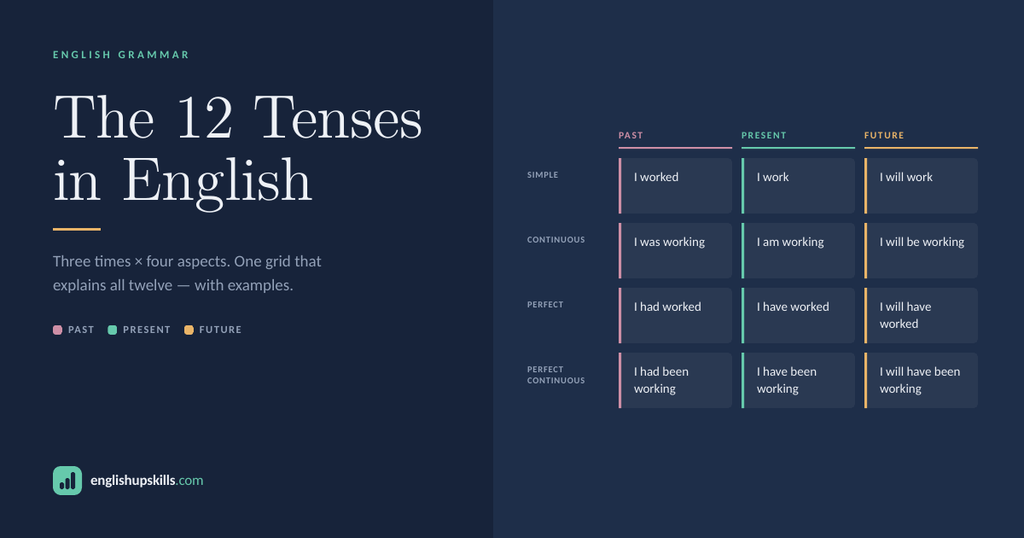
Three times multiplied by four aspects gives you twelve tenses. That is the entire system.
Here is what each aspect actually means:
- Simple — a complete fact or a finished action. I eat breakfast at seven.
- Continuous — an action in progress, unfinished. I am eating breakfast.
- Perfect — an action linked to a later point in time. I have eaten breakfast.
- Perfect continuous — an action in progress that has lasted a period of time. I have been eating breakfast for ten minutes.
Read those four sentences again. The time is the same in all of them. Only the aspect changes, and each one gives you a different picture.
The 12 Tenses Chart
Save this table. It is the fastest reference you will find.
| Aspect | Past | Present | Future |
|---|---|---|---|
| Simple | I worked | I work | I will work |
| Continuous | I was working | I am working | I will be working |
| Perfect | I had worked | I have worked | I will have worked |
| Perfect continuous | I had been working | I have been working | I will have been working |
Notice the columns are almost identical in shape. had becomes have becomes will have. Once you know one row, you know the pattern for all three times.
The Present Tenses
1. Present Simple
Formula: Subject + base verb (+ s/es for he, she, it)
Use it for:
- Facts and general truths — Water boils at 100 degrees.
- Habits and routines — She catches the 7:15 train to Manchester.
- Timetables and schedules — The shop opens at nine.
- Opinions and states — I think that’s a fair price.
Negative: I don’t work on Fridays. / He doesn’t work on Fridays. Question: Do you work on Fridays? / Does he work on Fridays?
Common mistake: forgetting the -s in the third person. It is he works, not he work. This is the single most frequent error in beginner writing.
2. Present Continuous
Formula: Subject + am/is/are + verb-ing
Use it for:
- Actions happening right now — She’s writing an email.
- Temporary situations — I’m staying with my sister until the flat is ready.
- Changing trends — Rents are rising across the city.
- Fixed future arrangements — We’re meeting the client on Thursday.
That last use surprises people. When something is already arranged and in the diary, English speakers use the present continuous rather than will.
Common mistake: using the continuous with state verbs. Verbs like know, believe, want, own, understand, need and belong describe states, not actions, so they do not usually take -ing. Say I understand, not I am understanding.
3. Present Perfect
Formula: Subject + have/has + past participle
Use it for:
- Past actions with a result you can still see now — I’ve lost my keys. (They are still missing.)
- Life experience, with no specific time — She’s visited Japan three times.
- Something that started in the past and continues — We’ve lived here since 2019.
- Very recent news — The results have just come in.
Common mistake: pairing it with a finished time expression. You cannot say I have seen him yesterday. If you name a finished time — yesterday, last week, in 2020, two hours ago — you must use the past simple: I saw him yesterday.
Use for with a length of time (for six months) and since with a starting point (since March).
4. Present Perfect Continuous
Formula: Subject + have/has been + verb-ing
Use it for:
- An activity that started in the past and is still going — He’s been studying for four hours.
- A recent activity that explains a present result — Your eyes are red. Have you been crying?
- Emphasising duration rather than completion — I’ve been trying to reach you all morning.
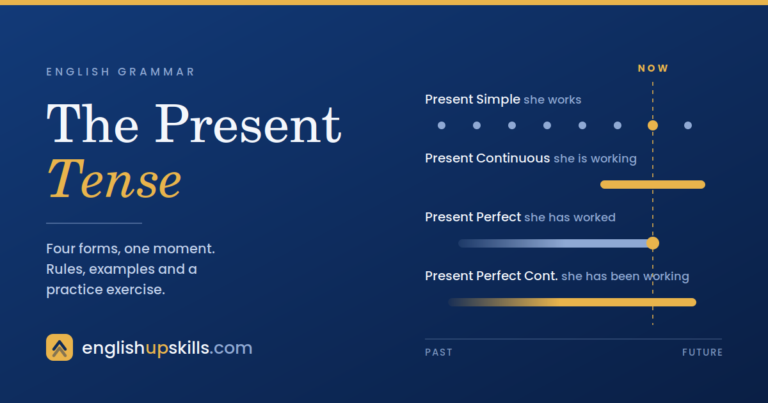
The difference from the present perfect is emphasis. I’ve painted the kitchen focuses on the finished job. I’ve been painting the kitchen focuses on the time and effort spent, and the kitchen may not be finished.
The Past Tenses
5. Past Simple
Formula: Subject + past form of the verb (-ed for regular verbs)
Use it for:
- Finished actions at a definite past time — We moved to Leeds in 2021.
- A sequence of completed events — She opened the door, picked up the post and went inside.
- Past habits that have stopped — He smoked for years.
Negative and question: use did with the base verb. I didn’t go. / Did you go? Never I didn’t went.
Common mistake: irregular verbs. There is no rule for these, only exposure. Go → went, buy → bought, think → thought, teach → taught, catch → caught. Learn them in groups that rhyme and they stick faster.
6. Past Continuous
Formula: Subject + was/were + verb-ing
Use it for:
- An action in progress at a past moment — At eight last night I was cooking dinner.
- A background action interrupted by another — I was crossing the road when the car pulled out.
- Two actions happening at once — She was reading while he was working.
The pattern to remember: the past continuous sets the scene, the past simple is the event that cuts into it.
7. Past Perfect
Formula: Subject + had + past participle
Use it for one job only: showing that one past action happened before another past action.
By the time we arrived, the meeting had finished. She had already eaten, so she just ordered coffee.
If the order of events is obvious from before, after, or from the sequence itself, the past perfect is optional. After he left, she called. is perfectly correct.
Common mistake: overusing it. You only need the past perfect when the sequence would otherwise be unclear.
8. Past Perfect Continuous
Formula: Subject + had been + verb-ing
Use it for an activity that had been going on for a period before another past event.
He’d been waiting for an hour before the train finally came. They were exhausted because they had been driving since dawn.
It is the past version of the present perfect continuous. The reference point simply shifts backwards.
The Future Tenses
9. Future Simple
Formula: Subject + will + base verb
Use it for:
- Decisions made at the moment of speaking — That’s the doorbell. I’ll get it.
- Predictions — I think prices will fall next year.
- Promises and offers — I’ll send it over this afternoon.
- Facts about the future — The conference will be held in Birmingham.
Will vs going to: use going to when you have already decided or when there is present evidence. I’m going to start the course in September (already planned). Look at those clouds — it’s going to rain (visible evidence). Use will for spontaneous decisions and general predictions.
10. Future Continuous
Formula: Subject + will be + verb-ing
Use it for:
- An action in progress at a future moment — This time tomorrow I’ll be flying to Dubai.
- Planned or expected future events — I’ll be seeing Tom later, so I’ll ask him.
- Polite enquiries about plans — Will you be using the car this evening?
That last use is worth noting. Will you be using the car? sounds softer and less demanding than Will you use the car?
11. Future Perfect
Formula: Subject + will have + past participle
Use it for something that will be finished before a point in the future.
By December, I’ll have completed the training. She’ll have left by the time you get there.
It almost always appears with by + a future time.
12. Future Perfect Continuous
Formula: Subject + will have been + verb-ing
Use it to emphasise how long something will have lasted by a future point.
Next month, I’ll have been working here for ten years. By midnight, they’ll have been travelling for eighteen hours.
This is the least common tense in everyday English. Learn to recognise it, but do not worry about producing it often.
How to Choose the Right Tense
When you are unsure, ask yourself three questions in order:
- When did it happen? Past, present, or future. This gives you the column.
- Is it finished or ongoing? Finished points to simple or perfect; ongoing points to continuous.
- Does it connect to another point in time? If yes, you need a perfect form.
Take “I ___ here for three years.”
Is it past, present or future? The situation continues now, so present. Is it ongoing? Yes. Does it connect to an earlier point? Yes, three years ago. That gives you the present perfect: I have lived here for three years.
Five Mistakes That Cost Learners Marks
- Using the present simple for right now. I go to the shops is a habit. If you mean this moment, say I’m going to the shops.
- Mixing the present perfect with finished time. I have finished it yesterday should be I finished it yesterday.
- Adding -ing to state verbs. I am wanting a coffee should be I want a coffee.
- Double past in questions and negatives. Did you went? should be Did you go?
- Switching tenses mid-story. Pick a time frame and stay in it unless the meaning genuinely changes.
Quick Practice
Choose the correct form. Answers below.
- She ___ (work) here since 2018.
- When I got home, the film ___ (already start).
- Listen — someone ___ (knock) at the door.
- By next summer, we ___ (save) enough for the deposit.
- I ___ (see) that film last weekend.
Answers: 1. has worked / has been working 2. had already started 3. is knocking 4. will have saved 5. saw
Frequently Asked Questions
How many tenses are there in English? There are twelve tenses in common use, formed by combining three times (past, present, future) with four aspects (simple, continuous, perfect, perfect continuous). Some grammarians argue English technically has only two true tenses, past and present, with the rest formed using auxiliary verbs, but for learning purposes the twelve-tense model is the standard.
What is the difference between the present perfect and the past simple? The past simple describes a finished action at a known past time. The present perfect describes a past action that still matters now, or one with no specific time attached. I lost my keys yesterday uses the past simple because the time is stated. I’ve lost my keys uses the present perfect because the keys are still missing.
Which tenses are most important to learn first? Present simple, past simple, present continuous and future with will or going to. These four cover the large majority of everyday conversation. Add the present perfect next, then work through the remaining forms.
Why is the present perfect so difficult? Many languages use their past tense where English uses the present perfect, so the instinct to translate directly leads learners astray. The trick is to stop translating and instead ask whether the action still connects to now.
What is the hardest English tense? Learners usually find the present perfect and present perfect continuous hardest, because the difference between them is about emphasis rather than fact. The future perfect continuous is the rarest, but it is easy to form once you know the pattern.
Final Thoughts
Twelve tenses sounds like a lot until you see it as a grid of three times and four aspects. Learn the four aspects properly and the rest is pattern recognition.
Start with the four core tenses, read plenty of English, and pay attention to which tense native speakers choose in each situation. Rules teach you the shape; reading teaches you the instinct.