
Have you ever heard someone say “I don’t know nothing” and wondered if it is correct? It is one of the most common errors learners make. Double negatives in English happen when two negative words appear in the same clause, and in standard English the two negatives cancel each other out or simply sound wrong. In this guide you will learn what a double negative is, the simple rules for avoiding one, and how to fix any sentence quickly. If you are working through our sentence correction rules, this is one of the easiest marks to win back.
Quick answer — how to avoid double negatives:
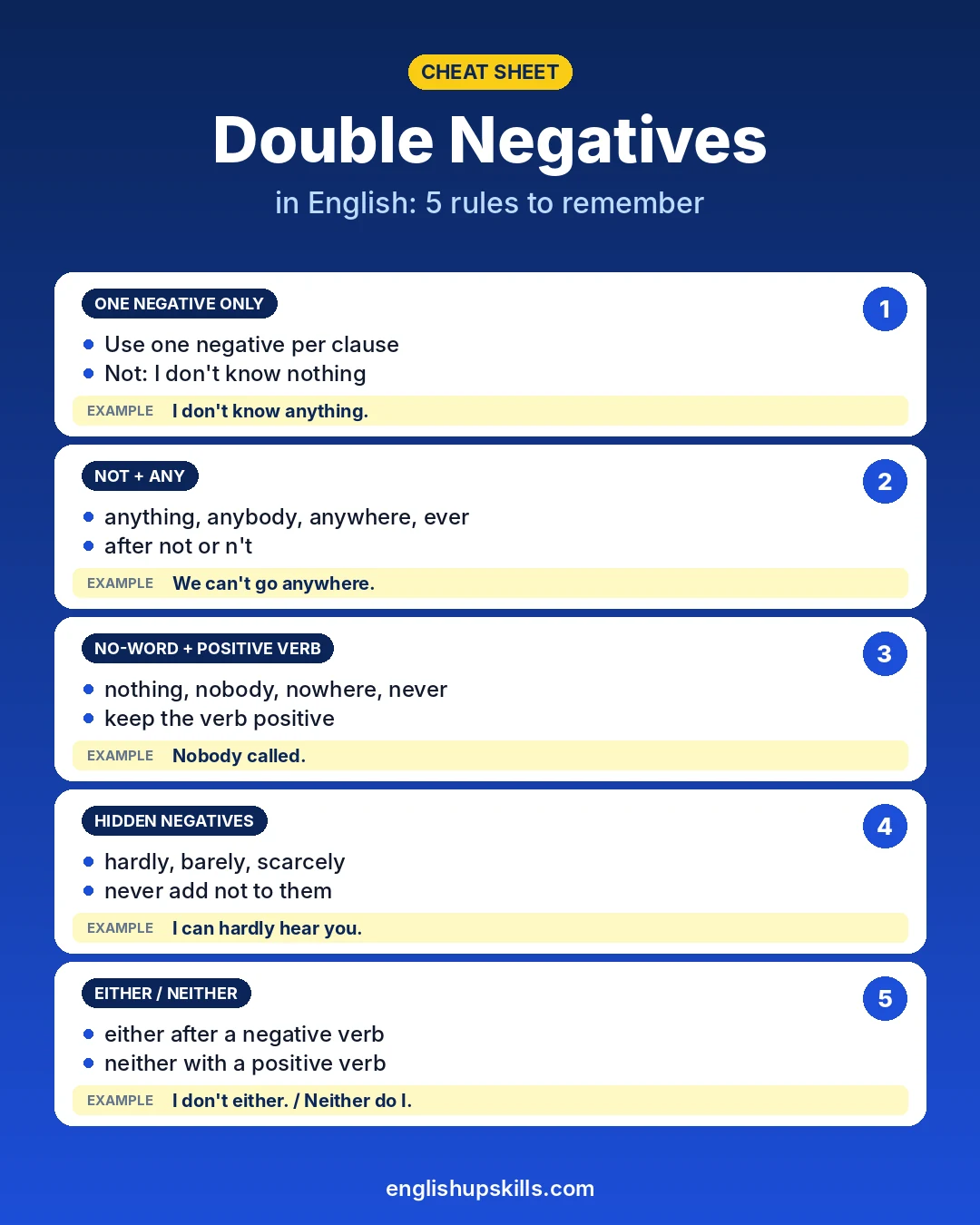
- Use only one negative word in each clause.
- After not or n’t, use any words: anything, anybody, anywhere, ever.
- Without not, use no words: nothing, nobody, nowhere, never.
- Hardly, barely and scarcely are already negative, so do not add not.
- Use either after a negative verb and neither without one.
What is a double negative?
A double negative is a sentence or clause that contains two negative words when the speaker means only one negative idea. Look at this example:
- Wrong: I didn’t see nobody at the station.
- Correct: I didn’t see anybody at the station.
- Also correct: I saw nobody at the station.
The speaker wants to say “zero people”. The word didn’t already makes the sentence negative, so nobody adds a second negative that is not needed. In logic, two negatives make a positive, so a strict reader could understand “I didn’t see nobody” as “I saw somebody”. That is why teachers, examiners and employers treat it as a mistake.
You will hear double negatives in songs, films and some regional dialects of English. They are part of real speech for many people, and they are not “lazy”. However, they are not part of standard written English, which is what you need for exams, emails, job applications and formal speaking. This fits with the wider English grammar rules used in formal writing: one idea, one clear marker.
Negative words in English
Before you can avoid a double negative, you need to recognise the negative words. Here are the main ones, with the positive (any-type) word that replaces each one after not.
| Negative word | Use after not / n’t | Example with one negative |
|---|---|---|
| no | any | There isn’t any milk. / There is no milk. |
| nothing | anything | She didn’t say anything. / She said nothing. |
| nobody / no one | anybody / anyone | I don’t know anybody here. / I know nobody here. |
| nowhere | anywhere | We aren’t going anywhere. / We are going nowhere. |
| never | ever | He doesn’t ever call. / He never calls. |
| none | any | I don’t want any. / I want none. |
| neither | either | I don’t like either option. / I like neither option. |
| nor | or | She doesn’t eat meat or fish. / She eats neither meat nor fish. |
Remember that not and its short form n’t are negative too. That is where most double negatives start: a learner uses don’t, can’t or won’t, then adds another negative word later in the sentence.
The rules for avoiding double negatives
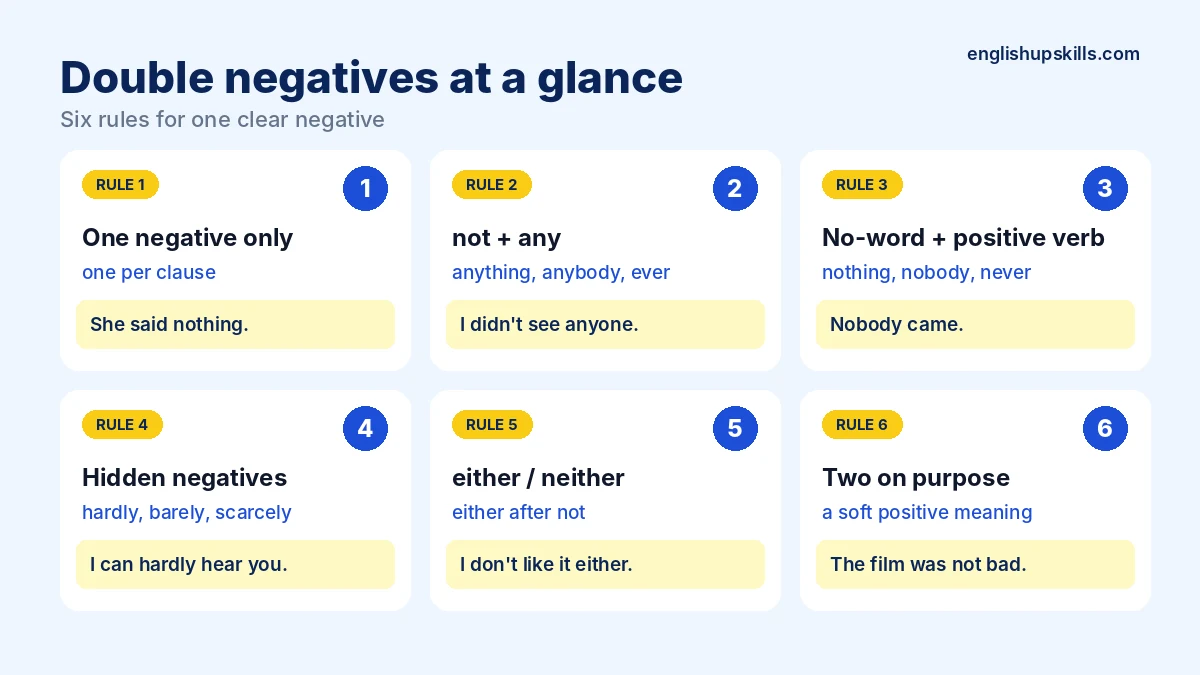
Rule 1: Use only one negative in each clause
This is the golden rule. Choose either a negative verb (with not) or a negative word (like nothing), but not both. The rule works the same way in every tense, so you can apply it whether you are using the present simple, the past simple or the future (see our guide to the 12 tenses in English). For a refresher on how to make negative sentences, the British Council explains how not goes after the first part of the verb.
| Tense | Wrong | Correct |
|---|---|---|
| Present simple | She doesn’t need nothing. | She doesn’t need anything. |
| Past simple | They didn’t go nowhere. | They didn’t go anywhere. |
| Present perfect | I haven’t never been to Paris. | I have never been to Paris. |
| Future | We won’t tell nobody. | We won’t tell anybody. |
Rule 2: After not, use any, anything, anybody, anywhere and ever
When the verb is already negative, the words that follow should be the “any” family. Think of not + any as a pair that always works together.
- I can’t find my keys anywhere.
- He didn’t eat anything for breakfast.
- We haven’t ever met before.
Rule 3: Without not, use no, nothing, nobody, nowhere and never
If you want a stronger or more formal sentence, keep the verb positive and use a “no” word instead. Both versions are correct, but the “no” version often sounds more emphatic.
- There is nothing in the fridge. (= There isn’t anything in the fridge.)
- Nobody called while you were out.
- I have never seen snow.
Note that when the negative word is the subject, you must use the “no” form. You cannot say “Anybody didn’t come”. The correct sentence is Nobody came.
Rule 4: Hardly, barely and scarcely are already negative
Many learners miss this one. The adverbs hardly, barely, scarcely and rarely have a negative meaning (“almost not”). Adding not creates a hidden double negative.
| Wrong | Correct |
|---|---|
| I can’t hardly hear you. | I can hardly hear you. |
| She didn’t barely sleep last night. | She barely slept last night. |
| There isn’t scarcely any time left. | There is scarcely any time left. |
Notice that any follows hardly and scarcely, just as it follows not: hardly anything, hardly anyone, hardly ever.
Rule 5: Use either after a negative verb and neither without one
When you agree with a negative statement, use either with a negative verb, or neither with a positive verb.
- A: I don’t like horror films. B: I don’t either. / Neither do I.
- Wrong: I don’t like neither of them.
- Correct: I don’t like either of them. / I like neither of them.
Rule 6: Two negatives can be correct when you mean a positive
Sometimes a speaker uses two negatives on purpose to make a careful, polite positive. This is called litotes, and it is common in British English.
- The film was not bad. (= quite good)
- It’s not impossible. (= it is possible, but difficult)
- I can’t not go to her wedding. (= I must go)
These sentences are correct because the speaker really does mean a positive idea. Use them carefully, and only when you want that softer meaning.
How to fix a double negative in two steps
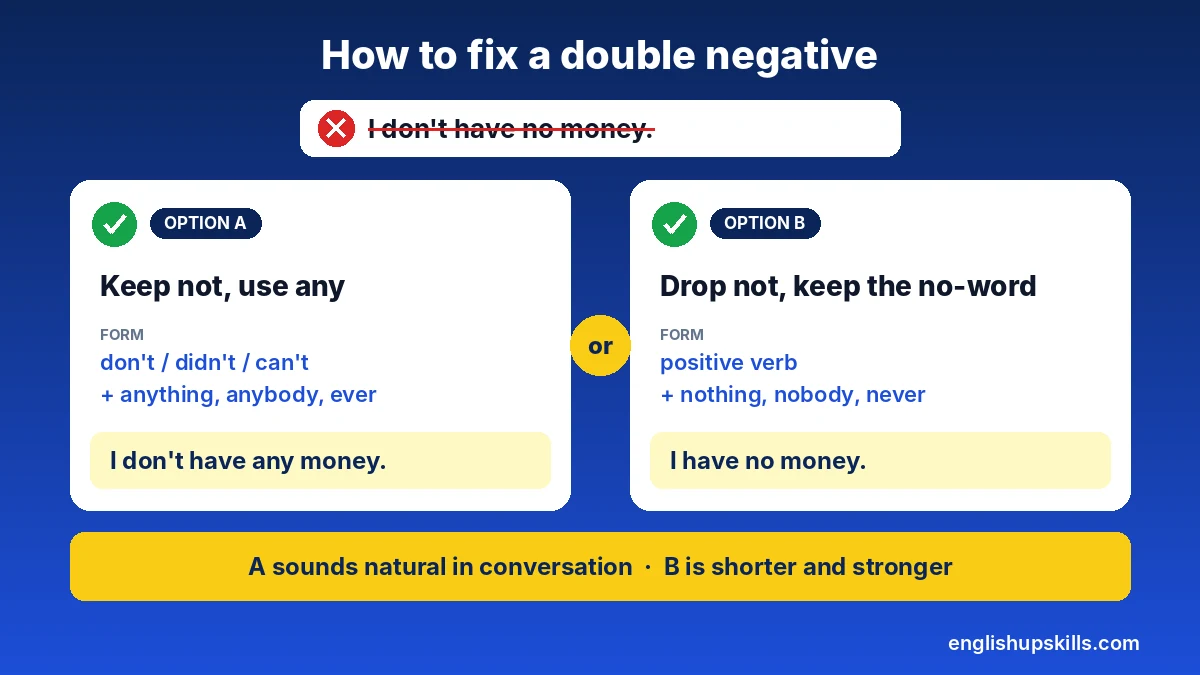
When you spot a double negative in your writing, you have two simple choices. Both give you a correct sentence.
| Step | What to do | Example |
|---|---|---|
| 1. Find both negatives | Underline not / n’t and the second negative word | I don’t have no money. |
| 2A. Keep not, change the other word | Replace the no-word with its any-word | I don’t have any money. |
| 2B. Remove not, keep the no-word | Make the verb positive | I have no money. |
Option A usually sounds more natural in everyday conversation. Option B is shorter and more emphatic, so it suits strong statements and formal writing.
Double negatives in short answers and question tags
Short answers and question tags follow the same one-negative rule, but learners often add an extra negative by mistake.
| Situation | Wrong | Correct |
|---|---|---|
| Short answer | Did you see anyone? No, I didn’t see nobody. | No, I didn’t. / No, I saw nobody. |
| Question tag after a no-word | Nobody called, didn’t they? | Nobody called, did they? |
| Question tag after never | He never smiles, doesn’t he? | He never smiles, does he? |
| Agreeing | I don’t like it. I don’t neither. | Me neither. / Neither do I. |
The key point is that words like nobody, nothing and never make the whole sentence negative. That is why the question tag must be positive, just as it would be after a sentence with not. If you remember that a negative sentence takes a positive tag, you will choose the right form every time.
Common mistakes with double negatives
The table below shows the errors examiners see most often. Some of them also involve words that look alike, so it is worth reviewing our list of commonly confused words as well.
| Wrong | Correct | Why |
|---|---|---|
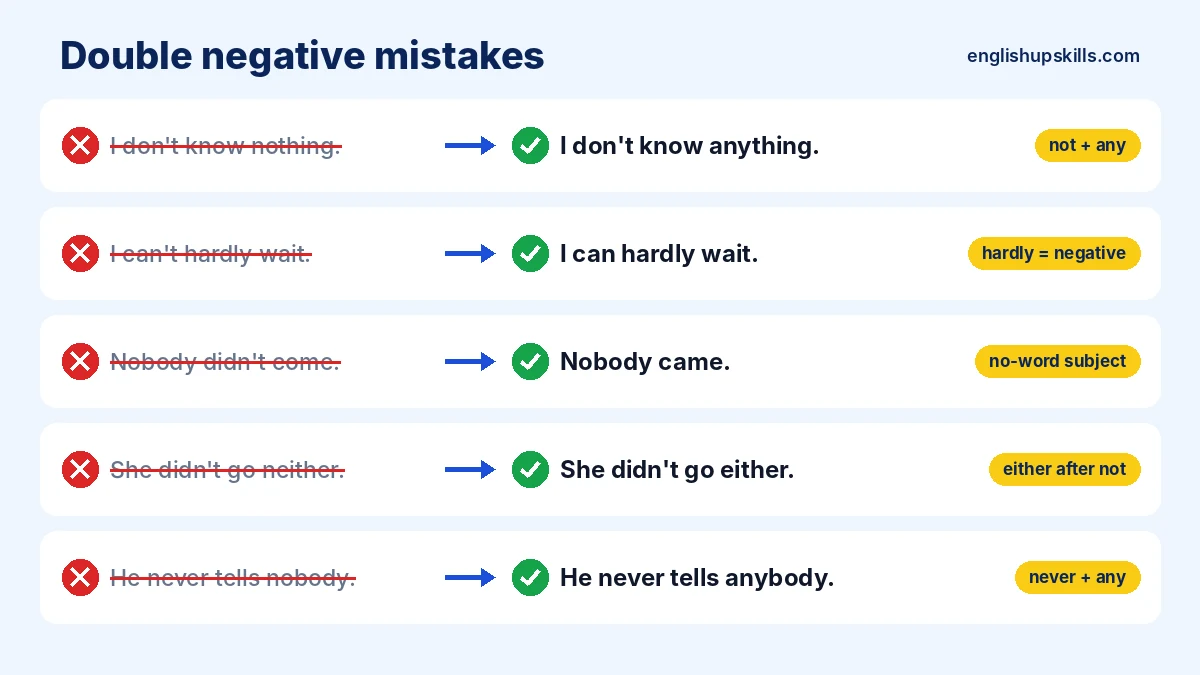
| I don’t know nothing about it. | I don’t know anything about it. | not + nothing = two negatives |
| He never tells nobody. | He never tells anybody. | never is already negative |
| I can’t hardly wait. | I can hardly wait. | hardly already means “almost not” |
| There isn’t no reason to worry. | There is no reason to worry. | use no or not any, not both |
| She didn’t go neither. | She didn’t go either. | use either after a negative verb |
| Nobody didn’t come. | Nobody came. | a negative subject needs a positive verb |
| I haven’t got none. | I haven’t got any. | none becomes any after not |
Double negatives in speaking and exams
In IELTS, Cambridge and school exams, a double negative is marked as a grammar error. In the IELTS Speaking test, one or two slips will not ruin your score, but repeated double negatives can lower your grammatical range and accuracy band. In writing tasks they are more serious, because the examiner expects careful, standard English.
A good habit is to check every sentence that contains not or n’t. Ask yourself: “Is there another negative word later in this clause?” If yes, change it to the any-form. This takes only a few seconds and removes the error for good.
Practice exercise
Correct each sentence. Some sentences can be fixed in two ways.
- I didn’t buy nothing at the market.
- We can’t go nowhere tonight.
- She hasn’t never been late.
- There wasn’t nobody in the office.
- I can’t barely see the board.
- He doesn’t like neither of the jackets.
- Nobody didn’t answer the phone.
- They don’t want no help.
Answers:
- I didn’t buy anything at the market. / I bought nothing at the market.
- We can’t go anywhere tonight.
- She has never been late. / She hasn’t ever been late.
- There wasn’t anybody in the office. / There was nobody in the office.
- I can barely see the board.
- He doesn’t like either of the jackets. / He likes neither of the jackets.
- Nobody answered the phone.
- They don’t want any help. / They want no help.
Frequently asked questions
What is a double negative in English?
A double negative is the use of two negative words in one clause, such as not and nothing, when only one negative meaning is intended. For example, “I don’t want nothing” should be I don’t want anything.
Is “I don’t know nothing” grammatically correct?
No, not in standard English. Say I don’t know anything or I know nothing. The original form is used in some dialects and songs, but it is marked wrong in exams and formal writing.
Do two negatives make a positive in English?
In logic, yes. That is why some double negatives can confuse readers. When a speaker uses two negatives on purpose, as in It’s not impossible, the meaning is a soft positive.
Is “can’t hardly” a double negative?
Yes. Hardly already means “almost not”, so “can’t hardly” has two negatives. The correct form is I can hardly do something.
Is “not bad” a double negative?
Not really. “Not bad” uses one negative word (not) with a negative-meaning adjective (bad). It is correct and common, and it means “fairly good”.
How can I stop making double negatives?
Remember the pair not + any. Whenever you use not or n’t, check the rest of the clause and change any no-word (nothing, nobody, nowhere, never) into its any-word (anything, anybody, anywhere, ever).
Conclusion
Double negatives are easy to fix once you know the pattern: one negative per clause, not + any, or a no-word with a positive verb. Watch out for hidden negatives such as hardly, barely and never, and use either and neither correctly. Practise by reading your sentences aloud and checking every not. To keep building accuracy and confidence when you talk, read our guide on how to improve your spoken English.