
Introduction
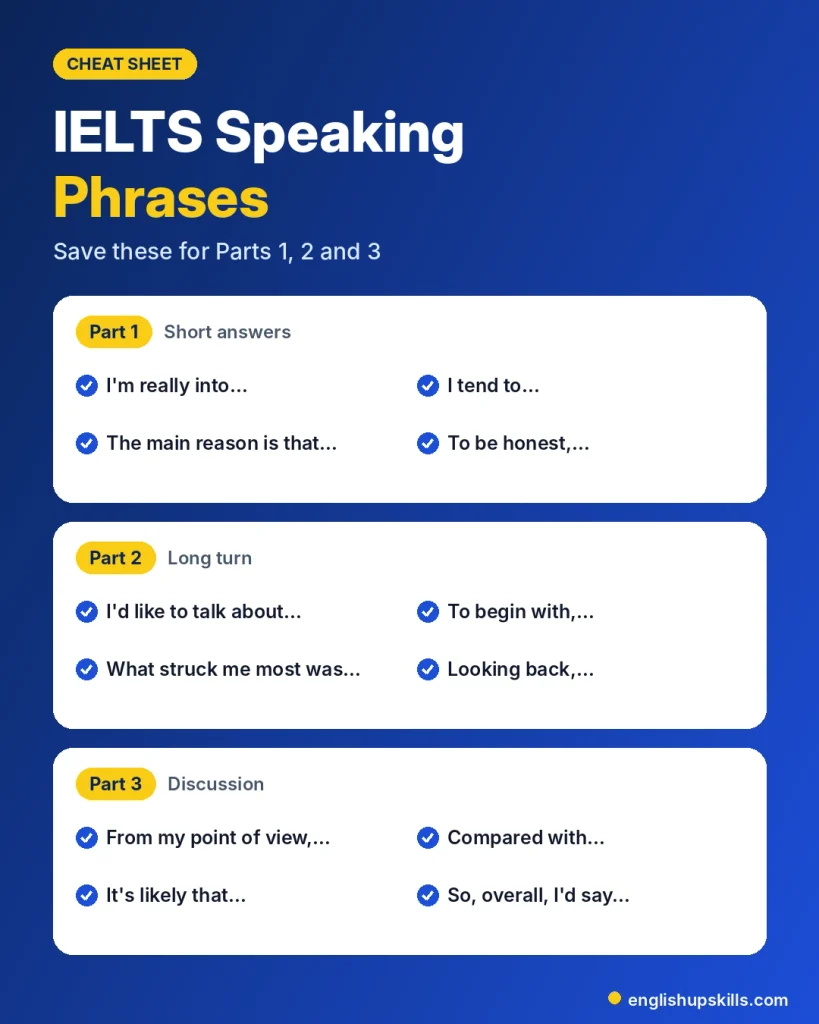
The right IELTS speaking phrases help you start answers smoothly, give opinions clearly and keep talking when your mind goes blank. Examiners do not reward memorised speeches, but they do notice when a candidate links ideas naturally and uses a wide range of everyday expressions. That is exactly what the phrases in this guide are for.
Below you will find 60 useful expressions, sorted by the three parts of the speaking test, with example answers you can adapt. If you want to build your general fluency first, read our guide on how to improve your spoken English.
Quick answer: the most useful IELTS speaking phrases
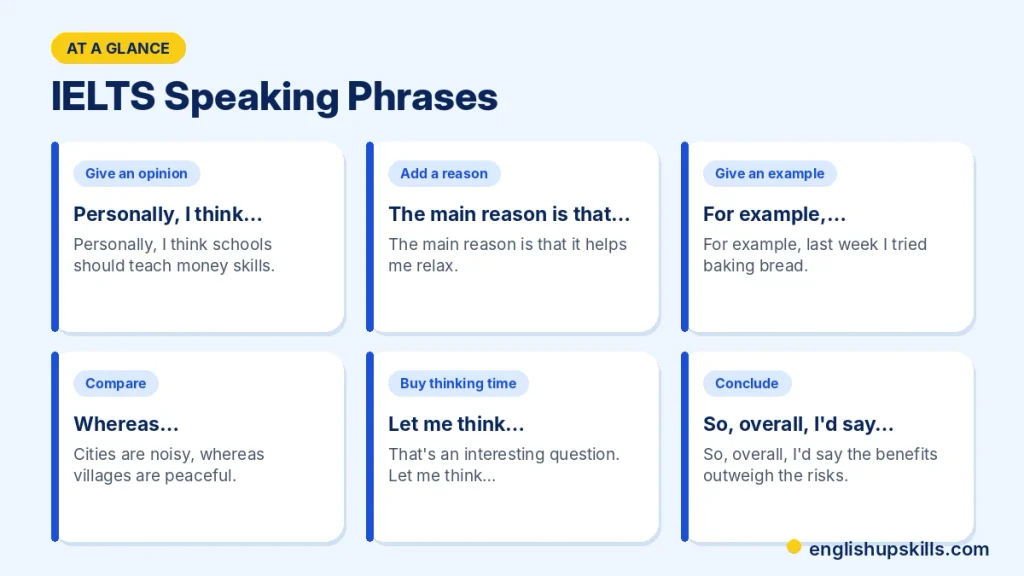
- To give an opinion: Personally, I think… / From my point of view…
- To buy thinking time: That’s an interesting question. Let me think…
- To add a reason: The main reason is that… / On top of that…
- To give an example: For instance… / A good example of this is…
- To compare: Compared with… / Whereas…
- To finish a long turn: So, that’s why it means so much to me.
- To balance an argument: On the one hand… on the other hand…
How the IELTS speaking test works
The speaking test is a face-to-face conversation with an examiner that lasts about 11 to 14 minutes and has three parts, according to the British Council’s IELTS test format page. Each part needs a slightly different kind of language, so it helps to learn phrases part by part.
| Part | What happens | Length | Phrases you need most |
|---|---|---|---|
| Part 1 — Introduction | Short questions about you, your home, work, study and hobbies | 4–5 minutes | Extending short answers, likes and dislikes, habits |
| Part 2 — Long turn | You get a task card, 1 minute to prepare, then speak for up to 2 minutes | 3–4 minutes | Starting, sequencing a story, describing feelings, finishing |
| Part 3 — Discussion | Deeper, more abstract questions linked to the Part 2 topic | 4–5 minutes | Opinions, comparing, speculating, balancing views |
Examiners score you on four areas: fluency and coherence, lexical resource (vocabulary), grammatical range and accuracy, and pronunciation. Good phrases mainly lift the first two, because they help you connect ideas and show a wider range of natural vocabulary.
IELTS speaking Part 1 phrases (1–20)
Part 1 questions are simple, so the challenge is to avoid one-word answers. A good pattern is answer + reason + example, usually in two or three sentences. Most Part 1 topics are about your routine, so you will use the present tenses a lot.
Talking about likes and dislikes
| # | Phrase | Example |
|---|---|---|
| 1 | I’m really into… | I’m really into cooking, especially spicy food. |
| 2 | I’m a big fan of… | I’m a big fan of cricket, so I watch every match. |
| 3 | I’m quite keen on… | I’m quite keen on reading before bed. |
| 4 | It’s not really my cup of tea. | Horror films? They’re not really my cup of tea. |
| 5 | I can’t stand… | I can’t stand waiting in long queues. |
| 6 | I’m not particularly fond of… | I’m not particularly fond of cold weather. |
Talking about habits and routines
| # | Phrase | Example |
|---|---|---|
| 7 | I tend to… | I tend to study in the evening when it’s quiet. |
| 8 | As a rule, I… | As a rule, I go for a walk after dinner. |
| 9 | Every now and then… | Every now and then, I visit my grandparents in the village. |
| 10 | Once in a blue moon… | I eat fast food once in a blue moon. |
| 11 | I used to…, but now… | I used to play football, but now I prefer the gym. |
| 12 | These days… | These days, I spend more time online than I’d like. |
Extending a short answer
| # | Phrase | Example |
|---|---|---|
| 13 | The main reason is that… | The main reason is that it helps me relax. |
| 14 | What I like most about it is… | What I like most about it is the friendly people. |
| 15 | For example,… | For example, last week I tried baking bread. |
| 16 | On top of that,… | On top of that, it’s very cheap. |
| 17 | It depends on… | It depends on the weather, to be honest. |
| 18 | I’d say… | I’d say I’m more of a morning person. |
| 19 | To be honest,… | To be honest, I don’t watch much TV. |
| 20 | Not really, but… | Not really, but my brother loves it. |
IELTS speaking Part 2 phrases (21–40)
In Part 2 you speak alone for up to two minutes, so you need phrases that open the talk, move it forward and close it neatly. Many cue cards ask you to describe a past experience, so check your past forms in our guide to the 12 tenses in English.
Starting your talk
| # | Phrase | Example |
|---|---|---|
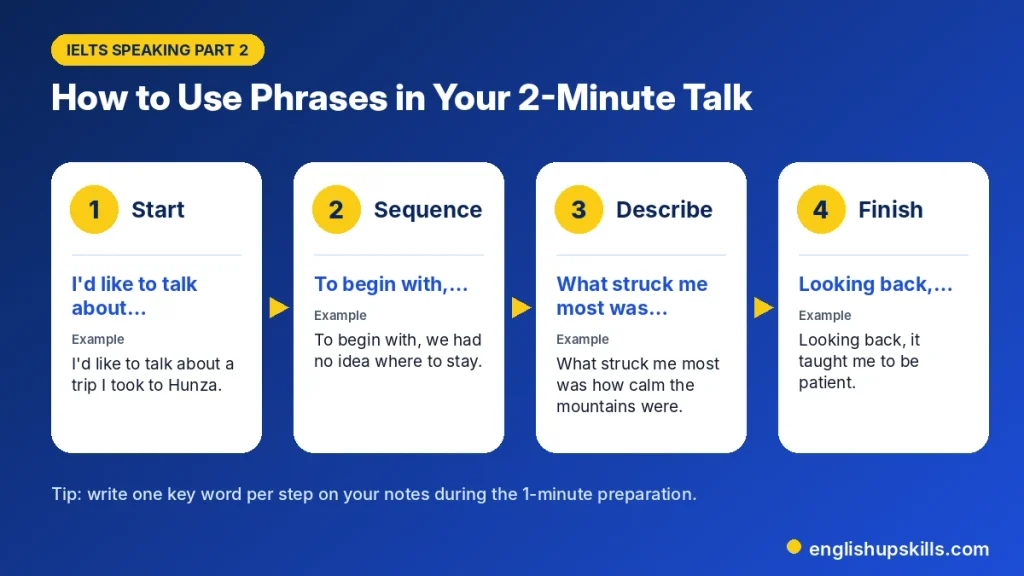
| 21 | I’d like to talk about… | I’d like to talk about a trip I took to Hunza. |
| 22 | I’m going to describe… | I’m going to describe my favourite teacher. |
| 23 | The first thing that comes to mind is… | The first thing that comes to mind is my sister’s wedding. |
| 24 | This happened about… ago. | This happened about two years ago. |
Sequencing a story
| # | Phrase | Example |
|---|---|---|
| 25 | To begin with,… | To begin with, we had no idea where to stay. |
| 26 | After that,… | After that, we took a bus to the lake. |
| 27 | Before long,… | Before long, it started raining heavily. |
| 28 | Meanwhile,… | Meanwhile, my friend was trying to find a taxi. |
| 29 | Eventually,… | Eventually, we found a small hotel. |
| 30 | What happened next was… | What happened next was a real surprise. |
Describing people, places and feelings
| # | Phrase | Example |
|---|---|---|
| 31 | What struck me most was… | What struck me most was how calm the mountains were. |
| 32 | It was the kind of place where… | It was the kind of place where time seems to stop. |
| 33 | I was over the moon. | When I got the result, I was over the moon. |
| 34 | It was a bit of a let-down. | The final match was a bit of a let-down. |
| 35 | I’ll never forget… | I’ll never forget the smell of fresh bread there. |
| 36 | He/She has a great sense of humour. | My uncle has a great sense of humour. |
Finishing your talk
| # | Phrase | Example |
|---|---|---|
| 37 | Looking back,… | Looking back, it taught me to be patient. |
| 38 | That’s why it means so much to me. | That’s why it means so much to me. |
| 39 | All in all,… | All in all, it was one of the best days of my life. |
| 40 | If I had the chance, I’d… | If I had the chance, I’d go back tomorrow. |
IELTS speaking Part 3 phrases (41–60)
Part 3 questions are more abstract: society, education, technology, the future. Here the examiner wants to hear you give opinions, explain causes, compare and predict. Longer, well-linked answers of four to six sentences work best.
Giving and supporting opinions
| # | Phrase | Example |
|---|---|---|
| 41 | Personally, I think… | Personally, I think schools should teach money skills. |
| 42 | From my point of view,… | From my point of view, public transport should be free. |
| 43 | I’m convinced that… | I’m convinced that reading builds empathy. |
| 44 | I’d argue that… | I’d argue that working from home saves time. |
| 45 | As far as I’m concerned,… | As far as I’m concerned, health matters more than wealth. |
Buying thinking time
| # | Phrase | Example |
|---|---|---|
| 46 | That’s an interesting question. | That’s an interesting question. I haven’t thought about it before. |
| 47 | Let me think about that for a moment. | Let me think about that for a moment. |
| 48 | It’s hard to say, but… | It’s hard to say, but I’d guess most people agree. |
Comparing and contrasting
| # | Phrase | Example |
|---|---|---|
| 49 | Compared with… | Compared with my parents’ generation, we travel much more. |
| 50 | Whereas… | Cities are noisy, whereas villages are peaceful. |
| 51 | On the one hand… on the other hand… | On the one hand, phones connect us; on the other hand, they distract us. |
| 52 | There’s a big difference between… and… | There’s a big difference between knowing a rule and using it. |
Explaining causes and effects
| # | Phrase | Example |
|---|---|---|
| 53 | This is mainly because… | This is mainly because housing is so expensive. |
| 54 | As a result,… | As a result, many young people live with their parents. |
| 55 | This leads to… | Too much screen time leads to poor sleep. |
Speculating about the future
| # | Phrase | Example |
|---|---|---|
| 56 | I imagine that… | I imagine that most jobs will use AI in some way. |
| 57 | It’s likely that… | It’s likely that cars will become electric. |
| 58 | In the long run,… | In the long run, this could save a lot of money. |
Agreeing partly and concluding
| # | Phrase | Example |
|---|---|---|
| 59 | I agree up to a point, but… | I agree up to a point, but exams aren’t everything. |
| 60 | So, overall, I’d say… | So, overall, I’d say the benefits outweigh the risks. |
Sample Part 3 answer
Examiner: Do you think people read less than in the past?
Candidate: It’s hard to say, but I’d guess people read just as much, only in a different way. Compared with twenty years ago, we read far more short texts on our phones. This is mainly because apps make news and messages so easy to reach. On the other hand, fewer people sit down with a long book. So, overall, I’d say we read more words but fewer books.
Common mistakes with IELTS speaking phrases
Even strong candidates lose marks by using phrases in an unnatural or incorrect way. Small word choices matter too, so it is worth revising commonly confused words in English.
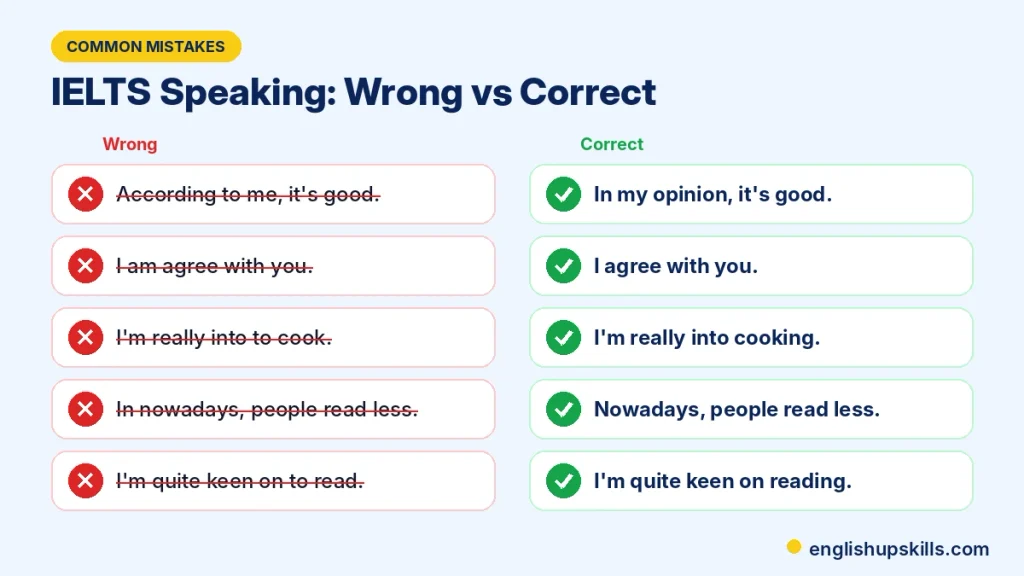
| Wrong | Correct | Why |
|---|---|---|
| In my opinion, it’s good. | According to is used for other people or sources, not yourself. | |
| I agree with you. | Agree is a verb, so it does not need am. | |
| I’m really into cooking. | After into, keen on and fond of, use a noun or -ing form. | |
| I play football every Sunday now. | Used to is only for past habits that have stopped. | |
| Well, mainly because… | Long lists of linkers sound like a written essay in short answers. | |
| Use idioms only when they fit the meaning. | Forced idioms sound memorised and can lower your vocabulary score. | |
| Use it once, then vary or answer directly. | Repeating one filler shows a narrow range. | |
| Nowadays, people… | Nowadays never takes in. |
Practice exercise
A. Choose the best phrase to complete each answer.
- Do you like cooking? — Yes, I’m really ___ cooking. (into / agree / according)
- Describe a trip. — ___, we had no idea where to stay. (To begin with / In nowadays / Up to a point)
- Is technology good for children? — On the one hand, it helps them learn; ___, it can be addictive. (as a rule / on the other hand / once in a blue moon)
- Will cities change in the future? — ___ that more people will cycle. (I used to / It’s likely / I can’t stand)
- Do you watch horror films? — Not really. They’re not really my cup of ___. (coffee / tea / plate)
B. Correct the mistake in each sentence.
- According to me, exams are stressful.
- I am agree that sport is important.
- In nowadays, young people use their phones a lot.
- I’m quite keen on to read novels.
- I used to go to the gym every day now.
Answers
- into
- To begin with
- on the other hand
- It’s likely
- tea
- In my opinion, exams are stressful.
- I agree that sport is important.
- Nowadays, young people use their phones a lot.
- I’m quite keen on reading novels.
- I go to the gym every day now. (or: I used to go to the gym every day.)
Frequently asked questions
What are the best phrases for IELTS speaking?
The best phrases are the ones that help you do a job: give an opinion (Personally, I think…), add a reason (The main reason is that…), give an example (For instance…) and compare (Whereas…). Learn a few for each job rather than a long list you cannot use naturally.
Can I memorise answers for the IELTS speaking test?
No. Examiners are trained to spot memorised answers, and these can lower your fluency and coherence score. Memorise flexible phrases instead, then build fresh answers around them.
How many phrases should I use in one answer?
Two or three in a Part 1 answer and four to six in a Part 3 answer is plenty. The phrases should support your ideas, not fill every sentence.
Do idioms help me get a band 7 or higher?
Idioms can help when they are accurate and fit the context, because band 7 vocabulary includes some less common and idiomatic language. Forced or old-fashioned idioms, such as raining cats and dogs, often sound unnatural.
What should I say if I don’t understand the question?
Ask politely: “Sorry, could you repeat the question, please?” or “Do you mean…?” Asking once is perfectly normal and does not lose you marks.
How can I practise IELTS speaking phrases at home?
Pick five phrases a day, write one example sentence for each, then answer three sample questions aloud using them. Record yourself, listen back and replace any phrase you overused.
Conclusion
These 60 IELTS speaking phrases give you a tool for every moment of the test: extending short answers in Part 1, shaping a clear story in Part 2 and giving balanced opinions in Part 3. Learn them in small groups, practise them aloud every day and keep your answers natural rather than memorised.
Phrases work best on top of solid grammar, so keep revising the basics with our English grammar rules guide.