
The future tense in English helps you talk about plans, predictions, promises and things that will happen later. If you can use it well, you can say what you will do tomorrow, describe your goals in a job interview, or make a promise to a friend.
Many learners think the future tense is just “will”. In fact, English has four future tenses, plus two very common future forms: going to and the present continuous. This guide explains each one with simple rules, clear tables and real examples.
Quick answer: the 4 future tenses
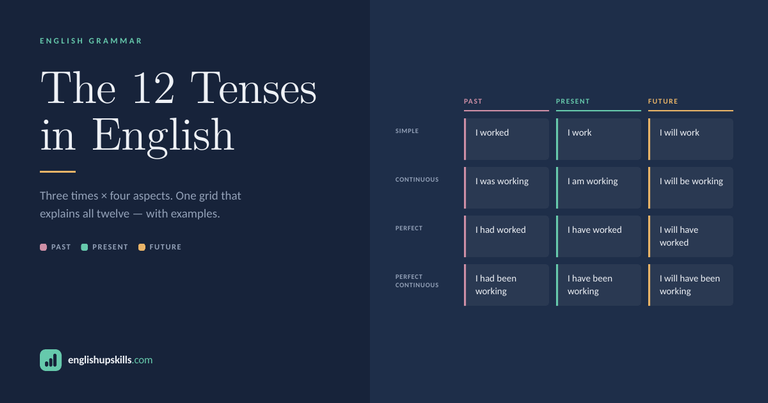
- Future simple: I will help you.
- Future continuous: I will be working at 9 pm.
- Future perfect: I will have finished by Friday.
- Future perfect continuous: I will have been living here for ten years in June.
If you are new to tenses, start with our guide to the 12 tenses in English. Then come back here to master the future.
The 4 types of future tense
Every future tense starts with will. What comes after “will” tells the listener whether the action is simple, in progress, completed or ongoing up to a future point.
1. Future simple tense
The future simple is the most common future tense. We use it for quick decisions, predictions, promises, offers and facts about the future.
| Sentence type | Structure | Example |
|---|---|---|
| Positive | subject + will + base verb | She will call you tonight. |
| Negative | subject + will not (won’t) + base verb | I won’t forget your birthday. |
| Question | Will + subject + base verb? | Will they come to the party? |
When to use the future simple:
- Instant decisions: The phone is ringing. I**’ll answer** it.
- Predictions based on opinion: I think Pakistan will win the match.
- Promises: I will pay you back next week.
- Offers and requests: Will you help me with this box?
- Future facts: The sun will rise at 6:45 tomorrow.
Tip: In speaking, we almost always use the short form: I’ll, you’ll, she’ll, we’ll, they’ll, won’t.
2. Future continuous tense
The future continuous describes an action that will be in progress at a specific time in the future.
| Sentence type | Structure | Example |
|---|---|---|
| Positive | subject + will be + verb-ing | At 8 pm, I will be watching the news. |
| Negative | subject + won’t be + verb-ing | She won’t be working on Sunday. |
| Question | Will + subject + be + verb-ing? | Will you be using the car tonight? |
When to use the future continuous:
- An action in progress at a future time: This time tomorrow, we will be flying to London.
- Polite questions about plans: Will you be joining us for dinner?
- Things that will happen as part of a normal routine: I**’ll be passing** the shop anyway, so I can buy milk.
3. Future perfect tense
The future perfect describes an action that will be finished before a certain time in the future. Look for words like by, by the time and before.
| Sentence type | Structure | Example |
|---|---|---|
| Positive | subject + will have + past participle | I will have finished the report by 5 pm. |
| Negative | subject + won’t have + past participle | They won’t have arrived before lunch. |
| Question | Will + subject + have + past participle? | Will you have saved enough money by June? |
When to use the future perfect:
- A deadline: By next year, she will have completed her degree.
- Before another future event: By the time you wake up, I will have left for work.
4. Future perfect continuous tense
sThe future perfect continuous shows how long an action will have been happening up to a point in the future. It usually includes for + a period of time.
| Sentence type | Structure | Example |
|---|---|---|
| Positive | subject + will have been + verb-ing | In May, I will have been teaching for five years. |
| Negative | subject + won’t have been + verb-ing | He won’t have been waiting long. |
| Question | Will + subject + have been + verb-ing? | How long will you have been studying English by December? |
When to use the future perfect continuous:
- Duration up to a future point: By 6 pm, we will have been driving for nine hours.
- Explaining a future result: She will be tired because she will have been running all morning.
This is the least common future tense. You will hear it more in formal speaking and writing, such as IELTS and job interviews.
Will vs going to vs present continuous
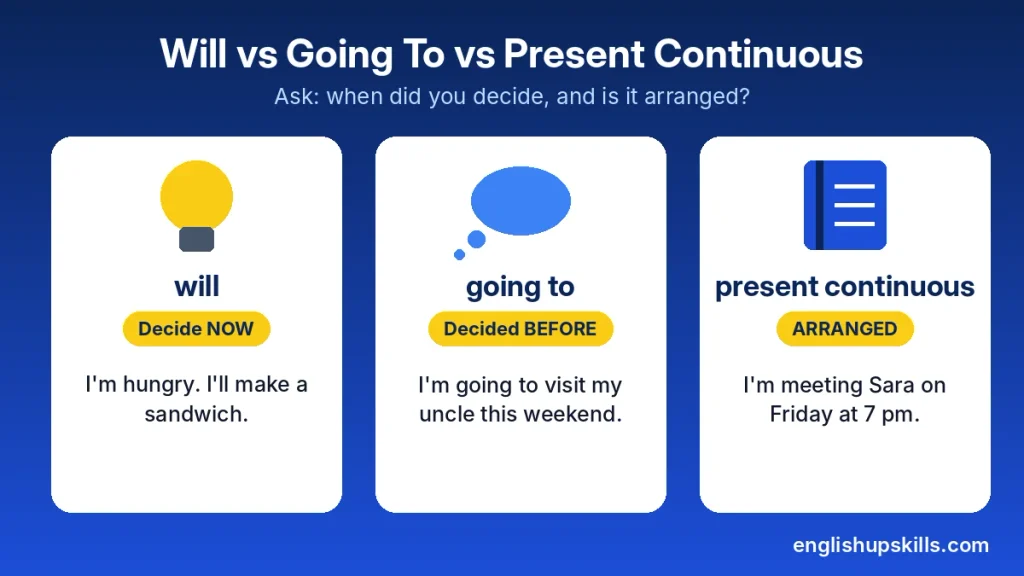
This is where most learners get confused. All three talk about the future, but each one shows when you made the decision and how sure the plan is.
| Form | Use it for | Example |
|---|---|---|
| will | A decision made at the moment of speaking, or an opinion about the future | I’m hungry. I**’ll make** a sandwich. |
| be going to | A plan you decided before speaking, or a prediction based on what you can see now | I**’m going to visit** my uncle this weekend. Look at those clouds. It**’s going to rain**. |
| present continuous | A fixed arrangement with a time, a place or another person | I**’m meeting** Sara at 7 pm on Friday. |
A simple way to remember it
- will = I decide now.
- going to = I decided before.
- present continuous = it is arranged (booked, agreed, in the diary).
Compare these three sentences:
- “Oh, the bin is full. I**’ll take** it out.” (a new decision)
- “I**’m going to clean** the whole house on Saturday.” (a plan in my head)
- “I**’m seeing** the dentist at 10 am tomorrow.” (an appointment)
The British Council’s LearnEnglish guide to future forms uses the same three-way split, so this rule will serve you well in exams.
What about the present simple for the future?
We also use the present simple for timetables and schedules, such as trains, flights, classes and TV programmes.
- The train leaves at 9:15 tomorrow.
- The exam starts on Monday.
You can review this form in our guide to the present tense.
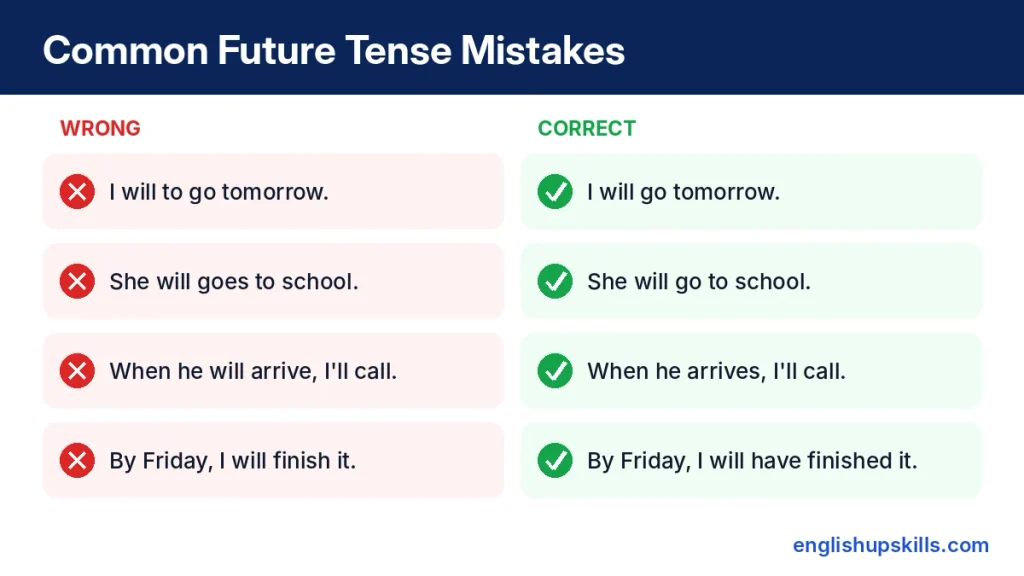
Common future tense mistakes
These are the errors we see most often. Fixing them will make your English sound more natural straight away. For more fixes like these, see our sentence correction rules.
| Wrong | Correct | Why |
|---|---|---|
| I will to go tomorrow. | I will go tomorrow. | After “will”, use the base verb without “to”. |
| She will goes to school. | She will go to school. | “Will” never takes -s, -ed or -ing on the next verb. |
| When he will arrive, I will call you. | When he arrives, I will call you. | After when, if, as soon as, before, after, use the present simple. |
| I will meet my friend at 6. It’s booked. | I**’m meeting** my friend at 6. | A fixed arrangement uses the present continuous. |
| Look at the sky! It will rain. | Look at the sky! It**’s going to rain**. | A prediction based on present evidence uses “going to”. |
| By Friday, I will finish the project. | By Friday, I will have finished the project. | “By + future time” usually needs the future perfect. |
| I am go to travel next month. | I am going to travel next month. | The form is be + going to + base verb. |
Practice exercise
Choose the correct future form. Answers are below.
- Wait, I ___ (help) you carry those bags.
- We ___ (fly) to Dubai on Saturday. The tickets are booked.
- By 2030, scientists ___ (find) a cure for many diseases.
- This time next week, I ___ (lie) on a beach.
- Be careful! You ___ (drop) the plates.
- If it ___ (rain) tomorrow, we will stay at home.
- By December, she ___ (work) here for three years.
- I think the new phone ___ (be) expensive.
Answers
- ‘ll help (instant decision)
- are flying (fixed arrangement)
- will have found (finished before a future time)
- will be lying (in progress at a future time)
- are going to drop (prediction from what you can see)
- rains (present simple after “if”)
- will have been working (duration up to a future point)
- will be (opinion about the future)
Frequently asked questions
How many future tenses are there in English?
There are four: future simple, future continuous, future perfect and future perfect continuous. English also uses “going to”, the present continuous and the present simple to talk about the future.
What is the difference between will and going to?
Use “will” for decisions made at the moment of speaking. Use “going to” for plans you made earlier, or for predictions based on what you can see now.
Can I use “shall” instead of “will”?
Yes, but only with I and we, and mostly in British English. Today it is common in offers and suggestions: Shall I open the window? Shall we go?
Why can’t I use “will” after “when” or “if”?
In time and condition clauses, English uses the present simple even for the future. Say “When I get home, I’ll call you”, not “When I will get home”.
Which future tense is used most in daily conversation?
The future simple with “will”, “going to” and the present continuous are by far the most common. The future perfect continuous is rare in everyday speech.
Is “I will be going” correct?
Yes. It is the future continuous. It sounds softer and more polite than “I will go”, for example: “I’ll be going to the shops later, do you need anything?”
Conclusion
The future tense in English is easier than it looks. Remember the four tenses, then focus on the everyday choice between will, going to and the present continuous. Practise by writing five sentences about your plans for next week, using each form at least once.
Ready for the next step? Review all of the English grammar rules every learner should know, or use these tenses in conversation with our tips to improve your spoken English.