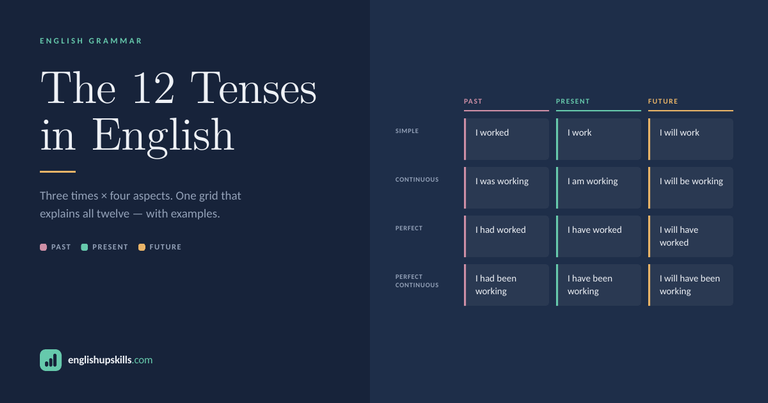

English has four present tenses: the present simple, present continuous, present perfect and present perfect continuous. Each one describes a different relationship with the moment you are speaking — a habit, an action happening right now, an experience that still matters, or an activity that has been going on for a while. This guide covers all four types of present tense with formulas, 60+ examples, the mistakes learners make most often, and a practice exercise with answers.
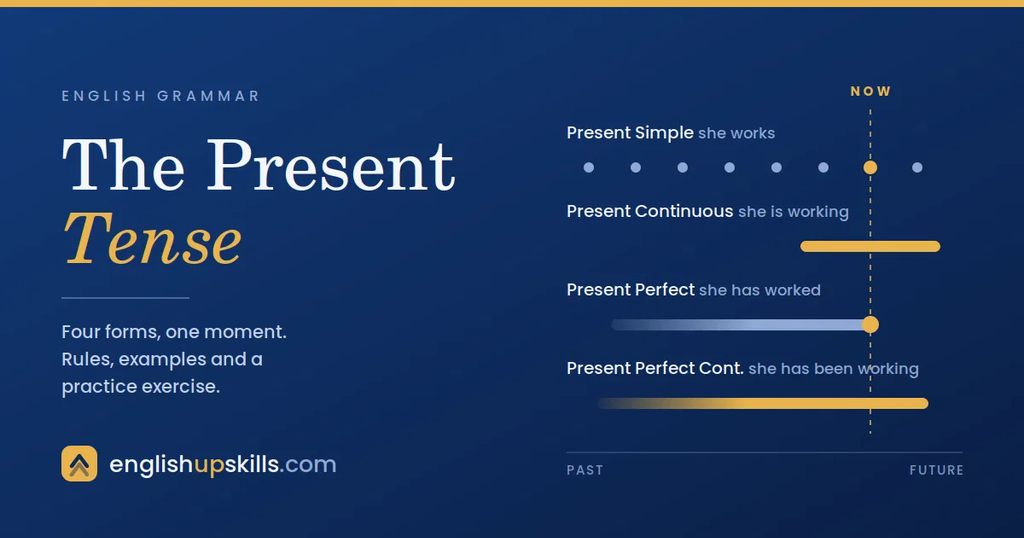
The 4 Types of Present Tense at a Glance
| Type of Present Tense | Formula | Example |
|---|---|---|
| Present Simple | subject + base verb (+ -s for he/she/it) | She works in Manchester. |
| Present Continuous | subject + am/is/are + verb-ing | She is working from home today. |
| Present Perfect | subject + have/has + past participle | She has worked here for six years. |
| Present Perfect Continuous | subject + have/has been + verb-ing | She has been working since 8 a.m. |
The formulas are the easy part. Choosing the right present tense is the real skill, and that is what most of this guide is about.
1. Present Simple Tense
Present Simple Formula
For I, you, we and they, use the base verb. For he, she, it and singular nouns, add -s or -es.
- I / you / we / they eat breakfast at seven.
- He / she / it eats breakfast at seven.
Negatives and questions use do or does:
- I don’t eat breakfast. → Do you eat breakfast?
- She doesn’t eat breakfast. → Does she eat breakfast?
Once does appears, the main verb drops the -s. “Does she eats?” is wrong; “Does she eat?” is correct.
Spelling Rules for the -s Ending
- Most verbs: add -s — work → works, play → plays
- Verbs ending in -ch, -sh, -ss, -x, -o: add -es — watch → watches, go → goes
- Consonant + -y: change y to i and add -es — study → studies
- Vowel + -y: add -s only — buy → buys
When to Use the Present Simple
- Habits and routines: I take the bus every morning.
- Permanent situations: My brother lives in Leeds and speaks three languages.
- General truths and facts: Water boils at 100 degrees Celsius.
- Timetables and schedules: The train leaves at 6:45.
- Instructions and recipes: First you chop the onions, then you add the garlic.
- Commentary and headlines: He passes to the winger, who shoots.
Signal words: always, usually, often, sometimes, rarely, never, every day, twice a week.
2. Present Continuous Tense
Present Continuous Formula
am / is / are + verb + -ing.
- I am reading. / He is reading. / They are reading.
Negatives put not after be (she isn’t reading). Questions invert the subject and be (Are you reading?).
Spelling Rules for the -ing Ending
- Most verbs: add -ing — play → playing
- Silent -e at the end: drop it — write → writing, make → making
- One syllable ending consonant–vowel–consonant: double the last letter — run → running, sit → sitting
- Ending in -ie: change to y — lie → lying, die → dying
When to Use the Present Continuous
- Actions happening right now: Be quiet — the baby is sleeping.
- Temporary situations: I am staying with my aunt this month.
- Changing situations: The cost of living is rising.
- Fixed future arrangements: We are meeting the client on Thursday.
- Annoying repeated actions: He is always losing his keys.
Signal words: now, at the moment, currently, today, this week, these days, look!, listen!
3. Present Perfect Tense
The present perfect is the hardest present tense for most learners, because many languages have no direct equivalent. The core idea is simple: something happened before now, and it still matters now.
Present Perfect Formula
have / has + past participle.
- I / you / we / they have finished.
- He / she / it has finished.
Regular past participles end in -ed (worked, played, studied). Irregular ones have to be learned individually (go → gone, see → seen, write → written, break → broken).
When to Use the Present Perfect
- Life experience, no specific time: I have visited Spain three times.
- Past action with a present result: I have lost my wallet. (I don’t have it now.)
- Unfinished time periods: I have had three coffees today.
- Recent news: The government has announced a new policy.
- Situations continuing to now: They have lived here for ten years.
For vs Since
- For + a length of time: for three days, for two years, for a long time
- Since + a starting point: since Monday, since 2019, since I was a child
Already, Yet and Just
Already goes before the main verb in positive sentences. Yet goes at the end of negatives and questions. Just means very recently.
I have already finished. — I haven’t finished yet. — Have you finished yet? — She has just arrived.
4. Present Perfect Continuous Tense
Present Perfect Continuous Formula
have / has + been + verb-ing.
- I have been waiting. — She has been waiting.
When to Use the Present Perfect Continuous
- Duration of an ongoing action: I have been studying English for five years.
- A recent activity with visible results: Your eyes are red. Have you been crying?
- Repeated actions over a period: She has been calling me every day this week.
Signal words: for, since, all day, all morning, lately, recently, how long.
Present Tense Comparisons: Choosing the Right One
Present Simple vs Present Continuous
Ask one question: permanent or temporary?
I work in a bank. (my job in general)
I am working in the Leeds branch this month. (temporary)
State verbs describe conditions rather than actions, and are normally not used in the continuous:
- Thinking: know, believe, understand, remember, mean, doubt
- Feeling: love, hate, like, prefer, want, need
- Senses: see, hear, smell, taste, seem, appear
- Possession: have, own, belong, contain, consist
✗ I am knowing the answer. → ✓ I know the answer.
✗ She is wanting a coffee. → ✓ She wants a coffee.
A few state verbs change meaning in the continuous. “I think you’re right” is an opinion, but “I‘m thinking about it” is mental activity. “I have a car” is possession, but “I‘m having lunch” is an activity.
Present Perfect vs Past Simple
This is the most common present tense error in English. The rule: if the time is finished and stated, use the past simple.
✓ I have seen that film. (at some point in my life)
✓ I saw that film last night. (finished time)
✗ I have seen that film last night.
Time markers such as yesterday, last year, in 2020, two days ago and when I was young always force the past simple.
Present Perfect vs Present Perfect Continuous
The perfect emphasises the result. The continuous emphasises the activity and its duration.
I have written three emails. (result — three finished emails)
I have been writing emails all morning. (activity — how I spent my time)
State verbs stay in the simple perfect: “I have known him for years,” never “I have been knowing him.”
5 Common Present Tense Mistakes
- Dropping the third-person -s. ✗ He live in London. → ✓ He lives in London.
- Using state verbs in the continuous. ✗ I am believing you. → ✓ I believe you.
- Present perfect with a finished time. ✗ I have met her in 2018. → ✓ I met her in 2018.
- Confusing for and since. ✗ since three years → ✓ for three years
- Present simple for arrangements. ✗ I meet my dentist tomorrow. → ✓ I am meeting my dentist tomorrow.
Present Tense Exercise With Answers
Put the verb in brackets into the correct present tense.
- Listen! Someone ______ (knock) at the door.
- Water ______ (freeze) at zero degrees.
- I ______ (know) Sarah since we were at school.
- She’s tired because she ______ (work) in the garden all afternoon.
- ______ you ever ______ (be) to Scotland?
- My sister usually ______ (walk) to work, but this week she ______ (take) the bus.
- I ______ (not finish) my homework yet.
- The flight ______ (leave) at 7:30 tomorrow morning.
- He ______ (always interrupt) me when I’m speaking.
- How long ______ you ______ (learn) English?
Answers
- is knocking — happening at this moment
- freezes — a general truth
- have known — a state continuing to now; know is a state verb
- has been working — duration with a visible present result
- Have … been — life experience with ever
- walks … is taking — routine versus temporary situation
- haven’t finished — unfinished action with yet
- leaves — a fixed timetable
- is always interrupting — an irritating repeated action
- have … been learning — emphasis on duration
Frequently Asked Questions
What are the four types of present tense?
The four types of present tense are the present simple (she works), the present continuous (she is working), the present perfect (she has worked) and the present perfect continuous (she has been working).
What is the present tense formula?
Present simple: subject + base verb (+ -s for he/she/it). Present continuous: subject + am/is/are + verb-ing. Present perfect: subject + have/has + past participle. Present perfect continuous: subject + have/has been + verb-ing.
What is the difference between the present simple and present continuous?
The present simple describes habits, facts and permanent situations, such as “I work in a bank.” The present continuous describes actions happening now or temporary situations, such as “I am working from home this week.”
When should I use the present perfect instead of the past simple?
Use the present perfect when the time is unfinished or unstated and the past connects to the present, as in “I have visited Spain.” Use the past simple when the time is finished and specified, as in “I visited Spain in 2019.”
Can the present tense talk about the future?
Yes. The present simple is used for timetables and schedules (“The train leaves at 6:45”), and the present continuous is used for fixed personal arrangements (“I am meeting her on Friday”).
What are state verbs?
State verbs describe conditions rather than actions — verbs such as know, believe, want, love, own and seem. They are normally used in the present simple, not the present continuous.
Summary
Four questions will get you to the right present tense almost every time:
- Is it a habit or a fact? → present simple
- Is it happening now or temporarily? → present continuous
- Does the past connect to the present? → present perfect
- Am I emphasising how long? → present perfect continuous
Grammar sticks faster when you use it than when you read it. Write a short paragraph about your own life using all four present tenses — your daily routine, what you are doing this week, what you have achieved so far, and what you have been working on lately. Five minutes of that is worth an hour of tables.